OTTAWA - Prime Minister Mark Carney says there are 50 investigators on the ground probing how one of the worst peacetime tragedies unfolded at an Alberta military base.
On Saturday, four soldiers were killed during a scheduled training exercise at Canadian Forces Base Wainwright, Alta.
Thirty-nine military members were hospitalized, with 19 people in critical condition.
A battalion of soldiers conducting live-combat training with grenades and artillery was overtaken by a fast-spreading fire whipped by strong winds.
When asked by reporters, if he trusts the military to investigate itself, Carney said, “Absolutely.”
“We will give them all the resources that they need … We will get the answers to what caused this terrible tragedy as expeditiously and transparently as necessary,” Carney said after paying tribute in the House of Commons to the four soldiers who died.
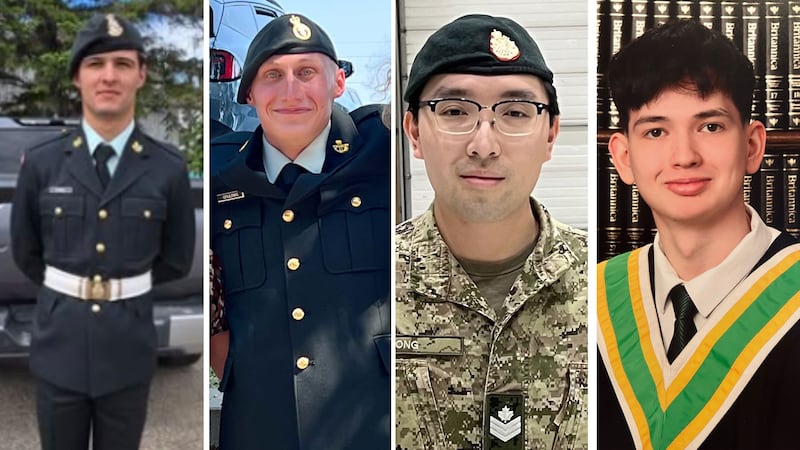
Sgt. Morgan Wong, and privates Shaun Farrell, Aidan Goulding and Hayden Lykkemark were killed during a training exercise.
The young men, who were serving with the Princess Patricia’s Canadian Light Infantry, were preparing to deploy to Latvia next year.
Military lawyer and former soldier, Col. Michel Drapeau says the scope of the tragedy demands more than an internal investigation, it deserves an inquiry “under the glare of the public.”
Drapeau says the military cannot investigate itself because the Department of National Defence and the Canadian Armed Forces “lacks the impartiality, neutrality, objectivity and disinterest” to analyze the evidence and report on the outcome.
Drapeau said a coroner’s inquest is an ideal mechanism to get answers.
“Let there be an open audience. People can attend. People can listen and people can testify.”
He said that soldiers may not tell Armed Forces investigators the full story of what they saw or experienced because they’re nervous or afraid of being blamed. Only when testimony is given under oath, and there’s cross examination can the “bare truth come out,” Drapeau said in an interview with CTV News.
“The purpose of this is to prevent recurrence, to prevent (future) fatalities. We need to get to the bottom of it - not assign blame.”
Drapeau, whose firm has represented soldiers and veterans in legal battles with the Department of National Defence, is also concerned a large swath of the public could be “suspicious” of the findings if an investigation is not done by an independent actor.
What defence officials have said at this point is that the battalion was doing “live-fire training.”
Maj.-Gen. Wade Rutland, the commander of the 1st Canadian Division, said the group was practising a simulated attack, while a fire was burning about a kilometre away was being monitored by range control.
Rutland said the cause of that fire was under investigation – and that there was a variety of ordnance moving through the area. He said the source could have been “grenade launchers, grenades, small arms, ammunition.”
“Quite frankly it could have been any of that or none of it,” Rutland told reporters one day after the tragedy.
The military official said that the battalion didn’t see a fire, but then around 4 p.m., within “30 seconds to a minute … there was a fire right on top of them.”
“This was a very uncommon occurrence. That being said, the reason why there was an investigation is to decide if it was a preventable, non-preventable, or to what extent something was preventable.” Rutland said.
On Oct. 17, the forecast from Environment Canada warned of strong winds that could gust up to 90 kilometres an hour.
But according to the hourly data report for the airfield at CFB Wainwright, wind gusts at 4 p.m. on that day registered at 42 km/h.

