


The Canadian Armed Forces says that completing its comprehensive Board of Inquiry investigation into the tragedy at CFB Wainwright could take up to a year to complete.
The CAF says the Boards of Inquiry (BOI) is a “fact finding investigation which will try to determine how an incident came about and what lessons can be learned to prevent recurrence.”
“While timings can vary greatly depending on file complexity, the typical Board of Inquiry investigation (BOI) can take anywhere between nine to 12 months to ensure that its investigation is comprehensive and its recommendations are robust,” said National Defence media relations spokesperson Cheryl Forrest in an email to CTV News.
Prime Minister Mark Carney had said on Monday that 50 investigators are on the ground in Wainwright.
The Canadian Armed Forces says that the BOI investigation will run concurrently with separate but complimentary investigations led by the National Investigation Service. It will be conducted with support from the military police, the RCMP and Alberta’s chief medical examiner and the Canadian Armed Forces (CAF) Fire Marshal.
The BOI report is also the report Canada’s top soldier, Chief of Defence Staff, Gen. Jennie Carignan has committed to making public.
On Wednesday, Defence Minister David McGuinty said that the BOI investigation had yet to begin.
“(CAF) is working their way forward now on terms of reference. The question is, of course, who would be on that board of inquiry? What’s the appropriate balance. Those are the details we’re looking at,” he said. McGuinty added that the timeline would be up to the Canadian Forces to decide.

Residents show support
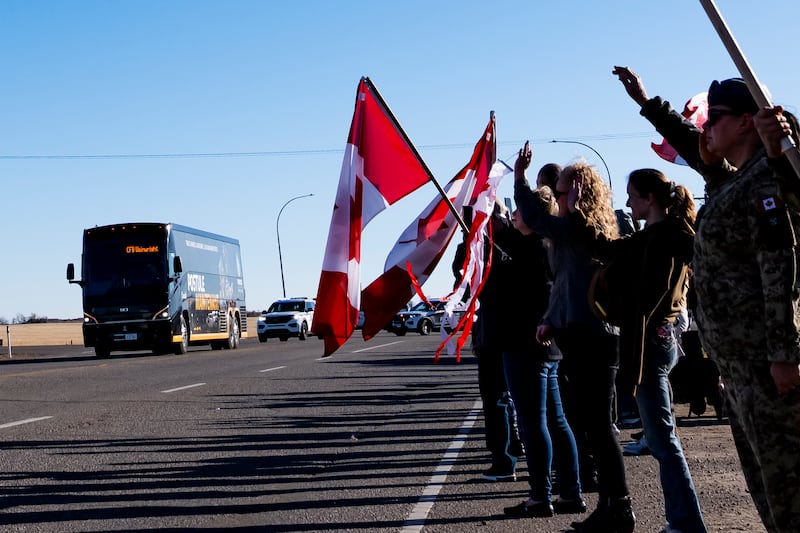
Around the same time that McGuinty was speaking with reporters, dozens of Wainwright residents were lining both sides of a highway near the military base to show support for the battalion who survived a fast-moving brush fire that surrounded their fellow soldiers.
Most of them were members of the Princess Patricia Light Infantry or the Loyal Edmonton Regiment.
Flanked by a convoy of seven police vehicles, two buses carrying an unknown number of soldiers drove past a group of people waving Canadian flags. People applauded, while other military members saluted. The buses were on their way back to Edmonton.
In her update, Alberta Premier Danielle Smith said on Wednesday afternoon that 27 CAF members remained in hospital, 13 of them in critical condition. The Department of National Defence says that 12 members have been released from hospital.
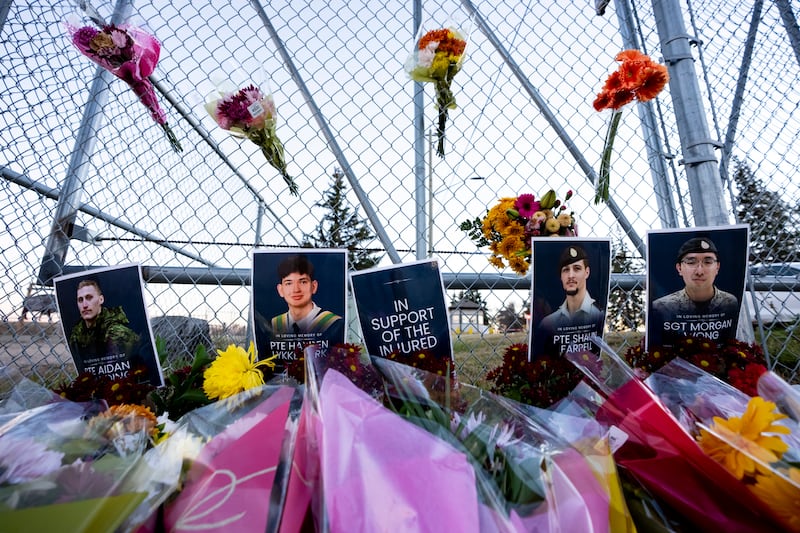
Saturday’s brush fire claimed the lives of Sgt. Morgan Wong, Pte. Shaun Farrell, Pte. Aidan Goulding and Pte. Hayden Lykkemark. Thirty-nine people were initially hospitalized.
The members were participating in a “high-intensity” combat training exercise conducted by the Third Battalion, Princess Patricia Canadian Light Infantry.
During a weekend news conference, military officials said that a fire, whipped by strong winds, moved one kilometre in less than a minute, jumping “on top” of “Charlie” company. The company consists of more than 80 soldiers.
Major General Wade Rutland, said that a smaller group of 10 members practicing attacks on a simulated enemy using hand grenades, were primarily impacted when the wind suddenly shifted.
A grass fire had been burning on the range for a few hours. It was located a kilometre away from the training exercise and was being monitored by range control.
One wildfire expert interviewed by CTV News, questions why the training went ahead given the “extreme” weather forecast on that day.
“The winds were extreme and there was a cold front moving across the region. All of those things can align. If you have an active wildfire and if you have an ignition – it can produce incredible rates of spread,” said Jen Beverly, a wildland fire researcher at the University of Alberta.
“I’m surprised that (CAF) would be undertaking any activities that posed a risk of igniting fires or put personnel in the vicinity of an active fire during the forecast conditions.”
The forecast for Saturday, Oct. 17 in the Wainwright area called for wind gusts up to 90 km/h. Beverly says presence of a cold front, combined with high winds, can cause a blaze to spread in a new direction.
Beverly says that type of fire behaviour is “well known as a threat to personnel on the ground among firefighting agencies.”
The associate professor says that investigators will likely take samples from the surrounding grasslands to measure the “fuel loadings.”
“(The grass) has been growing all summer. Now it’s in a dry cured state and there’s absolutely enough fuel there that you would expect flame lengths higher than a person. Perhaps even higher.”
Beverly has not visited CFB Wainwright, but she visited CFB Gagetown in New Brunswick a couple of years ago to learn about CAF fire management practices.
“My impression at the time was that they were well informed about the decision support and fire behaviour tools that are used by other agencies that manage fires across the country,” she said.
Beverly says she was told military personnel that their training activities often ignited fires on the range and that they were “well equipped and well trained to manage those incidents.”
Other soldiers have told CTV News, that CFB Wainwright has man-made firebreaks, such as sand pits and ponds throughout the range.
In his initial briefing, Major-Gen. Rutland said the cause of the brush fire which had been burning for hours had not yet been determined and that the flames crossed a fire break.

