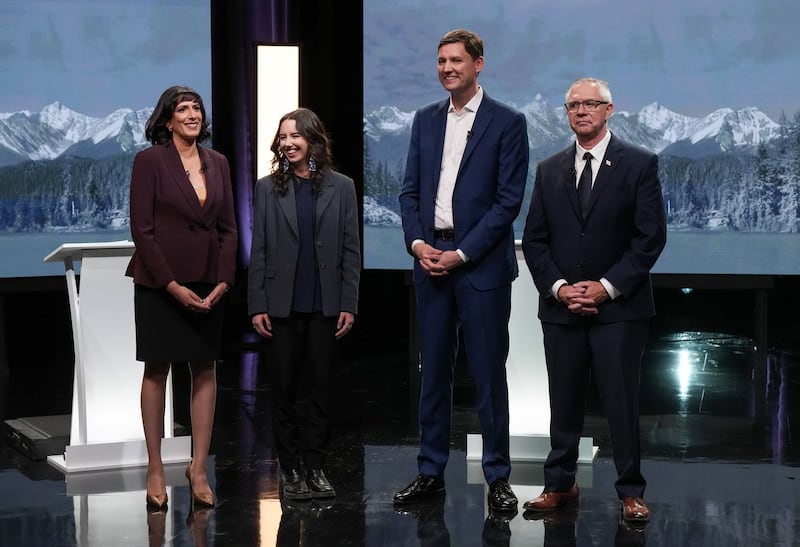
David Eby’s snap election gamble has handed the B.C. Conservative Party a majority government, CTV News has declared.
While some ridings have yet to be called, interim leader Lorne Doerkson’s Conservatives have secured enough seats to relegate the B.C. NDP back to the Opposition benches after nine years in power.
Doerkson’s party was leading or elected in 62 of the province’s 93 ridings when he made his victory speech to a roaring crowd Saturday night.
“Our best days are still ahead of us, my friends—I promise you that,” Doerkson said. “We are going to super-charge British Columbia.”
In a conciliatory address, the premier-designate from Williams Lake vowed to represent rural and urban communities alike, as well as the province’s First Nations.
“This future is one that we will build together as partners, with all the certainly all of us need,” Doerkson said.
He reiterated the party’s plan to triple B.C.’s liquefied natural gas production by 2035, and to provide a $1,000 tax cut for nearly every worker—all while improving service in the province’s public health system.
“I want a B.C. where a hard day’s work gets you a family home and a future, right here in this beautiful province,” Doerkson said.
Eby resigns as NDP leader
In a somber concession speech at the NDP’s Vancouver headquarters, Eby announced his resignation as party leader.
“This is obviously something I do with a very heavy heart, but it is time for new leadership within our party,” he told supporters.
“It has been a wild ride, but my family has paid a very significant cost for this work, and I am very keen to spend some time with my kids, with my wife, with our friends—and not worry if someone is videotaping me while I am singing karaoke.”
He also reflected on some of the NDP’s accomplishments, which included more than $7 billion invested in school capital projects, the elimination of Medical Services Plan payments, and increasing the province’s minimum wage from among the lowest in Canada to the highest.
Eby has also credited his government’s short-term rental restrictions and forced housing density policies for helping to bring down what had once been skyrocketing rents.
“We should all be proud of that,” he said. “It has been the honour of my life to serve as premier.”
But his decision to send voters to the polls two years into his mandate—following weeks of Conservative infighting and defections—will go down as a historic blunder, said political scientist Stewart Prest.
“Nobody in the province wanted him to do this,” Prest said on the eve of the election.
“He alone ultimately bears responsibility for the NDP having two fewer years in power than they were scheduled to have, and I think that is going to leave a mark on his legacy.”
Despite leading the party to defeat, Eby was re-elected in his Vancouver-Point Grey riding.
The next leader of B.C.
Premier-designate Doerkson has been the MLA for Cariboo-Chilcotin since 2020, but only became interim Conservative leader 34 days ago, following predecessor Kerry-Lynne Findlay’s resignation.
For many voters, he was a blank slate contrasted with the baggage Eby carried into the campaign.
Prior to entering politics, Doerkson’s resume included newspaper publisher, financial planner, Rotary president and rodeo announcer. A younger Doerkson also competed in bareback riding, which left him with broken bones and a dislocated shoulder.
“I have watched a lot of people get thrown at a rodeo, and I’ll say I’ve been thrown a few times myself,” Doerkson told the crowd in his victory speech.
“You pick up yourself, dust yourself off, and you get back on—and the crowd gets to its feet for you because you’re trying. That is the approach that I have brought to my political life.”
Doerkson and the Conservatives were elected despite repeated NDP warnings that the party offered a political home for candidates and staffers with extremist views, including some separatist sympathies.
Over the course of the campaign, the party ejected two candidates—Joachim Agou and Jordan McIntosh—over offensive social media posts, though both were running in NDP strongholds.
Doerkson notably stood behind campaign director Katy Merrifield even after a social media post emerged in which she called Islam an “abhorrent ideology.”
After Eby forced the Conservatives into a campaign without a permanent leader, the NDP raised questions about whether Doerkson would be able to serve as premier long-term—as the party’s constitution mandates a leadership race within the next year, and bars interim leaders from running.
The Conservative board of directors responded to those concerns with a statement last month assuring the constitution would be amended for Doerkson, should his campaign succeed.
“A premier chosen by British Columbians deserves the certainty of leading his party. This amendment will provide it,” the statement added.
Such an amendment would require a two-thirds vote—in a party that has been plagued by infighting since nearly clinching victory in 2024.
Party in turmoil pulled together
When Eby called the election, a schism had been forming on the province’s political right.
The Conservatives suffered an exodus of a dozen MLAs over the summer, each citing problems with then-leader Findlay, whose divisive rhetoric led to charges of playing “Trump-style politics.”
The trouble continued into mid-September, when allegations emerged that a former executive director for the Conservatives had hired a private investigator to snoop on the party’s critics, both internal and external.
“I was unaware of it,” Findlay said at the time. “I can’t really respond. They are just allegations.”
Shortly after, eight former Conservatives banded together under CentreBC, a fledgling party billed as a more moderate alternative free from radical affiliations.
Findlay ultimately resigned amid mounting calls for her to step aside—and growing speculation of Eby’s snap election intentions.
The premier pushed ahead with the call two days later, only to see his political opponents announce their reunification within hours.
The snap election interrupted what could have become an “increasingly institutionalized division” on the right side of the political spectrum, Prest said.
“This is another piece of David Eby’s legacy,” he said. “He is essentially did the one thing that could bring these different factions of conservatism back together again in the province.”
Prest, an associate professor of political science at the University of British Columbia, also argued the reunification should have been easy to predict.
“You can’t say no one could possibly have known the Conservatives would put aside their differences to fight an election because that’s exactly what happened in the run up to the 2024 election,” he said.
Seven members of CentreBC returned to the Conservatives on the day the writ dropped, leaving only Elenore Sturko, who became the party’s leader.
She was defeated Saturday.
Conservative platform
Doerkson’s party notably did not provide a costed platform in time for the B.C. leaders’ debate, or the first days of advance voting.
The plan the Conservatives ultimately presented promised to reduce the province’s expected $14-billion deficit to $10.8 billion over three years, based on economic growth forecasts significantly higher than those included in B.C.’s latest budget.
Ahead of the election, Doerkson defended the most ambitious prediction—of 3.2 per cent GDP growth in 2029—as “absolutely doable,” despite skepticism from some economists.
The interim leader managed to overcome NDP-fanned fears that a Conservative government would be disastrous for public health care, particularly given his pledge to “never raise taxes.”
Prest argued it’s going to be hard for the party to make good on its promises.
“The province’s economic situation has deteriorated and a good chunk of that is outside the control of any premier, given those trade winds buffeting the country right now,” he said.
“It’s hard to claim to be fiscally responsible and also invest in all the kinds of social care and health care that British Columbians are rightly demanding and the Conservatives are promising. At some point, the rubber is going to hit the road.”
The party further promised to expand $10-a-day childcare, fund 500 more RCMP officers to be deployed to rural areas over five years, hire 50 more Crown prosecutors, and expand the use of involuntary care.
The party’s environmental platform was largely tied to massively increased LNG production, with the Conservatives suggesting the expansion would reduce global greenhouse gas emissions by replacing higher-emission fuels used in Asia and Europe.