
TORONTO - When MaryAnn Bradley noticed that her mother, Olga, was suddenly struggling to speak properly, she feared the 92-year-old might be having a stroke. So, Bradley asked staff at the nursing home near St. Catharines, Ont. to call an ambulance.
But it wasn’t a stroke. It was sepsis; a life-threatening reaction to infection that can lead to severe illness, amputations and even death. Bradly said doctors told her it was caused by an undetected and untreated urinary tract infection (UTI).
“They gave her antibiotics, they gave her a feeding tube,” said Bradley.
But two days later, Olga was dead.
“I was horrified,” Bradley recalled.
Bradley’s story has taken on a new significance as researchers investigate how a widely underused treatment might help women with UTIs and potentially reduce the risk of serious complications like sepsis.
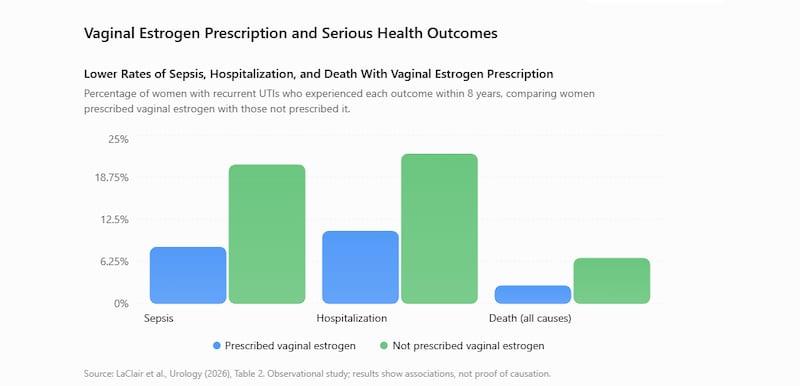
A study, published in the journal “Urology,” tracked nearly 1.9 million women who suffered with two UTIs. Led by Justin LaClair at the Albany Medical Center, researchers compared what happened to those prescribed vaginal estrogen, with those who weren’t.
The results were striking. Across all ages, women prescribed vaginal estrogen had significantly lower rates of sepsis, hospitalization and a death.
“I was sort of shocked. The data was so strong. We did look at all ages and we found protection,” said Dr. Elise De, a urologist and professor at Albany Medical College in New York and LaClair’s co-author.
Vaginal estrogen is a low-dose hormone treatment in cream or pill form that is used in the vagina and vaginal area. Studies dating back to the 1990s show it helps reduce recurring UTIs.
The new study impressed critical care physician and professor of medicine at McMaster University, Dr. Alison Fox Robichaud. She says she regularly sees women hospitalized after recurrent UTIs.
“How do we get this piece into the hands of the health professionals, most of whom are not urologists, who are caring for women with recurrent urinary tract infections?” she wondered.
She prescribes vaginal estrogen in cases where women are hospitalized with repeated UTIs but says the treatment is not widely known.

“I know that when I prescribed it in the hospital in the past, I get funny looks, sometimes from the patients and sometimes from the nursing staff,” said Fox Robichaud, who is also president of the Canadian Sepsis Foundation “It’s now about spreading the knowledge throughout the health system.”
Her thoughts were echoed by Dr. Rachel Rubin, an American urologist, who co-authored an editorial and promoted the study in an Instagram post that now has over 3.7 million views.
“We have known since the ’90s that vaginal hormones prevent urinary tract infections, and we should be using it,” she said. “It’s a huge wake-up call.”
An underused treatment
Women who have experienced an urinary tract infection, say the symptoms can be miserable. The constant urge to pee, the burning sensation and the discomfort can make an ordinary day difficult.
Surveys show that up to 50 to 60 per cent of adult Canadian women experience at least one urinary tract infection in their lifetime. 25 to 33 percent of them will suffer recurrent infections that become more challenging to treat.
Treatments can include repeated antibiotics, advice to drink more fluids, take more trips to the bathroom and take pro-biotics. UTIs account for about 500,000 physician office visits across Canada each year.
“It’s a real sap on the entire ecosystem of the patient’s life, their family’s lives, their work life, and the health-care system, and the providers,” said De.
What many women don’t realize is that declining estrogen levels can play an important role.
The hormone estrogen helps keep vaginal and urinary tissues healthy, and harmful bacteria in check. But during and after menopause, estrogen levels drop as the tissues become thinner, drier and more fragile, making it easier for bacteria to multiply and infections to take root.
A survey cited by the Menopause Foundation of Canada found that 82 per cent of Canadian women did not recognize the association between menopause and UTIs. Yet guidelines by both the U.S. and Canadian Urological societies were updated in 2025 to recommend vaginal estrogen prescribed for peri- and postmenopausal women with recurrent UTIs.
While there is no published data showing how many Canadian women are being prescribed vaginal estrogen for this, data from other countries indicate that it is universally low, with only roughly 5 to 25 per cent of women with chronic UTIs given the therapy.
LaClair says the latest study confirmed a dismal uptake in the U.S., based on the group of women studied.
“Only about 5.1 per cent of women received vaginal estrogen within two months of being diagnosed with a recurrent UTI,” he said.
Battling misinformation
Confusion over hormone use may contribute to the problem, says De.
Hormone Replacement Therapy, delivered throughout the body using patches, creams or earlier pill forms, was deemed dangerous and linked to breast cancer in the 1980s. Newer analysis of the data showed the risk was much lower with added benefits of HRT, for heart disease and bone density. There is also research suggesting a benefit for brain health.
“We have, for years, really been battling this misinformation about the risks of estrogen, and vaginal estrogen is different than systemic estrogen,” she said.
De says vaginal estrogen, works just in a specific area: The urinary and vaginal area.
In fact, black box warnings on low dose vaginal estrogen were removed by the FDA in 2025 with a similar move being discussed in Canada. De suggests that people in the know are moving to use it to prevent UTIs before they occur.
“I will tell you that every urologist, every female urologist I know who is perimenopausal, has started vaginal estrogen without waiting for her first UTI,” said De.
It’s all news to Bradley who says, at 71-years-old, she is now getting urinary tract infections and is getting worried about the possible consequences. “I’m scared,” she said.
That’s why she is planning to discuss the study with one of her doctors soon. “I don’t want to end up like my mother.”
“I didn’t find out (she had a UTI) until the emergency,” she said.
Bradley is urging families to be vigilant if a loved one’s condition suddenly changes, particularly among older adults, as prompt medical attention for a UTI could prevent it from progressing to sepsis.

