


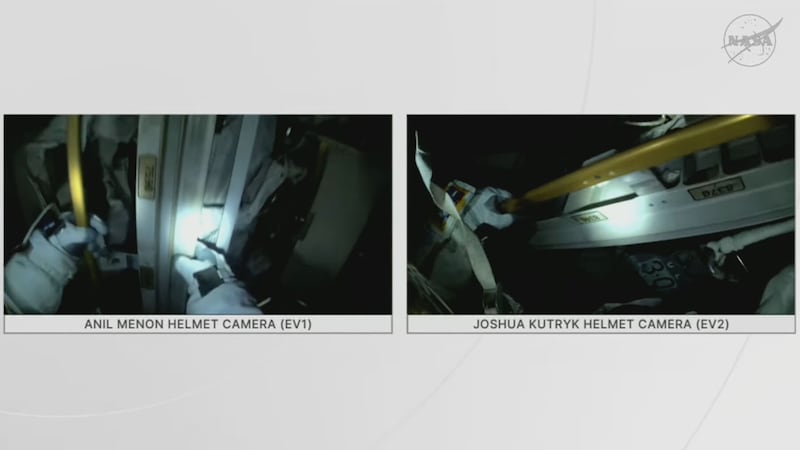
Astronaut Joshua Kutryk was some 420 kilometres above the Earth when he stepped into the vacuum of space on Thursday morning, making him the fifth Canadian to perform a spacewalk.
Kutryk and NASA astronaut Anil Menon placed their suits on battery power at 7:57 a.m. EDT, marking the official beginning of the spacewalk. They are working to install solar panels on part of the International Space Station, using the Canadarm2 robotic arm as a base for Menon to stand on.
The spacewalk was expected to last nearly seven hours. The duo will install seven of eight new solar arrays needed to upgrade the station’s power capacity.
Astronauts inside the station wished Kutryk and Menon luck before they left the airlock.
“From Luke (Delaney) and I on the other side of the hatch, good luck. We’re proud of you and we’ll see you on the other side,” NASA flight engineer Jessica Watkins told them.
Kutryk is on his first mission in space and his trip outside the space station is expected to be his first of two spacewalks.
Before Kutryk, the last Canadian to perform a spacewalk was David Saint-Jacques in 2019.
Saint-Jacques answered questions from schoolchildren at the Montreal Science Centre as the space agency projected the livestream showing the spacewalk.
He described the feat as “one of the most exciting and one of most dangerous things we do” and said Kutryk was in “very good spirits” when they last spoke ahead of the spacewalk.
“It’s kind of the peak of the career for an astronaut to get a chance to put on your own miniature spacecraft that we call a space suit and go outside to do some maintenance work,” he said.
Saint-Jacques said spacewalkers train for thousands of hours in a giant pool and a full-size replica of the space station in Houston. They learn to operate the space suit and study the procedures and equipment needed for their mission.
They also receive step-by-step instructions in real time.
The crew’s mission is crucial, Saint-Jacques said, as the station is nearly 30 years old and its original solar panels have lost efficiency. According to the Canadian Space Agency, the new panels, paired with previously installed arrays, will help increase power generation capacity on the station by up to 30 per cent. The space station is fully electric, said Saint-Jacques.
While astronauts can face technical challenges, such as a stuck bolt or trouble plugging in a connector, the veteran astronaut does not doubt Kutryk’s abilities.
The advice he gave the spacewalker? To really take in the view.
“Give yourself the chance to look around, let it all sink in, and come back with some emotions as well, because that really is what you bring back for yourself,” he said. “It’s very easy to get focused in the work, to want to do a good job.”
Canada is also playing a role in the mission from the ground.
While Watkins and Delaney, also a NASA flight engineer, assisted the spacewalkers with the Canadarm2 robotic arm, a Canadian Space Agency team were monitoring and supporting activities in real time from Longueuil, Que.
Canadian astronaut Jenni Gibbons was supporting the spacewalkers from NASA’s Johnson Space Center in Houston. The Canadian Space Agency described her as “the voice bridging two worlds” as she was the main link between experts on Earth and the space crew.
Gibbons was giving the astronauts directions as they carried out the maintenance work. She also served as the capsule communicator during the Artemis II lunar fly-by in April.
“Canada delivers. And so I’m very, very proud of our space sector,” said Saint-Jacques. “It’s a long history of success that we should all be very proud of ... at the forefront of exploration, breaking silos, innovating.”
Kutryk and Menon departed from the Quest airlock module on the space station to install solar panels on the portside truss structure of the orbital outpost.
The truss serves as the station’s structural backbone and supports major systems, including solar wings, radiators, power, data and temperature-control equipment.
The crew’s second spacewalk is scheduled for Nov. 5.
This report by The Canadian Press was first published Oct. 29, 2026.
By Erika Morris
With files from Sarah Smellie

