A majority of Canadians want the country to accept fewer immigrants and temporary residents next year, according to a new Nanos Research survey commissioned by CTV News, as the country continues to grapple with immigration levels and their impact on housing, services and the economy.
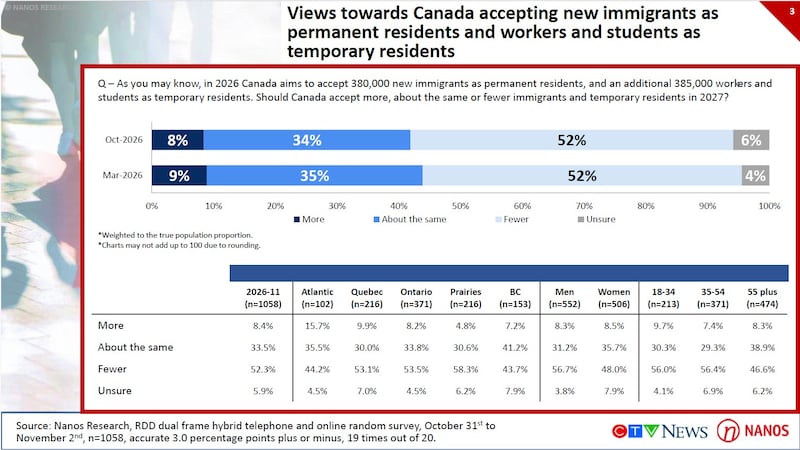
The survey found that 52.3 per cent of respondents believe Canada should accept fewer immigrants and temporary residents in 2027, compared with 33.5 per cent who want the numbers to remain about the same.
Just 8.4 per cent said Canada should accept more, while 5.9 per cent were unsure.
The findings come as Canada’s immigration targets include 380,000 new permanent residents and an additional 385,000 workers and students as temporary residents in 2026.
Similar results found in March survey
The survey, conducted between Oct. 31 and Nov. 2, asked respondents: “As you may know, in 2026 Canada aims to accept 380,000 new immigrants as permanent residents, and an additional 385,000 workers and students as temporary residents. Should Canada accept more, about the same or fewer immigrants and temporary residents in 2027?”
The results suggest Canadians are largely in favour of reducing immigration and temporary resident levels, with more than half of respondents selecting fewer.
The October findings are consistent with those recorded in March, when 52 per cent of Canadians said they wanted fewer immigrants and temporary residents in the following year.
In March, 35 per cent favoured maintaining the same levels, compared with almost 34 per cent in October. Support for accepting more declined slightly, from nine per cent in March to eight per cent in October.
The proportion of respondents who were unsure increased from four and a half per cent to almost six per cent over the same period.
Regional and age differences emerge
The survey also found differences in opinions across the country.
Respondents in the Prairies were the most likely to favour fewer immigrants and temporary residents, with 58.3 per cent selecting that option.
Ontario and Quebec followed at 53.5 per cent and 53.1 per cent, respectively. In Atlantic Canada, 44.2 per cent wanted fewer, while 43.7 per cent of respondents in British Columbia said the same.
British Columbia had the highest proportion of respondents who wanted immigration and temporary resident levels to remain about the same, at 41.2 per cent.
Findings show differences across age groups
Canadians aged 35 to 54 were the most likely to favour fewer immigrants and temporary residents at 56.4 per cent, closely followed by those aged 18 to 34 at 56 per cent.
Among respondents aged 55 and older, 46.6 per cent wanted fewer, while 38.9 per cent favoured maintaining current levels — the highest proportion among the three age groups.
Survey details
The Nanos Research survey was conducted using a dual-frame hybrid telephone and online random survey between Oct. 31 and Nov. 2, 2026.
A total of 1,058 Canadians were surveyed. The results are weighted to the true population proportion.
The survey has a margin of error of plus or minus three percentage points, 19 times out of 20.

