Evacuations have been ordered and a state of local emergency has been declared over drenching rain on northern Vancouver Island, as forecasters warn more is on the way from multiple weather systems arriving in British Columbia over the next week.
Parts of Vancouver Island could receive 400 millimetres or more by the time the current and incoming systems are done, according to an Environment Canada meteorologist.
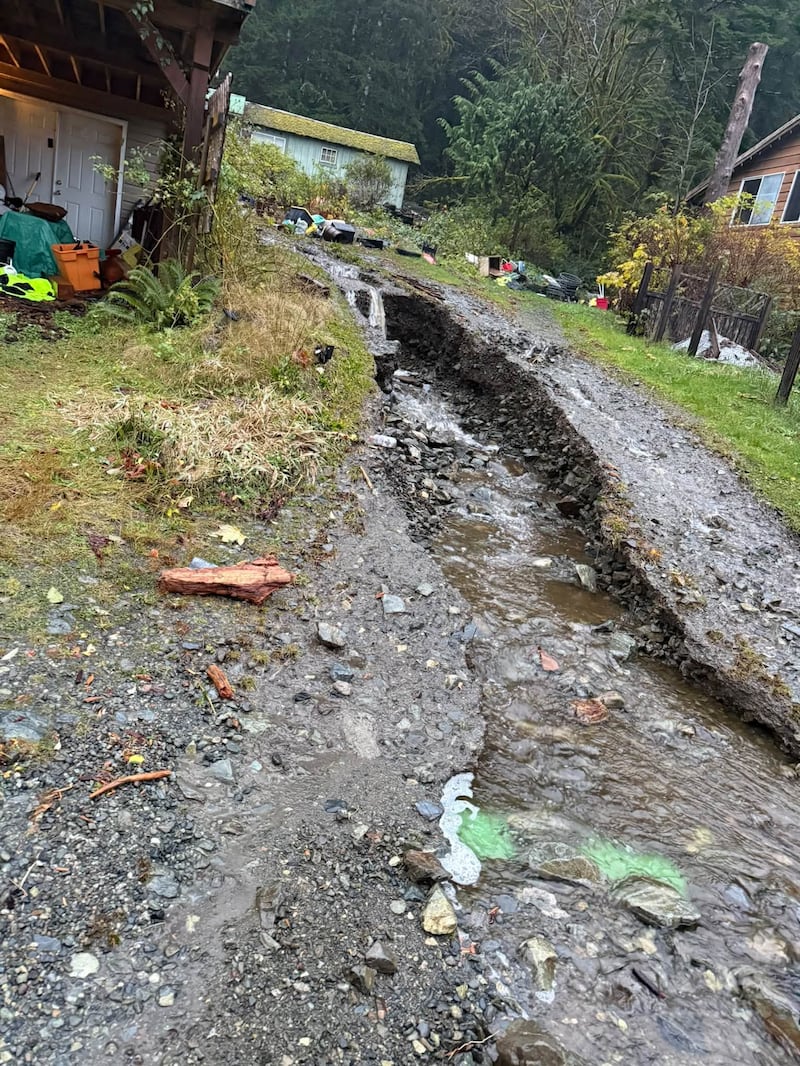
The Village of Zeballos ordered the evacuation Friday of 22 properties due to landslide risks that it said posed a threat to life and safety.
Photos posted on social media showed water coursing down slopes and over roads.
The Strathcona Regional District, which covers a region that includes parts of the coastal mainland, announced the local emergency.
“The Village of Zeballos and (the district) are actively monitoring flooding and potential landslide risks in the area,” it said.
“Both the Village of Zeballos and (district) emergency operations centres are activated and co-ordinating response efforts.”
Steve Boily, a meteorologist for Environment Canada, said on Friday that parts of northwest Vancouver Island had received 140 millimetres of rain since Thursday.
He said the region that includes Zeballos will get a break from the rain late Friday and into Saturday before another system brings close to 100 millimetres on Saturday evening and into Sunday.
A third system, expected to bring up to 200 millimetres of rain to exposed areas, is slated to begin on Monday, Boily said, and last for an “extended period of time.”
“They are forming much further over the ocean, and then they hit the coast one after the other,” he said, adding that until the low pressure moves south, there will be precipitation “at least for another week.”
The first major weather system of British Columbia’s storm season has also set off wind and rainfall warnings across most of the province’s coast and parts of the Interior.
Ferry sailings have been cancelled, and high streamflow advisories are also in place.
More than two dozen wind and rainfall warnings were in place across B.C.
Forecasters say the highest rainfall amounts on Vancouver Island are expected to be northwest of Tofino including Port Alice, Zeballos, Tahsis and Gold River and warns residents to stay away from rivers, creeks and culverts.
A wind warning for East Vancouver Island says strong southeasterly winds of 70 km/h gusting to 90 km/h have developed through the Strait of Georgia.
Environment Canada also issued rainfall warnings for parts of Metro Vancouver, including the North Shore and Coquitlam-Maple Ridge, with up to 80 millimetres expected at higher elevations.
Wind warnings cover southern parts of Metro Vancouver, including Richmond, Surrey, Delta and Langley, with sustained winds at speeds nearing 70 km/h.
Warnings of winds up to 90 km/h have been issued for Greater Victoria and the Fraser Canyon, Sunshine Coast and Chilcotin regions.
The stormy weather resulted in the cancellation of dozens of BC Ferries sailings, although departures of some major routes resumed in the afternoon.
The Thompson Nicola Regional District in the Southern Cariboo warned residents that people in areas severely affected by wildfire should be prepared for landslide and flooding risks.
It said gusting winds forecast for the entire southern Cariboo could blow over dead or damaged trees in areas that were charred by wildfires.
The B.C. River Forecast Centre issued high streamflow advisories across the southwest of the province on Thursday, warning of a series of atmospheric river systems expected to bring heavy rain into next week.
Zeballos is a picturesque community of about 130 residents on the northeast coast of Vancouver Island.
It attracted international headlines in 2024, when a young killer whale became trapped for weeks in the nearby waters of Little Espinosa Inlet.
In addition to the evacuation orders that cover properties on Maquinna Avenue and Pandora Crescent, three properties have been placed on evacuation alert.
Pete Nelson-Smith, the village’s chief administrative officer, said in a statement that the emergency declaration could remain in place for up to 14 days.
This report by The Canadian Press was first published Nov. 6, 2026.

