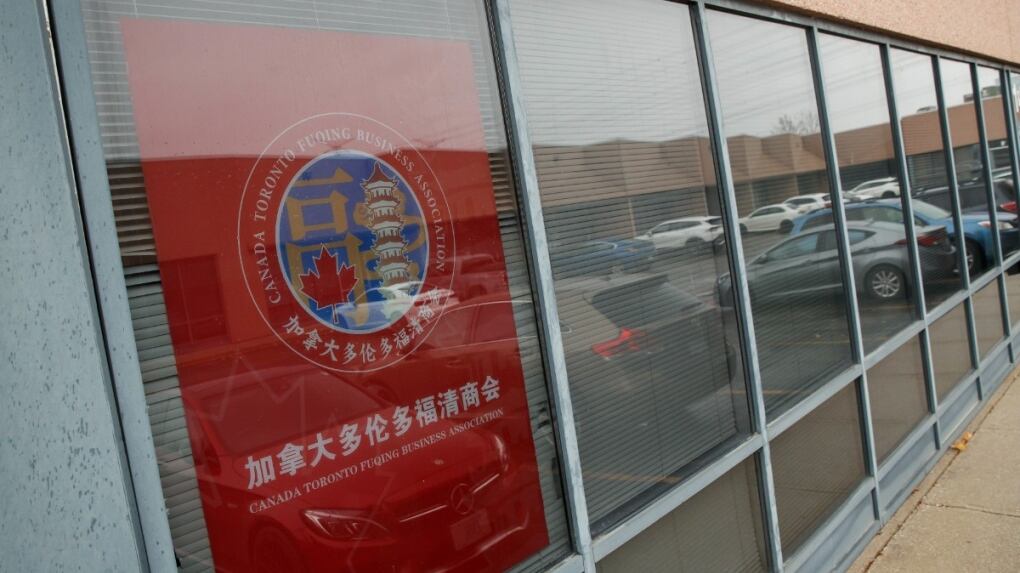
OTTAWA - China has exponentially expanded its network of illegal overseas police stations, to “extend its tentacles” across a web of new community associations, according to a report by international human rights group Safeguard Defenders.
In its latest report, the Spanish non-governmental organization (NGO) identifies nearly 1,250 overseas Chinese associations which they say are fronts for suspected police centres in 91 countries.
“That network is being used to watch the diaspora. To watch what they do, what they say and to essentially police them,” says Laura Harth, Safeguard Defender’s China director in an interview with CTV News.
The new figures are also a 12-fold increase from the NGO’s findings four years earlier.
In 2022, the NGO identified 100 illegal Chinese police stations operating in more than 50 countries, including Canada.
The report, A Formula for Repression, asserts that the Chinese Communist Party (CCP) is exporting “its domestic system of surveillance and control to Chinese diaspora communities around the world.”
China has more than 60 million citizens living abroad.
Michael Kovrig, senior advisor for the International Crisis Group, says the report reveals “an early stage” of the CCP’s efforts to expand its ability to influence the political choices of sovereign nations across the globe.
Kovrig, a former Canadian diplomat who was arbitrarily detained by China in 2018 says the “stunning” apparatus revealed by Safeguard Defenders could lead to the “slow erosion of the rights of Canadian citizens to express their own views and vote as they wish.”
The ‘magic weapon’
Safeguard Defenders says the associations are run by overseas party operatives under the direction of Beijing’s United Front Workers Department (UFWD).
President Xi Jinping calls the UFWD a “magic weapon” for monitoring and controlling its citizens, no matter where they live.
Safeguard was able to identify 1,247 community hubs that had acknowledged they were “liaison points” to Chinese police and prosecutor websites and in publications.
The NGO says any association connected to the UFWD can be mobilized to participate in its mass surveillance program.
China says it has “tens of thousands” of UFWD affiliated organizations around the world.
Instead of being chastened by the past exposure of its illegal activities, Harth, the report’s lead researcher, says China has gotten better at covering its tracks.
“They’ve learned their lesson. The public security bureaus were maybe a bit too enthusiastic. They (previously) put their own logos on walls and doors. Now post 2022, they’re more careful about (not) naming the exact associations they’re working with.”
How the network grows
A Formula for Repression, details how China’s global grid for community control works.
Researchers say that more than 10 police forces from five provinces in China are working through a vast network of Chinese Federation hubs on foreign soil.
The hubs are marketed as a place for the diaspora to connect culturally and foster business and tourism ties with various provinces and cities in China.
Safeguard Defenders lists the names of 80 regional associations linked to Chinese law enforcement. In 2022, it only found four associations that had set up police stations.
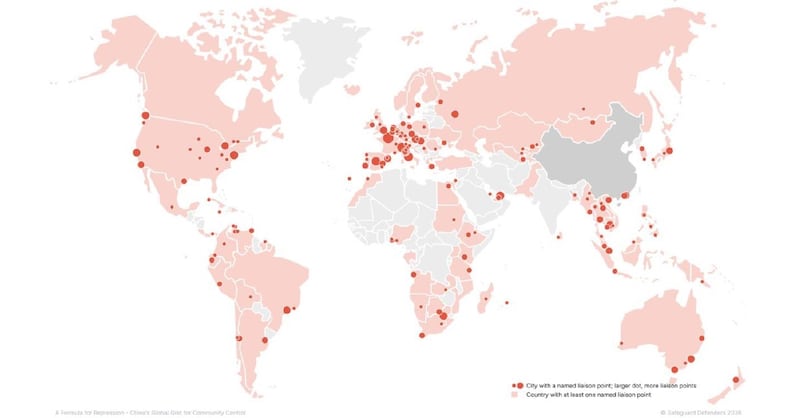
The NGO warns that the CCP’s tentacles extend “into every part of ordinary life.”
The Canadian picture
Safeguard’s report reveals 18 alleged Chinese police monitoring stations in Canada, compared to the five that it found in 2022.
However, additional research by Jamestown, an American think tank cited in the report, uncovered 575 organizations linked to the UFWD in Canada.
New Democratic Party MP, Jenny Kwan calls the allegations troubling.
“If true, it suggests that existing government responses have not been sufficient to deter these illegal activities,” Kwan wrote in an open letter addressed to Canada’s public safety minister.
“Canada must close the legal gaps, investigate these operations and ensure that people in our communities can speak, organize and exercise their democratic rights without coercion, intimidation or fear.”
Public Safety Minister Gary Anandasangaree represents a riding in Scarborough, Ontario with a high population of ethnic Chinese constituents. He’s cautioning against jumping to conclusions.
“I can say that foreign interference of any sort is unacceptable. It’s something that we will not tolerate. With respect to these specific allegations – they are allegations and have not been investigated,” Anandasangaree said.
In 2023, the RCMP closed its investigation into two Chinese service centres in Montreal alleged to be police stations. No charges were laid. The organizations are now suing the federal government.
Anandasangaree says law enforcement will do their due diligence and follow up on the information in the report but says investigations must be conducted with “nuance.”
He says some of the associations are sports or book clubs, that on a day-to-day basis “just go about providing civic life to members of the Chinese diaspora.”
Will the foreign influence registry make a difference?
CTV News asked Anandasangaree if he had spoken to the Chinese embassy about registering the co-ordinators of overseas Chinese organizations as foreign agents.
Canada’s foreign-influence registry started operating in August. Under the act, failure to register foreign organizations could result in fines of $250,000 to $1 million.
Anandasangaree said the onus of education is with the individual embassies and that it’s up to Canada’s first Foreign Influence Transparency Commissioner, Anton Boegman to ensure compliance.
The minister also said he’s concerned the “unsubstantiated” numbers of reported organizations will cause difficulties for the Chinese community.
“Of course (foreign interference) is a concern. The other side is mislabelling and putting people and communities in fear unnecessarily.”
The organizations may promote recreation and culture, but Harth points out some also actively repress other communities who take part in celebrations the CPP doesn’t like, such as Tibetan or Uyghur culture.
“We can’t give legitimacy to a system that does not deserve it…We need to start sending clear signals that this kind of thing isn’t going to pass and put the United Front on notice.”
The Chinese Embassy has not responded to a request for comment from CTV News.
Fear in ethnic communities
The highest profile example of an illegal police station comes from New York City. In May 2026, Lu Jianwang, a U.S. citizen was convicted of operating a clandestine police station, to gather information on Chinese dissidents for Beijing.
In Canada, the RCMP says it has investigated five alleged Chinese police stations in Toronto, Montreal and Vancouver. However, no charges were laid.
Uyghur-Canadian Rukiye Turdush, the executive director for Center for East Turkistan National Interest, calls the massive spike in China’s overseas police stations “shocking and scary,” but not a surprise.
She has organized protests against China’s violation of human rights in Xinjiang and says she has seen firsthand how the UFWD is suppressing dissent.
Turdush, says fellow Uyghur activists who received visas to visit relatives in China were pressured to sign documents stating support for Chinese national law.
“They come back and they’re scared…They hide and can no longer come to my organization.”
The activist is also concerned that her organization has been infiltrated by CCP operatives to launch attacks on the leadership and spy on members.
“That’s how China is dividing the community. We don’t trust each other and we don’t feel safe,” Turdush said.
Canada-China police co-operation agreement
Safeguard Defender’s new data comes 11 months after Prime Minister Mark Carney signed a new police co-operation agreement with President Xi.
In January, the two leaders committed the RCMP and China’s Ministry of Public Security (MPS) to increased co-operation in combating corruption and transnational crimes such as telecommunications fraud, cyberfraud and the trafficking of illegal synthetic drugs.
The prime minister has refused to release the text of the agreement despite calls from the Conservatives and the NDP to do so.
Kovrig says Canada should not have signed the agreement because of the “political signal” it sends.
The former diplomat points out that China has a record of arbitrary detention, executions and psychological and physical torture. Kovrig himself was detained by China for more than 1,000 days.
Canada does not have an extradition treaty with China, but Kovrig says the agreement implies that the RCMP and the MPS are co-equal policing organizations that follow similar norms and behaviours.
“That’s simply not the case. The RCMP is not setting up fake police stations to influence Canadians abroad. It’s not involved in subversive activities in foreign countries. We should be calling for the agreement to be released. We need transparency and accountability.”
With files from CTV News’ Menna Elnaka

