What happens when a simple trip turns into a nightmare? Part two of W5’s five-part investigation on CTVNews.ca follows travellers who say they went from passenger to prisoner, caught in a scheme that crossed borders and changed lives forever.
More than two dozen Canadians accused of international drug smuggling are now turning to a personal injury lawyer, claiming they were victims of a bag tag switching scheme. Some say the airlines offered them peanuts after they were detained abroad in nightmarish conditions.
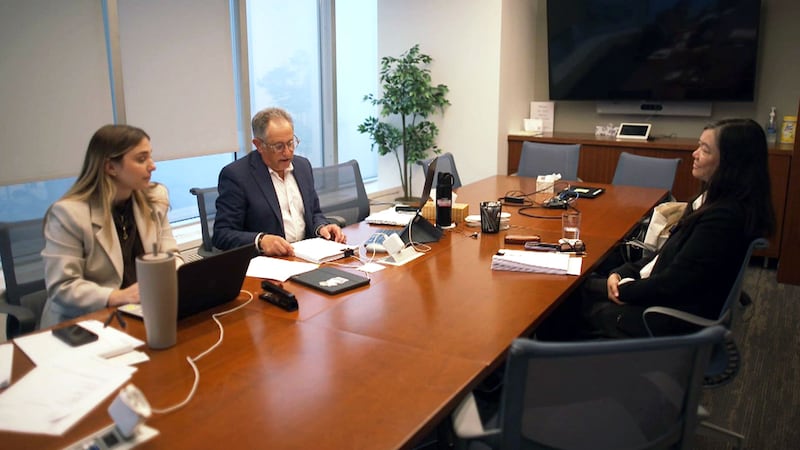
W5 has now identified more than two dozen cases of travellers being detained after their airline luggage tag was swapped from their bag and put onto another bag, containing drugs, allegedly by corrupt workers at Pearson Airport.
When the scheme goes as planned, an accomplice picks up the drug bag at the destination airport. But, if the drugs are detected, the pickup is aborted, and the innocent passenger is left trying to explain why their luggage tag is on a bag of drugs.
Canadian seniors victimized
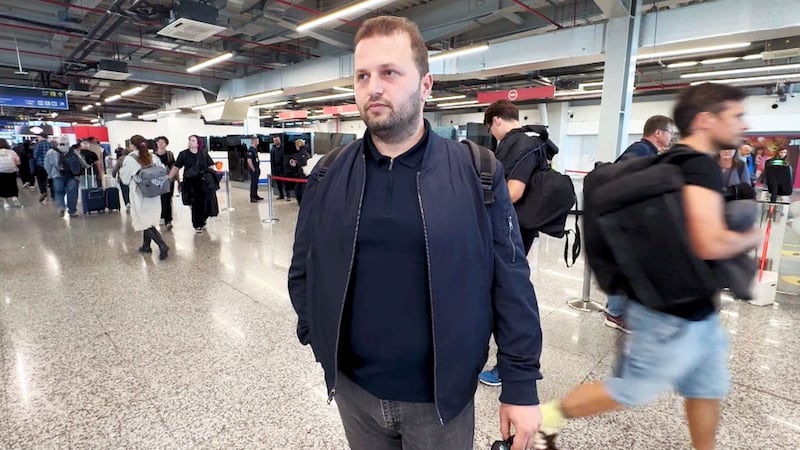
Following W5’s initial investigation into the bag tag switching scheme operating at Pearson Airport more travellers have come forward — including Kristian Gjoni, a Toronto I.T. businessman facing up to 15 years in Albanian prison — and at least three Toronto women in their 60s or 70s.
Leila Drakes, who uses a wheelchair, said Barbados police spoke to her in 2024 about “a very large suitcase of cannabis” with her name on it.
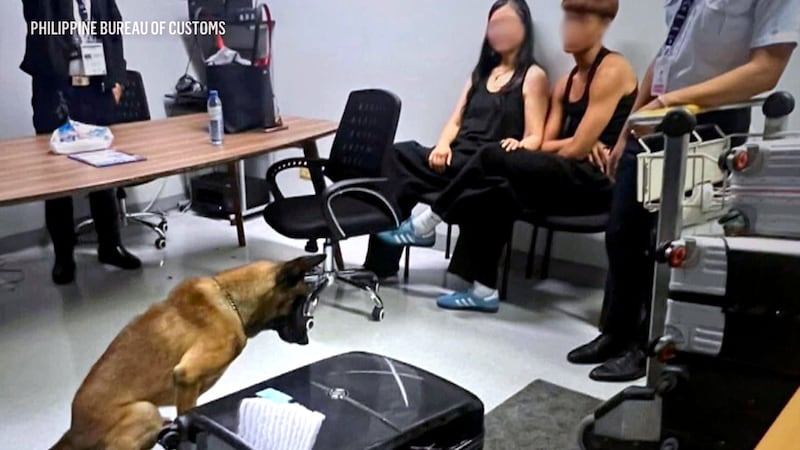
Grace Merano spent 24 hellish nights behind bars in the Philippines after being accused of importing 24 kilograms of methamphetamine.
And Naomi, who requested anonymity, said she was detained at Narita Airport in Japan last year for allegedly smuggling 21 kilograms of meth.
All three women flew out of Toronto Pearson International Airport.
A total of 11 people are now launching legal action in a bid to be compensated for what they went through.
Toronto lawyer Paul Miller is representing them. Miller, who has practiced personal injury law for 25 years, told W5 he’d never heard anything like the stories his clients told him.
“This was shocking,” he said. “This was right out of a James Bond type of movie.”
Being detained abroad is particularly traumatic, he noted.
“That’s not your home country anymore. Who’s there to help you? Who do you call?” he said.

Victims seeking up to $1M
Despite their ordeals, Miller said his clients were “basically told to go away” by the airlines.
Merano said her 24 nights in Filipino jail were spent sharing a three-by-five-metre space with three others.
“You can see cockroaches crawling all over the place, big and small. All I can do is just pray,” she said.
- If you have any information regarding tag switching or corruption at Canadian airports, please reach out to avery.haines@bellmedia.ca and jack.hauen@bellmedia.ca.
Merano said Cathay Pacific Airways offered her about $22,000 — roughly half of what she says the ordeal cost her in legal fees and upended travel plans.
Drakes, the 77-year-old wheelchair user, said she got a terrifying call after joining her brother in Barbados. The drug squad was looking for her.
Cops came to her hotel, “very much to my embarrassment,” she wrote in a statement for police. They explained that her bag tag was on a suitcase full of cannabis.
“Can you imagine how the rest of my vacation was spent? When I got back to Canada I was a basket case,” she wrote.
Drakes was never charged with a crime.
She said WestJet offered her a $300 flight credit.
Jan Baumann and Charlene Ranadheera, from Winnipeg, were detained on an Air Canada flight to Germany after their baggage tags were switched onto luggage containing 33 kilograms of marijuana.
After being handcuffed and detained at Pearson for 12 hours, then released without charges, Ranadheera said the airline offered them about $2,000.
“And we were like, ‘Haha, thank you, but no,’” she said.
Miller said his clients are looking for a little bit more — somewhere in the range of $100,000 to $1 million in each case.
‘You guys can fight it out’
In an airport the size of Pearson, where hundreds of organizations employ thousands of workers — many subcontracted by the airlines themselves — it’s complicated to figure out exactly who’s at fault, Miller said.
“Is the baggage handler [the airline’s] employee? Was it hired by Pearson, which is the Greater Toronto Airports Authority? Was it hired by a third party?” he said.
Miller said most of his tag switching cases will involve suing several organizations, including the airline, Transport Canada and the Greater Toronto Airports Authority, which runs Pearson.
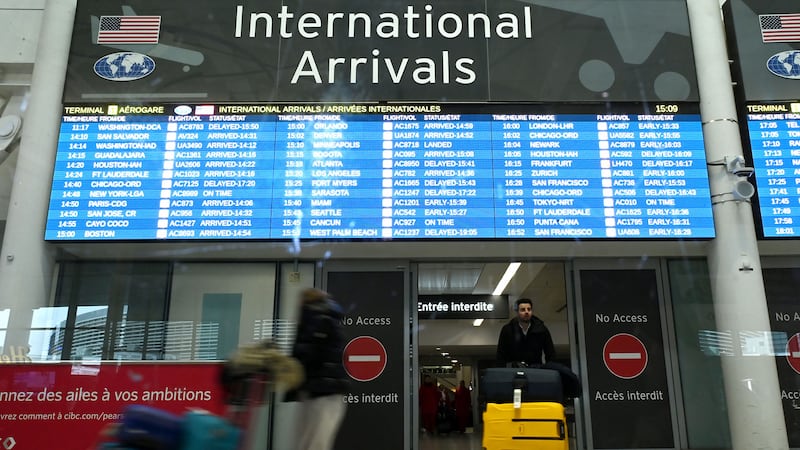
Ultimately, the airline is responsible, he argues, because that’s who took his clients’ bags from them.
“So, my attitude is, ‘Okay, I’ll sue a whole bunch of parties,’” he said. “You guys can fight it out.”
Spokespeople for Air Canada, Air Transat and WestJet said the airlines take security seriously but noted the many other organizations involved in the system.
Luggage moves through “a complex network of infrastructure operated and overseen by various third parties, from check-in to delivery,” said Air Canada spokesperson Sean Davidson.
Who is liable for bags that are tampered with comes down to “circumstances and applicable law, including an assessment of the role of each party,” he added.
Cathay Pacific did not comment by press time.
Miller said it would be better for the airlines to pony up now rather than let these cases run through the courts.
“Putting your head in the sand never works out well…the cover-up is always worse than the crime. If something bad happened and it’s under your company, deal with it,” he said.
The Greater Toronto Airports Authority, which runs Pearson, said it “does not direct or oversee baggage security,” and pointed to federal agencies and police.
The Canada Border Services Agency said it is “working with Transport Canada and the Greater Toronto Airports Authority to make airport security stronger. For security and operational reasons, we are not in a position to share more information.”
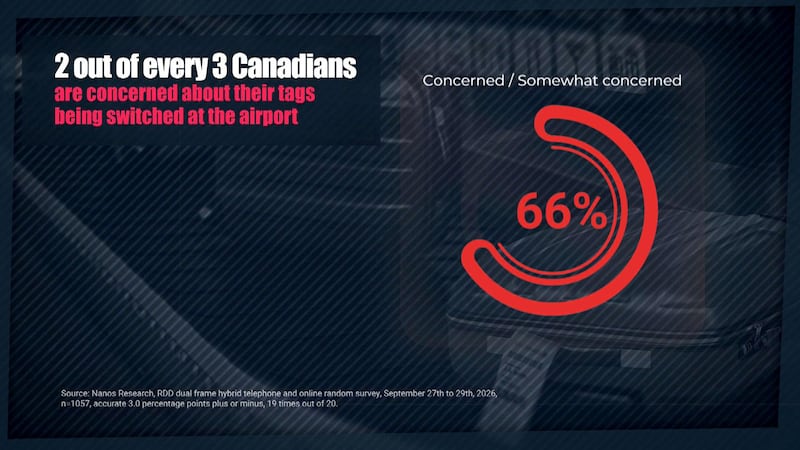
Majority of Canadians concerned about bag tag switching
Two-thirds of Canadians say they’re concerned about tag switching, according to a Nanos Research poll done for W5 in September.
Nearly half (45 per cent) of respondents say they’ve heard news coverage of tag switching in the past six months.
And 44 per cent of those say they’ve changed their airport behaviours — like holding onto their luggage receipt or putting a tracker in their bag, like an AirTag.
Almost half of those surveyed (48 per cent) said they were less confident in checked luggage systems than they were a year ago.
Watch the one-hour special presentation of W5’s Avery Haines Investigates Sunday at 10 p.m. ET live on W5’s official YouTube channel and on CTV and Crave following the Grey Cup.

