What happens when a simple trip turns into a nightmare? Part four of W5’s five-part investigation on CTVNews.ca follows travellers who say they went from passenger to prisoner, caught in a scheme that crossed borders and changed lives forever.
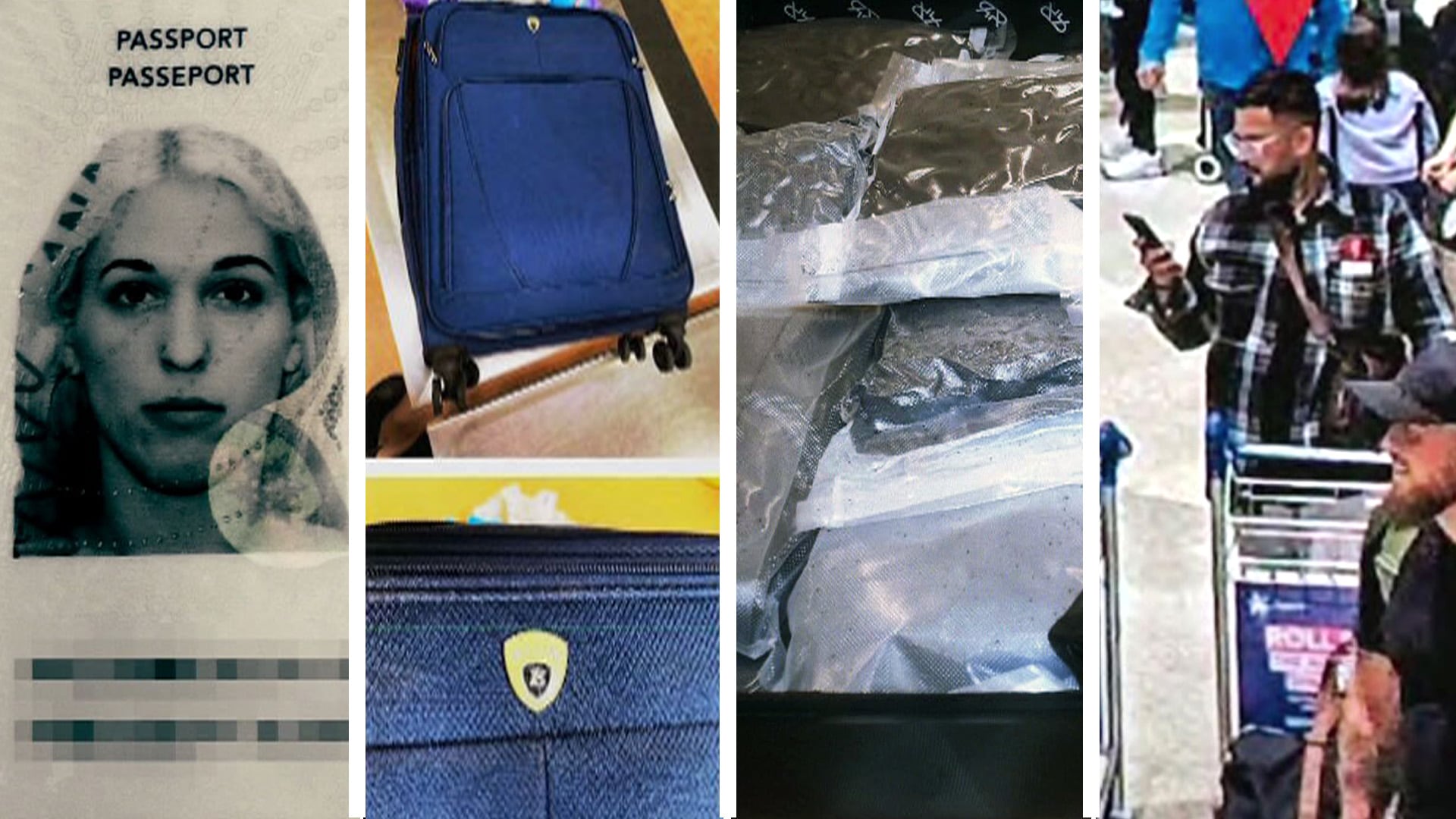
The last people Megan Maurer expected to come to her aid in her drug smuggling trial were the police who arrested her. Especially since the suitcase packed full of cannabis literally had her name on it.
But federal officers testified that organized criminals have successfully infiltrated Toronto’s Pearson International Airport, leaving the judge at her Brampton, Ont. trial little choice but to find Maurer not guilty.
Meanwhile, on the other side of the world, in New Zealand, another Canadian with a similar case was found guilty and sentenced to almost 10 years in prison.
How the scheme works
W5 first exposed the scheme in the documentary Trafficked: The Airport Conspiracy last May, revealing how Canadians were being wrongly accused in countries around the world.
Here’s how tag-swapping works: a corrupt airport employee takes the tag off luggage belonging to an unsuspecting passenger and attaches it to a suitcase filled with drugs. An accomplice is waiting to pick up the drug bag at its destination. But if the suitcase is intercepted, the innocent passenger is left trying to explain why their name is on a bag of drugs.
W5 has now identified more than two dozen cases, almost exclusively originating at Pearson Airport.
‘Multiple such incidents’
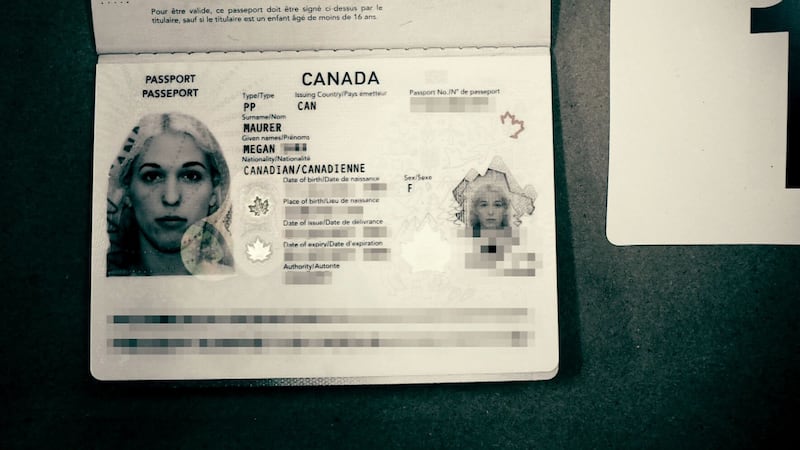
Two years ago, 30-year-old Canadian Megan Maurer was travelling from Calgary to Dusseldorf, Germany, with her first layover at Pearson International Airport.
That’s where a customs officer found two suitcases stuffed with dozens of vacuum-sealed packages of cannabis — 24.5 kilograms in all, worth up to $170,000.
On the handles: tags with Maurer’s name on them.
It didn’t look good.
At trial, Crown lawyers argued that Maurer being a drug smuggler was “the only reasonable inference” based on the evidence.
But around the time the trial began in early April, Maurer’s lawyer, Jessica Zita, told W5 that she saw CTV News’ early coverage of bag tag switching.
She remembered thinking, “I have to seize on this opportunity. This is timely.”
So when the Crown called to the stand two RCMP officers and a Canada Border Services Agency (CBSA) agent involved in Maurer’s arrest, she asked them about it.
Law enforcement isn’t usually eager to give defendants an easy out, Zita said.
But it worked.
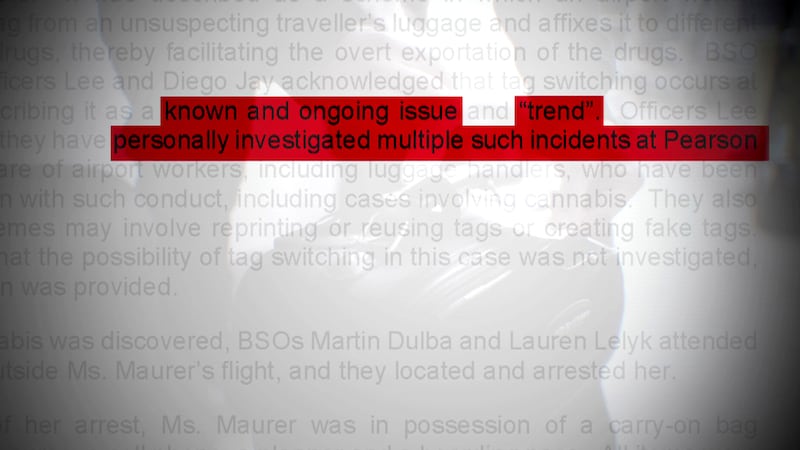
All three officers “acknowledged that tag switching occurs at Pearson Airport, describing it as a known and ongoing issue and ‘trend,’” Justice Robert Tomovski of the Brampton Court of Justice wrote in his not-guilty ruling.
- If you have any information regarding tag switching or corruption at Canadian airports, please reach out to avery.haines@bellmedia.ca and jack.hauen@bellmedia.ca.
The two RCMP officers went further, saying they had personally investigated “multiple such incidents” at Pearson, the judge wrote.
The Crown’s key witnesses had just given Zita a reasonable explanation for why her client’s name was on those drug bags.
“As a lawyer, I’m like, ‘This is great,’” Zita said.
“But I’m also thinking … ‘Wow, this must be a very serious issue. This must be more than a trend. This must be an ongoing problem, if not maybe a crisis, that Pearson is facing,’” she said.
In delivering the not-guilty verdict, the judge referenced the testimony about tag switching at Pearson, which gave him “reasonable doubt.”
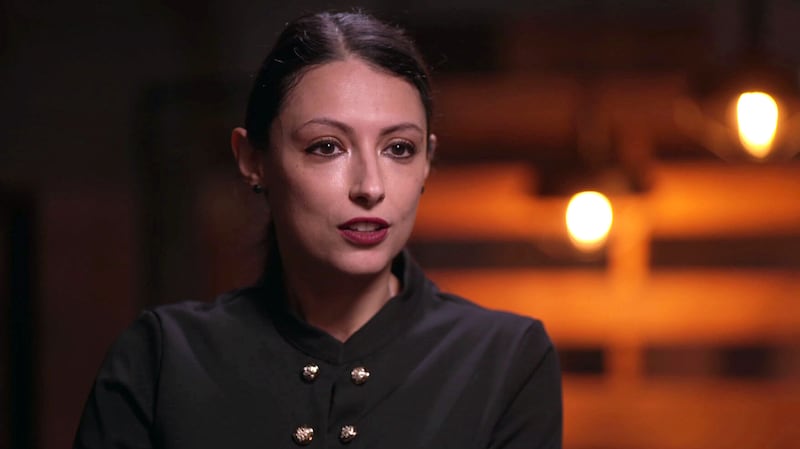
Before this case, defence lawyers didn’t have much to show a judge or jury that tag-switching is a trend, Zita said.
Now, she said, there’s a new “tool in their toolbox.”
“And I think that — I wouldn’t go so far to say precedent — but it does make the argument more palatable and more available for use,” she said.
On the other side of the world, one imprisoned Canadian is banking on it.
Across the globe, the opposite outcome
Two months after Maurer was arrested in late 2024, Tawheed-Ul Moyeen — who goes by Tommy — was also picked up on drug smuggling charges after flying from his home in Toronto to Auckland, New Zealand.
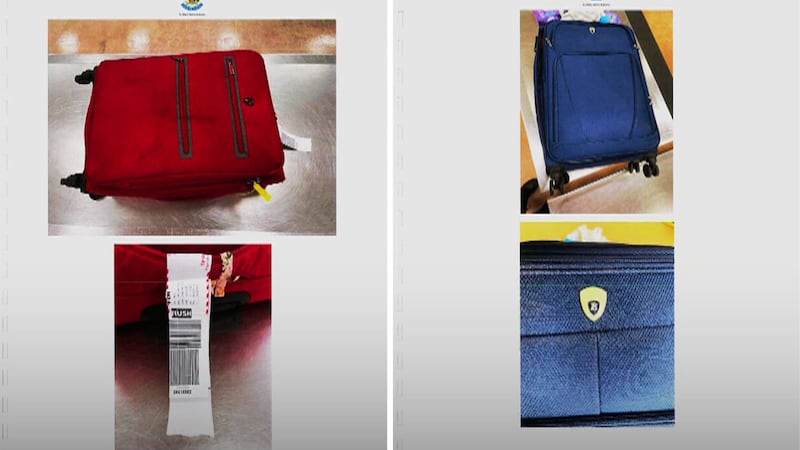
Moyeen checked a red suitcase at Pearson, but it didn’t meet him in Auckland.
Authorities did. And they said they had his blue suitcase right there.
“I’m like, ‘That’s not my bag,’” he said in a phone interview from prison with W5. “My bag is red. That’s a blue bag.”
Inside that blue bag was 23 kilograms of 80 per cent pure methamphetamine. And, like Maurer, his tag was on the handle.
But there’s a twist to Moyeen’s case: while he didn’t touch the blue meth suitcase, someone else did.
A ‘fascinating’ case that a judge found ‘difficult to assess’
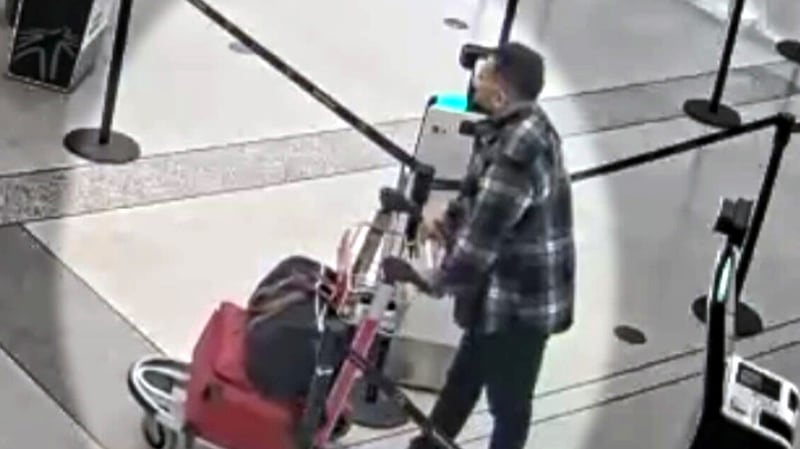
Vancouver man Le Tan Pham checked an identical blue suitcase onto that flight. It was filled with just six white towels. But when he got to the carousel in Auckland, he collected the drug bag with Moyeen’s name on it.
Moyeen and Pham both had layovers in Dubai on their way to Auckland. It’s unclear whether the tag swap happened in Dubai or Toronto.
Both Canadians were arrested. No evidence was presented at trial that the two men knew each other or communicated with each other.
In the trial last year, the judge wrote that Pham’s guilt was obvious, going so far as to mock his attempts at deception.
“It is sometimes said that the world of large-scale drug importations is littered with ‘bad actors’ — meaning people with disruptive or malevolent intent. You were a bad actor in a more literal sense — in that your acting was bad,” he wrote in his ruling.
Pham claimed he checked a suitcase with only towels because he didn’t trust hotel towels — an explanation that “clearly did not wash with the jury,” the judge added.
Pham’s job was clear, the judge ruled: he was the “catcher,” tasked with picking up the drugs and getting them out of the airport.
Moyeen’s role, however, he found “difficult to assess.”
- Part 1: Pearson luggage tag switch leaves Toronto man facing 15 years in Albania
- Part 2: Who’s responsible? Pearson tag-switching victims sue across the system
- Part 3: Federal government moves to overhaul airport security after CTV News investigation
Moyeen’s only direct connection to the drug bag was his tag. The Crown never proved he touched it, or had any contact with Pham.
Still, several facts worked against him.
Both Moyeen and Pham booked their trips just days before their travel dates, which is a red flag to authorities.
Despite sitting over 30 rows apart, Moyeen left the plane directly after Pham.
At the Auckland airport, Moyeen sent encrypted texts to someone saying “pulled me aside” and “don’t message me.”
Those texts, which were later deleted, were “central to the jury’s verdict,” the judge wrote.
Moyeen told W5 the messages were taken out of context. If the jury had seen the entire conversation with his friend, they wouldn’t have thought it was so suspicious, he said.
The judge wrote that Moyeen’s texts could reflect the fact that he was senior to Pham, “or at least … engaged in some sort of supervisory capacity.”
In the end, the Crown argued Moyeen’s role was making his tag “available” to the drug bag, sowing “confusion” and creating “plausible deniability.”
The whole scheme was “not entirely typical” and “frankly … quite fascinating,” the judge wrote.
A jury found them both guilty. Pham was sentenced to 10 years, while Moyeen got nine years and seven months. He has been behind bars for almost two years so far.
While the judge said the importation must have been an “inside job,” referring to at least one crooked airport worker, there was no explicit mention of tag switching in Moyeen’s trial.
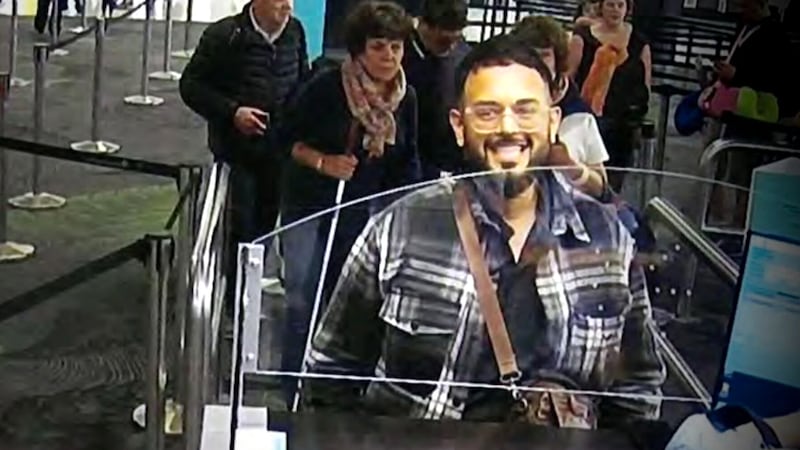
Moyeen’s hoping to change that in his appeal, which he said will heavily feature W5’s journalism.
“Everything happening in the documentary and the research is what’s being used to give strength to my appeal,” he said.
“I don’t know how long this will take, how long it will take for me to get a date,” he said. “I hope it’s really soon. I hope I can be home for Christmas.”
Watch the one-hour special presentation of W5’s Avery Haines Investigates Sunday at 10 p.m. ET live on W5’s official YouTube channel and on CTV and Crave following the Grey Cup.

