Canadians are increasingly opposed to any U.S. trade deal that would include tariffs on Canadian goods.
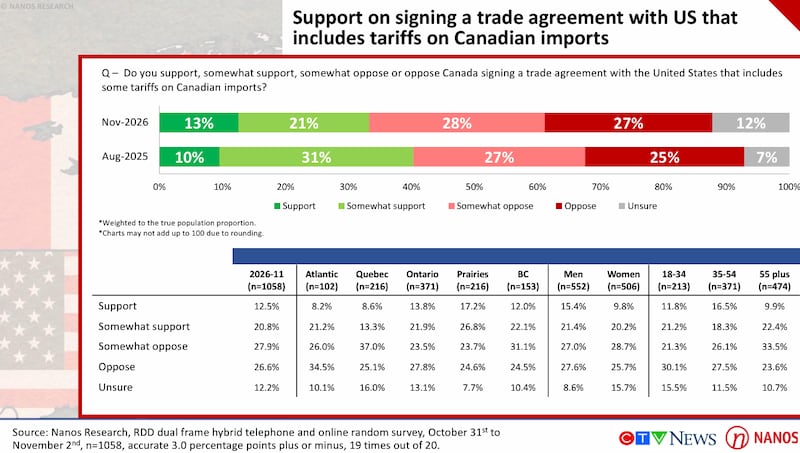
A new poll by Nanos Research and commissioned by CTV News finds just 33.3 per cent of Canadians would support such an agreement. That’s down from a similar survey in August of 2025 that found 41 per cent of Canadians willing to accept a deal that included import duties.
The results suggest growing resistance among Canadians to accepting a trade deal that leaves tariffs in place.
“Canadians feel more loved,” said Barry Appleton, international trade lawyer. “We’ve been courted by the Europeans. We’ve been courted out by the Philippines. We’ve been courted out in ASEAN. We’re talking to India for the first time. We don’t feel like we’re being rejected by our best friend. We’re feeling like we’re being loved at a party.”
That growing appreciation from other countries may explain why Canadians would prefer to find trading partners that don’t impose tariffs on Canadian products.
But that confidence can do little to alter North America’s geography, Canada’s proximity to the United States, and the natural trade flow those realities create.
“The problem is seven out of every $10 that we that we export still goes to the United States. So we still need to figure out how to make that relationship work,” said Appleton.
He added, “At the end of the day, the United States has made it clear with every single one of its trade partners -- the EU, for example, Great Britain is another good example -- they’re all paying. So, the price of getting to the United States is paying tariffs now. It’s pay-to-play. The question is going to be: Can we afford that, or can we not?”
That is the very question Canadian officials are mulling over right now.
In the past few weeks, trade talks between Canada and the United States have restarted, with the U.S. Ambassador to Canada, Pete Hoekstra, expressing confidence a trade deal can be reached before the end of the year.
Prime Minister Mark Carney addressed those talks on Saturday during a news conference in Manila, stating that, just before leaving for his current overseas trip, he had a substantive conversation with U.S. President Donald Trump.
“We are making progress,” said the prime minister. “There is a possibility of a deal, a bilateral deal, but we’re not yet there.”
It is impossible to know if any final agreement will include tariffs, but every signal from American officials suggest import duties will be a part of any deal the Trump administration signs.
And while the Nanos survey suggests most Canadians would reject a trade deal that includes tariffs, those closely involved in the Canada-U.S. trade file say tariffs are now part of the reality, and Canadians may have to learn to live with them.
“I think it’s pretty unlikely we’ll get back to a world of zero tariffs,” said Maryscott Greenwood, a Canada-U.S. relations consultant and head of Ottawa Street Strategy.
Greenwood says most Canadian goods still enter the U.S. tariff-free under the Canada-U.S.-Mexico Agreement (CUSMA). And despite the tariffs imposed by Trump through executive orders, Canada’s overall effective tariff rate remains relatively low.
She understands why industries hit by tariffs want the issue addressed but says preserving Canada’s relatively favourable position could give the country an advantage over other global competitors in the U.S. market.
“Canada’s effective tariff rate right now is at about five per cent, and that’s not as good as zero, but it’s better than, you know, a lot of the rest of the world.”
Appleton says any agreement reached now would fall short of ideal, but failing to secure a deal could inflict even greater damage on Canada’s economy by prolonging the uncertainty of the past year and a half.
“Canada still has a benefit with a trade deal if we can get some certainty,” he said. “It’s the lack of certainty, it’s the lack of political clarity that’s costing Canadians jobs, costing us in-bound investments, costing us expansion for our plants. That’s what we need to address.”
That leaves the federal government with two challenges: negotiating a deal with the U.S. and convincing Canadians to accept it if the final agreement includes tariffs.
Methodology
The results come from an omnibus survey conducted by Nanos Research using a dual-frame hybrid telephone and online random survey.
Nanos surveyed 1,058 Canadian adults between Oct. 31 and Nov. 2. The results were statistically checked and weighted by age and gender using the latest census information, and the sample was geographically stratified to be representative of Canada.
The margin of error for this survey is plus or minus 3 percentage points, 19 times out of 20.

