What happens when a simple trip turns into a nightmare? Part five of W5’s five-part investigation on CTVNews.ca follows travellers who say they went from passenger to prisoner, caught in a scheme that crossed borders and changed lives forever.
You might think the worst thing an airport employee could do to your luggage is lose it.
You’d be wrong.
W5 has identified more than two dozen cases of so-called bag tag switching — where a corrupt worker takes the tag off a checked bag and attaches it to a suitcase filled with drugs, allowing the dirty luggage to speed across continents under an unsuspecting traveller’s name.
In some cases, Canadians victimized by the scheme have served jail time in countries where police aren’t interested in hearing, “That’s not my bag.”
It’s an issue the federal transport minister said he’s trying to fix, after going “back to the drawing board” in the wake of W5’s original investigation into the issue earlier this year.
However, one Canadian says he has a solution that’s cheaper and easier than legislation: an un-switchable baggage tag.

The invention that could stop tampering
Bill Drori created a prototype 10 years ago and demonstrated it for W5.
While a normal tag can be stuck and re-stuck dozens of times without losing its adhesive, Drori’s reveals a “VOID” message the first time it’s taken off. The glue also disappears, making it impossible to re-attach.
Drori runs Tamperguard, a Montreal company that makes the tamper-evident tape for police evidence and the bags that hold airport duty-free purchases.
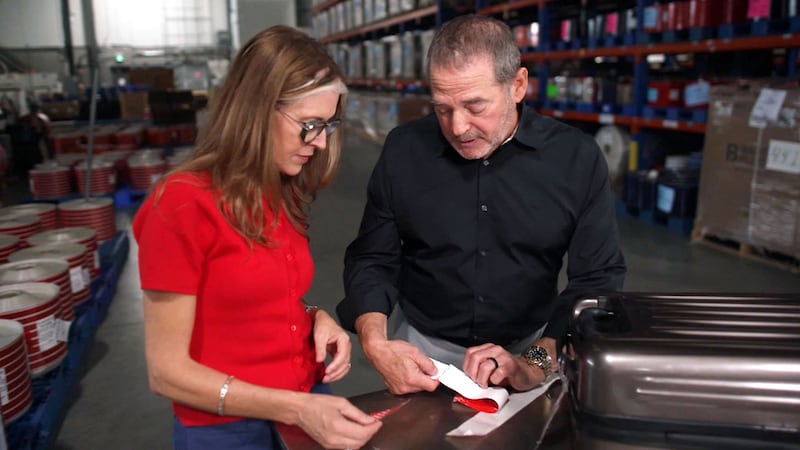
He created tamper-evident tags in 2016 for the Colombian airline Avianca, which ultimately lost interest. That same year, Drori said he pitched the idea to aviation industry leaders at the AVSEC (aviation security) World Conference in Kuala Lumpur, Malaysia.
“Everybody thought it was a great idea,” including Canadian and American officials, Drori said.
But no one, he said, wanted to take the lead.
“Everybody said it was somebody else’s decision,” he said. “So it ended up going nowhere.”
- If you have any information regarding tag switching or corruption at Canadian airports, please reach out to avery.haines@bellmedia.ca and jack.hauen@bellmedia.ca.
After W5’s documentary aired in May, Drori said he emailed the office of federal Transportation Minister Steven MacKinnon right away.

“I know he - I’m sure - receives … many, many emails, but I sent one out to him saying that there is a solution that exists,” he said.
He didn’t hear back.
He says he did, however, get an email from someone on the security team of the Greater Toronto Airports Authority (GTAA) — the non-profit organization that operates Toronto Pearson International Airport.
But despite multiple follow-ups from Drori, that conversation also fizzled, he said.
Drori said there was virtually no difference in price between his product and the standard baggage tags when he priced it out for Avianca in 2016. He said he could have the tamper-evident material ready for a label-maker in four weeks.
W5 raised Drori’s technology with MacKinnon during an interview. The minister said he would be open to learning more about it.
“We are open to all manner of measures that can ward off criminal behaviour,” he said.
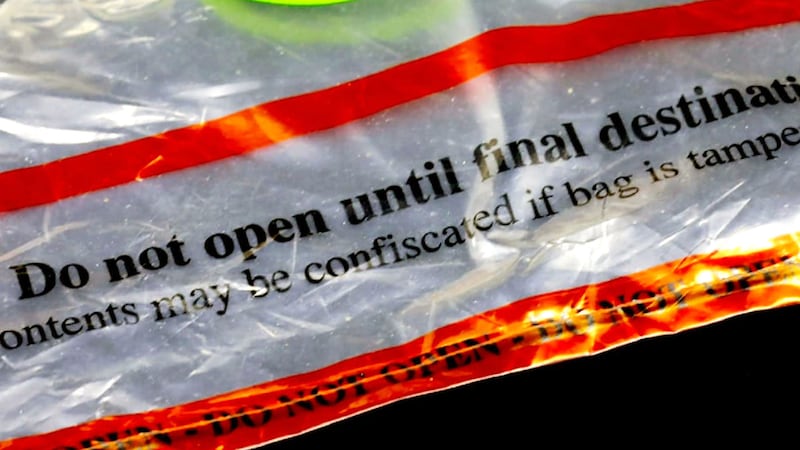
Tamper-proof stickers are already in use
Drori noted the irony that his products are already in airports, but only to secure duty-free booze — a necessity to allow secure alcohol purchases after passengers were banned from travelling with more than 100 millilitres of liquid.
“The product that we made for the baggage tags is the same type of thing, but there was no loss of revenue. So I guess there was no impetus to put it through,” he said.
“Until there’s a fire lit, until there is a mandate, a specific request saying, ‘Let’s do something,’ be it from the public or from the government, that nothing’s going to happen.”
Watch the one-hour special presentation of W5’s Avery Haines Investigates Sunday at 10 p.m. ET live on W5’s official YouTube channel and on CTV and Crave following the Grey Cup.
- Part 1: Pearson luggage tag switch leaves Toronto man facing 15 years in Albania
- Part 2: Who’s responsible? Pearson tag-switching victims sue across the system
- Part 3: Federal government moves to overhaul airport security after CTV News investigation
- Part 4: How a CTV News investigation connected bag tag cases around the world
- Part 5: What can Canadians do to protect themselves from bag tag switching?

