Scientists monitoring the ocean floor off the B.C. coast are seeing a warming trend that is becoming increasingly difficult to ignore, with temperatures reaching unprecedented levels hundreds of metres beneath the surface.
New measurements from Ocean Networks Canada (ONC) show water temperatures at some deep-sea monitoring locations running as much as 2.5 C above historical averages, raising questions about what the developing El Niño could mean for marine life along the B.C. coast.
According to Environment and Climate Change Canada, El Niño is a recurring climate pattern that occurs when ocean temperatures in the central and eastern tropical Pacific become warmer than normal. The shift affects atmospheric circulation and can influence weather and ocean conditions around the world, including along Canada’s West Coast.
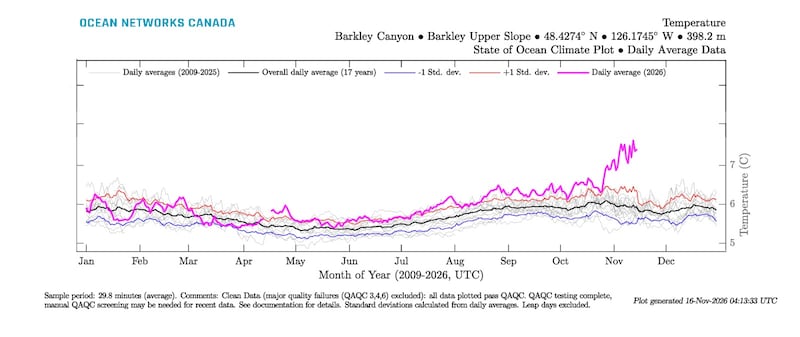
The most striking reading came Nov. 8 at Barkley Canyon Upper Slope, where instruments recorded a temperature of 8.21 C at a depth of 400 metres.
That is the warmest measurement recorded at the site since monitoring began in 2009, surpassing its previous record, set in 2019, by nearly a full degree.
And the warming is not confined to one location.
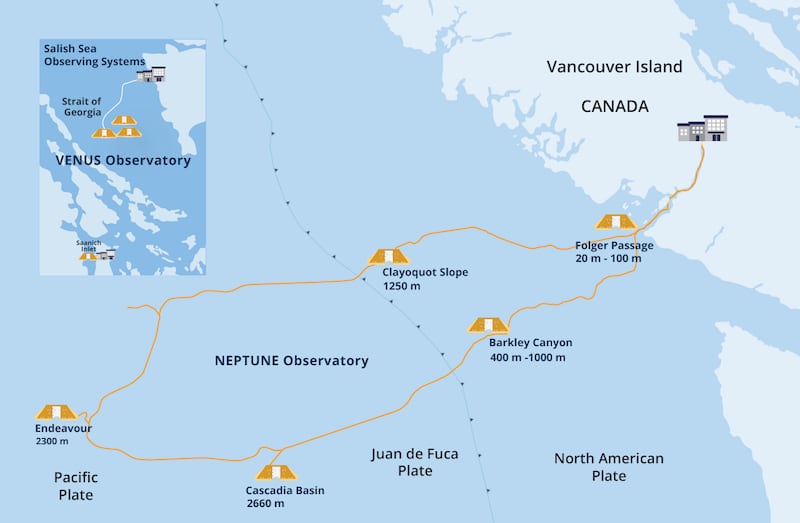
ONC says its Clayoquot Slope monitoring site, more than 1,200 metres beneath the surface, is also experiencing temperatures well above normal.
Researchers have been tracking unusually warm seasonal conditions at several offshore locations since late summer. The only major exception is the observatory’s deepest site, Cascadia Basin, at approximately 2,650 metres, where temperatures remain within their typical range.
The findings offer researchers an unusual opportunity to observe how large-scale climate patterns are influencing ocean conditions at different depths, rather than relying solely on measurements taken near the surface.
“What makes these observations significant is that we’re seeing significant warming not just at the surface, but hundreds of metres below it,” Jay Cullen, ONC’s interim president and CEO, said in a release.
“Our observatories are showing El Niño’s influence extending through a large portion of the water column off the coast of British Columbia.”
Cullen said researchers will be watching conditions closely in the coming months because warmer ocean temperatures can have important consequences for marine ecosystems and ocean health.
Steve Mihaly, a senior scientist with ONC, says the timing of the temperature spike is particularly interesting given the ocean conditions that have shaped the region throughout the fall.
He says northwest winds helped drive coastal upwelling, a process that draws colder water from deeper in the ocean toward the surface.
“This pulse of warm water along the continental slope is consistent with a strong El Niño, whose energy propagates northward from the equatorial Pacific to the waters off British Columbia as coastal trapped waves,” Mihaly said in a release.
The temperature changes are accompanied by another notable development: higher-than-normal sea levels.
Measurements from tide gauges in Bamfield and Tofino, along with ONC’s underwater pressure instruments, show sea levels were approximately 25 centimetres above normal by mid-November.
Researchers estimate that about 15 centimetres of that increase is associated with El Niño-related coastal waves, after accounting for local weather and atmospheric influences.
The emerging conditions could add to existing pressures on waters closer to shore.
ONC’s VENUS observatory in the Salish Sea has recorded above-average temperatures throughout 2026, even before the latest El Niño-related warming began to emerge offshore.
The prolonged warmth is raising questions about what happens when an already unusual year of ocean conditions is followed by another source of climate-related stress.
“The compounding of such conditions in a location known for migrating salmon, spawning herring populations, iconic marine mammals, makes it critical for us to understand how these conditions may affect the ecosystems that support the region’s fisheries, tourism, and overall cultural identity,” Jordan Watson, ONC’s science director, said in a release.
Understanding how prolonged warmer conditions affect these species will be important for the ecosystems, fisheries and coastal communities that depend on them.
Researchers will continue monitoring the measurements as El Niño develops, looking for signs of how far the warming extends and whether it persists.
ONC is also working with the Canadian Integrated Ocean Observing System Pacific Region to develop a new regional monitoring tool. It will bring together information from several research and government organizations, including the Hakai Institute, Fisheries and Oceans Canada, NOAA and the University of Washington.
The goal is to give scientists a broader picture of changing ocean conditions across the Northeast Pacific and the Salish Sea.
For now, the instruments on the ocean floor are providing an important early warning of changes unfolding beneath the waves.

