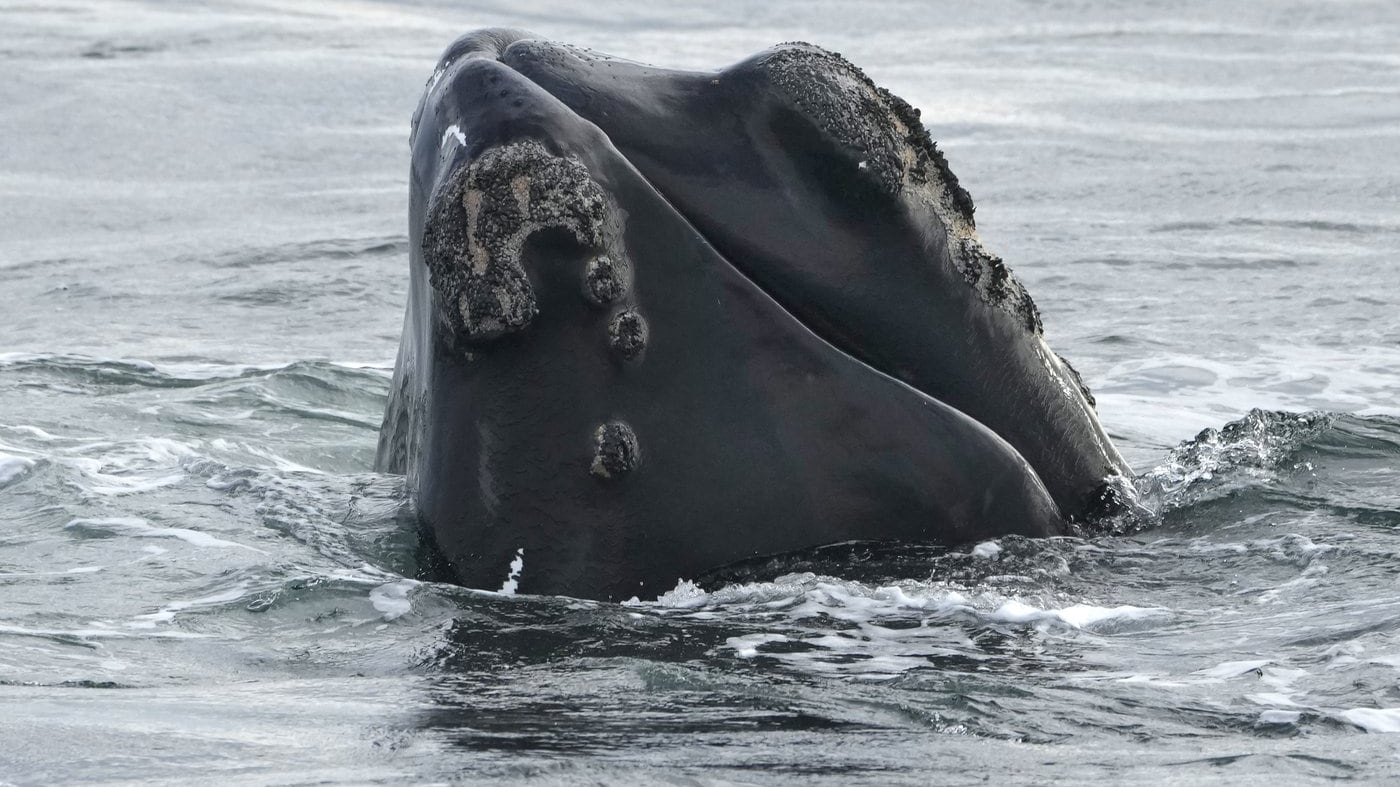
Scientists are one step closer to understanding why the critically endangered population of North Atlantic right whales produces so few calves each year.
Preliminary research presented Monday at the North Atlantic Right Whale Consortium meeting in Halifax cites genomic data indicating that up to 70 per cent of fetuses are lost due to inbreeding.
Tim Frasier, a professor at Saint Mary’s University, said the findings closely match the population’s reproductive rate, which is about 70 per cent lower than it should be.
Frasier’s findings sparked a series of questions from other researchers at the meeting, some of whom were concerned about how this could affect the recovery of a species with fewer than 400 living members.
“That’s kind of the million-dollar question,” Frasier said.
Though these numbers may seem grim, he said the high rate of lost fetuses has led to a purging of harmful genes that result from inbreeding. In the long run, this could promote long-term genetic diversity, a positive for a species with such a tiny population, he said.
Frasier said that there is a high risk of inbreeding among small populations and it can eventually lead to extinction.
“There’s a thing called an extinction vortex where inbreeding starts to be a bigger problem and that just magnifies over time,” he said. “The pattern that we’re seeing, it means … calves that are born have more genetic diversity than you would expect in this population.”
As well, this diversity should also lead to an eventual decline in the loss of fetuses.
Moira Brown, director of science at the Canadian Whale Institute, said she’s optimistic about the findings.
“It’s hopeful that all the efforts that we are (making) to reduce human impacts will show benefit in time,” she said.
However, the population must first endure this period of low reproduction, which Frasier expects is limiting the population’s recovery in the short term.
“I think they are in this critical period where they’re suffering from these genetic factors and other things,” said Frasier, referring to the fact that ship strikes and entanglements in fishing gear remain the leading causes of death.
“So we need to stop killing them in order to allow them to survive and get through this.”
Meanwhile, the population of the migratory species, which is typically found along the east coast of North America, is not yet on a clear path to recovery. A preliminary estimate released Monday says the annual population as of 2025 decreased by two per cent to 382 whales.
The most recent calving season, which was one of the strongest on record with 24 new calves, provided a glimmer of hope. Yet, Frasier said that number could have been around 100 if all adult females gave birth at anticipated rates.
Frasier said adult females should give birth once every three years, but for many females the interval is much longer and some whales in the population have never given birth.
This is a stark contrast to most other marine mammals, Frasier said, who typically give birth at their maximum rates.
In addition to inbreeding, Frasier said other factors may also be affecting reproductive rates, including poor nutrition and human-caused injuries. Researchers do not yet understand how these factors are potentially compounding the effect of inbreeding on reproductive rates, he said.
Moving forward, Frasier said he and his team plan to measure how low reproduction is affecting the population’s recovery.
Heather Pettis, a senior scientist at the New England Aquarium, said despite the low reproductive rate, researchers have documented population increases in recent years.
“We know that it’s not so debilitating that the population can’t recover,” she said.
It’s believed the right whale population peaked at about 21,000 before aggressive hunting drastically reduced their numbers. By the 1920s, fewer than 100 remained.
After a ban on hunting was imposed in 1935, the population grew to 483 by 2010. But a steep decline began in 2017 after 12 whales died in Canadian waters and another five died in U.S. waters, with most of the deaths linked to entanglements and vessel strikes.
Since 2020, however, their numbers have been slowly increasing.
This report by The Canadian Press was first published Nov. 17, 2026.
Tori Fitzpatrick, The Canadian Press

