An Ottawa defence company is taking a different approach to the growing threat posed by enemy drones, developing an interceptor missile that can bring them down without an explosion or even making direct contact.
A.I.RShare calls it the “world’s friendliest missile.” Its Overwatch interceptors use a lightweight rocket to travel beyond Mach one, faster than the speed of sound, before releasing a cloud of specially engineered latex strands designed to disable a drone in flight.
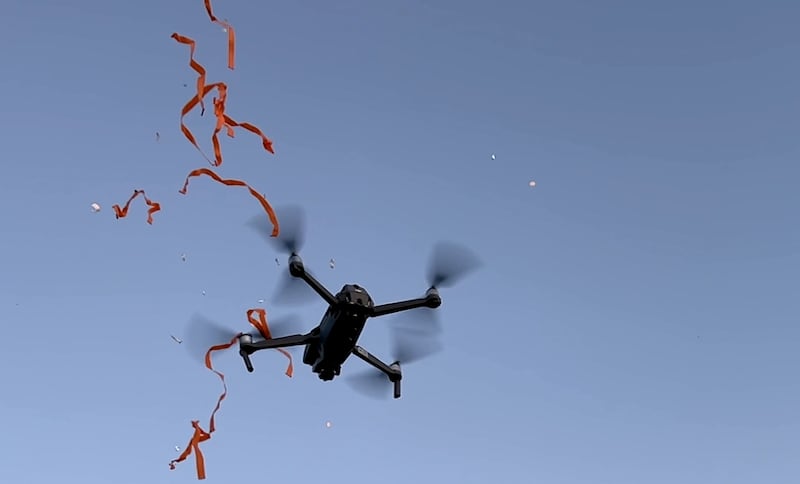
Founder and CEO Rick Whittaker says the technology targets something every drone needs to stay airborne.
“In order to fly you need lift and so we disrupt lift,” he says. “Our Casper lift disruptors are effectively aerodynamically engineered latex spaghetti. This latex spaghetti floats in a 60-foot radius and slowly descends to the ground, so any drone coming in sucks in the spaghetti traps up the propeller, blocks the air intake, and down comes the drone.”
Unlike traditional missile systems, Whittaker says the interceptor does not rely on explosives or a direct collision with its target.
“You can’t be spending $1 million to take down a $20,000 drone; the economics don’t make sense,” he says. “Also, we can’t be blowing things up over top of people. That’s very bad and so militaries needed something with low-cost collateral.”
The interceptors weigh roughly one kilogram when fully loaded. They travel at Mach 1.4 and have an engagement range of about four kilometres, according to Whittaker.
“Our ballistic rocket contains a non-lethal warhead, and a flight computer, which makes everything safe,” he says. “It uses time of flight as its engagement, and it has a rocket motor which sits in the middle. The missile is designed to be launched out of a tube.”
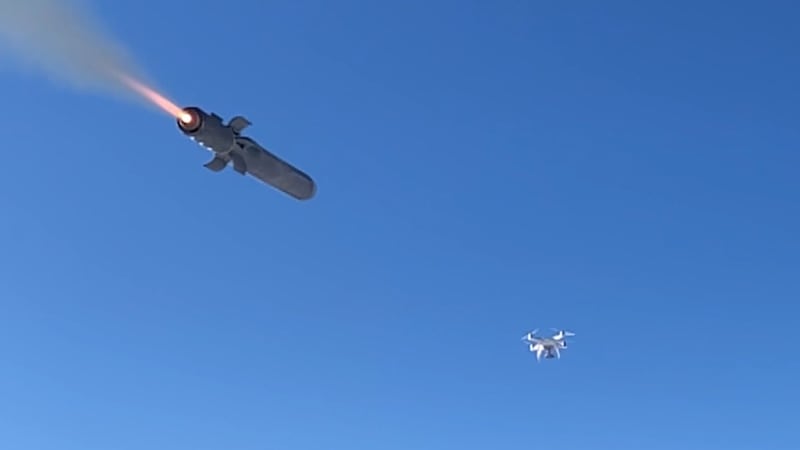
A.I.RShare says it has customers in the United States and overseas, including in conflict zones, and is currently shipping approximately 50 units a week.
The company is now in its seventh generation of the technology, with development taking place in Ottawa.
A key part of the process is 3D printing. The missiles’ plastic components can be manufactured relatively quickly, with the potential to establish production closer to where deployment is needed.
“The missiles are light, agile, effective and can be built out of a 40-foot shipping container if needed,” says Whittaker. “We can solve a very important supply chain and sovereignty issue. If they don’t have to rely on supply chains that are outside of their reach, or they become less resilient because there is a critical component, that’s bad news for them, and we solve that problem too.”
That flexibility is part of what attracted Luke Skinner to the company.
Luke Skinner, A.I.RShare’s missile and fire control engineer, and a Carleton University graduate, says the team’s approach and system design and in-house manufacturing allows it to move from an initial development to testing in a matter of days.
“We use a special different 3D printing techniques that we’ve spent years developing. I’ll design something beginning of the week. We’ll meet about it on Tuesday, we’ll print it on Wednesday, build it, and by the end of the week we’re already testing,” Skinner says. “And we do that cycle basically every week, which lets us iterate quickly and to see these missiles actually help people in conflict countries right now is really interesting.”
Whittaker says Canada may not be facing the same immediate drone threat as some of its international partners, but believes the technology has a growing role to play as warfare evolves.
A.I.RShare has received support from the Canadian government and says it intends to continue expanding operations in Ottawa, as it looks to grow its international footprint.

