Researchers at the University of Regina (U of R) are raising awareness about what they’re calling a “silent pandemic.”
It’s called Antimicrobial Resistance (AMR), when bacteria, viruses, fungi and parasites no longer respond to medicines intended to kill them, especially in the case of antibiotic resistance.
Dr. Omar El-Halfawy, associate professor of biochemistry at the University of Regina and Canada research chair in chemogenomics and antimicrobial research, explained the problem.
“[It] happens when microbes, or ‘bugs,’ no longer respond to antibiotics, so they become superbugs. They develop those shields or armour that helps them protect itself from the action of antibiotics, that translates to therapeutic failure,” he said.
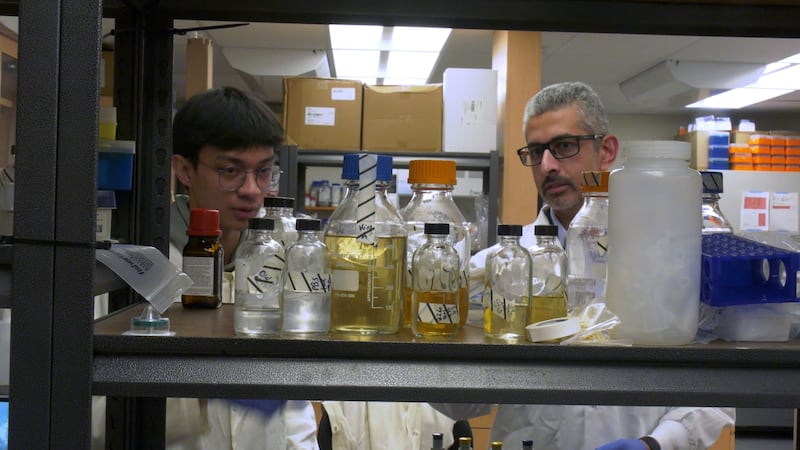
PhD student Joshua Adams said it’s referred to as the “silent pandemic” because it flies under most people’s radars.
“Our lab in particular is looking for new strategies to help improve patient outcomes,” he said.
El-Halfawy said it’s not something that’s being discussed every day because it is not a full-blown pandemic.
“But if the status quo remains and no concrete action happens, it can turn into a full-blown pandemic. If that happens, the tolls of the COVID-19 pandemic would dwarf next to antimicrobial resistance,” he explained.
Students have worked in the lab almost every day to continue their research.
“We will continue to have innovations and new solutions, but bacteria will continue to evolve,” El-Halfawy said.
“The battle between us versus bugs will continue.”
El-Halfawy says antimicrobial resistance is on the rise in Canada and around the world.
He cites a Council of Canadian Academies report from 2019 that found 14,000 Canadians died due to causes linked to antimicrobial resistance in a one-year period tracked in 2018, with projections showing the problem could become significantly worse by 2050.
The Council of Canadian Academies says that 500,000 in Canada will die from AMS by 2050. El-Halfawy says that numbers are expected to “substantially increase” to more than 10 million worldwide by 2050.
That’s the kind of future the research aims to prevent.
“AMS occurs or is accelerated when there is overuse or inappropriate use of antibiotics. “We shouldn’t take them for granted. The action that everyone can do is to prevent inappropriate or [the] overuse [of] antibiotics.”
El-Halfawy does acknowledge the important role antibiotics play in treating a range of conditions but still urges caution on how often they’re relied on. He says that the battle of “us versus bugs” will continue.
“Use it only when needed, when you have a bacterial infection. The best way also to prevent and reduce the use of antibiotics is to not get sick to begin with,” he said.
In honour of World AMR Awareness Week, the Saskatchewan Science Centre will be hosting the “Antimicrobial Resistance Awareness: Microbe Madness” this Saturday from 1 p.m. to 4 p.m.

