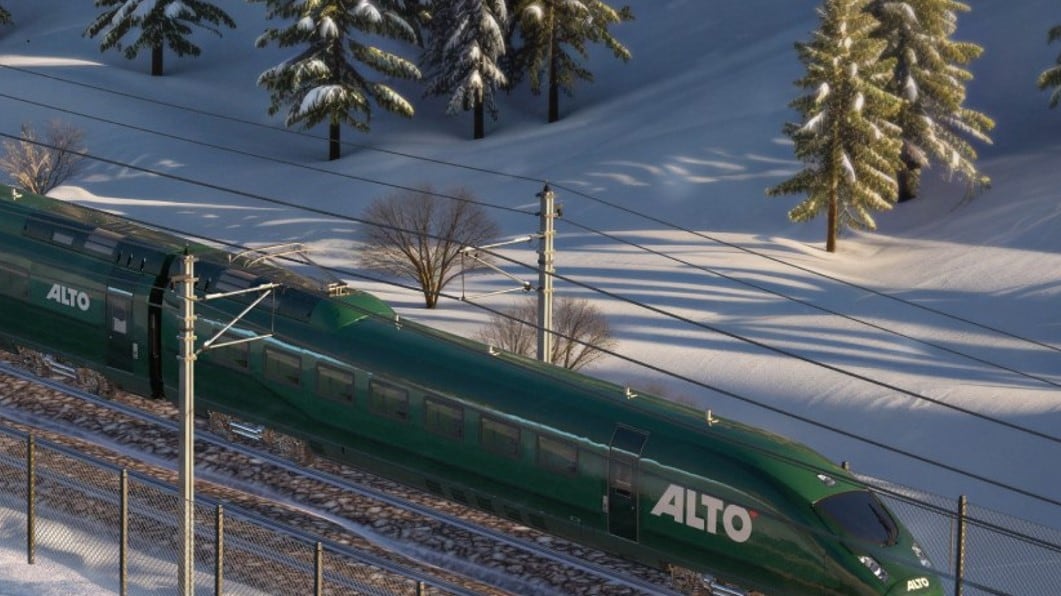
A new study commissioned for the Alto high-speed rail project says the proposed line connecting Quebec City and Toronto could provide Canada an annual economic boost to the tune of billions.
The study released on Friday from consulting firm Aviseo Conseil, says the project could increase Canada’s GDP by $24.5 billion per year.
The 1000-kilometre high-speed rail project promises to connect Quebec City to Toronto in four hours and 30 minutes, with stops planned in Trois-Rivières, Laval, Montreal, Ottawa and Peterborough. The government estimates the project will cost between $60 and $90 billion.
The study identifies the Quebec City-Toronto corridor as Canada’s main economic centre, housing 41 per cent of Canada’s population and generating 40 per cent of its national GDP.
Aviseo says the high-speed rail project would help to strengthen Canada’s long-term productivity by increasing connectivity between major economic hubs.
“The economic significance of Alto goes beyond transportation,” Jean-Pierre Lessard, partner and cofounder at Aviseo Conseil, said in a news release.
“As travel demand continues to grow, maintaining the status quo will also come at a cost. By bringing some of Canada’s major economic centres closer together, high-speed rail could help meet that growing demand while strengthening productivity and contributing to Canada’s long-term prosperity.”
This analysis follows a June study prepared by infrastructure and consulting firm CPCS, which suggested the project could provide a massive boost to the cities and towns along the proposed corridor.
Cost of inaction
Aviseo’s study also finds that there is a cost to inaction, stating that the corridor’s current transportation networks are facing “growing constraints that are increasing for travellers, in money, in time and in reliability.”
Air travel, Aviseo claims, is suffering from limited competition. Meanwhile, Aviseo claims VIA Rail suffers from having to share tracks with — and yield to — freight traffic.
“With the corridor’s population expected to grow by about 3 million people by 2050, these pressures will intensify in the absence of a structuring new option,” Aviseo’s analysis reads.
According to the study, intercity trips between the cities could increase from approximately 80 million today, to 115 million by 2059. Regardless of whether there is high speed rail, billions would need to be spent on transportation infrastructure to accommodate this traffic, Aviseo says.
“Without high-speed rail, this growth would be absorbed by existing networks, whose investment needs could exceed $50 billion for Québec and Ontario combined by 2050 under a status quo scenario,” Aviseo said.
“The question therefore is not so much whether to invest, but in which infrastructure.”
Alto is aiming to begin construction on the first phase of the project, connecting Montreal to Ottawa, in 2029. The first phase is expected to take eight years to complete.
The project has faced opposition from many different stakeholders along the potential corridors, including landowners, several municipalities and politicians.