WINNIPEG — A canoe crafted out of birch, oak and cedar bark may be Brian Rice’s swansong.
The Mohawk professor’s academic career has spanned nearly 35 years in classrooms across the globe, eventually planting him in the faculty of kinesiology and recreation management at the University of Manitoba.
With retirement on his mind, Rice knew he wanted to leave something behind for Manitoba’s largest university, where he teaches land-based learning.
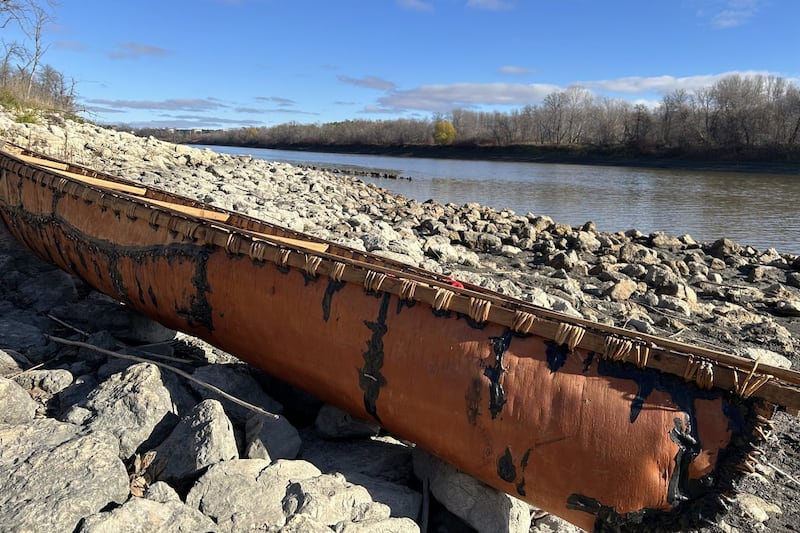
So he turned to his ancestors. The result: a 13-foot Eastern Woodland-style handcrafted birch-bark canoe.
“You do something for many years and we often walk away ... sometimes we’re forgotten or we forget where we were. I didn’t want that to happen this time,” Rice said at an event unveiling the finished product in early November.
“I wanted that memory to (always) be there.”
Birch-bark canoes were the primary mode of transportation for First Nations in eastern and central Canada, especially during the fur-trade era.
It is considered a cultural mainstay in Canada.
Rice enlisted Métis historian and craftsman Denis Gendron to complete the project, which brought Indigenous land-based learning, traditional knowledge and hands-on craftsmanship together.
The arduous process took about 350 hours to complete over a four-and-a-half month period from research to construction.
Under the warmth of the summer sun, the two men, with the help of volunteers, used shovels, gardening tools and their gloved hands to coax stubborn spruce roots from forest beds that would later be used to secure portions of the canoe.
“It took two weeks for my hands to recover,” said Gendron.
That same summer, heat took longer to pierce through the winter frost that coated trees until June. Once the men were able to cut through the bark, they sliced a strip down the side of each trunk and then peeled the bark off in sheets.
They were careful to only take what they needed, never more. Whenever they took something from the forest, they laid down tobacco and offered a prayer, a customary practice for some Indigenous nations when harvesting from the land.
For Gendron, there was a steep learning curve going from his experience building furniture to constructing a fully functional canoe.
“You have to travel into the woods. Not only that, you have to know where to look, and what to look for. Birch bark is a cantankerous material to work with, but it’s extremely strong. It’s got a lot of resilience to it,” said Gendron.
“It took a lot and it was a hot summer. So it brought a lot of determination. I lost about 25 pounds. It was great exercise.”
The challenges didn’t end there.
When it came to building the canoe, timing was everything.
Cedar ribs, strips of wood used to form the skeletal shape of the vessel, were shaped by pouring boiling water over them to make them flexible.
“It’s so exhaustive. It’s such hard work and it’s litres and litres of hot water. I had dreams about water,” said Gendron.
Throughout the build, Gendron would put the canoe in the water to take care of kinks and leaks, eventually taking it for a spin but not going very far because in his own words, he’s no “expert canoeist.”
The finished craft now greets students, staff and visitors as they enter the university’s active living centre.
Gendron already has plans to build a bigger canoe that can be used in the classroom and on the land.
While newer materials have changed the way canoes are made, Indigenous craftsmen and women continue to carry on the traditional artform. And, in the case of Rice and Gendron, bringing two people from different nations together with the common goal of exploring a shared history.
“We’re tied to this now, probably for the rest of our lives,” said Rice.
Brittany Hobson, The Canadian Press

