A Toronto architect says she has been caught up in the criminal bag tag switching scheme operating out of Pearson International Airport.
Maria, who doesn’t want to be identified, says she was victimized in an unusual way.
In April, she took an Air Canada flight from Pearson to São Paulo, Brazil to visit family with her husband. While most tag switch victims are apprehended at the airport, the couple returned home in May without incident, she said.
A month later, Maria said she got a call from a Canada Border Services Agency (CBSA) official. He asked her to come in for an interview.
Worried it was a scam, she called back and verified that she was indeed speaking with a CBSA officer. The interview took place at a police station an hour and a half away from her home.
“I had just started a new job, so for me it was not that easy to ask for time off to go for an interview,” she said.
Once there, she said the officer told her that her tag was found on a bag full of “illegal substances.” He asked if she had any involvement with drugs or drug trafficking, as well as detailed questions about her suitcase.
‘This is happening at YYZ’
Bag tag switching works like this: a corrupt airport employee takes the tag off an unsuspecting passenger’s luggage and attaches it to a suitcase filled with drugs headed to that traveller’s destination.
An accomplice on the other end waits to pick it up. But if the bag is intercepted by security, the innocent passenger is left to face the consequences.
W5 has identified more than two dozen cases of Canadians caught up in this scheme, almost all of them flying out of Toronto’s Pearson International Airport.
- If you have information about corruption at Canadian airports, please reach out to avery.haines@bellmedia.ca and jack.hauen@bellmedia.ca (jackhauen.33 on Signal).
Maria said CBSA officers told her it’s a known issue at Pearson. They advised her to take photos of her checked baggage in the future, as well as photos of herself checking the bags in, she said.
“‘Try to protect yourself, because this is happening at YYZ,’” she remembers the officers saying about tag switching or duplicate printing schemes at Pearson airport.
Another couple did take a photo of their bags, but it backfired. Kristian Gjoni was victimized by a bag tag switch out of Pearson, and when he was confronted by Albanian police, they thought the precaution was “extremely suspicious,” he said. He was jailed for days, and now faces a potential 15-year sentence in the country.
Brazil opens a formal case
Maria was terrified that the misunderstanding would hurt her case for permanent residency in Canada, which was ongoing at the time.
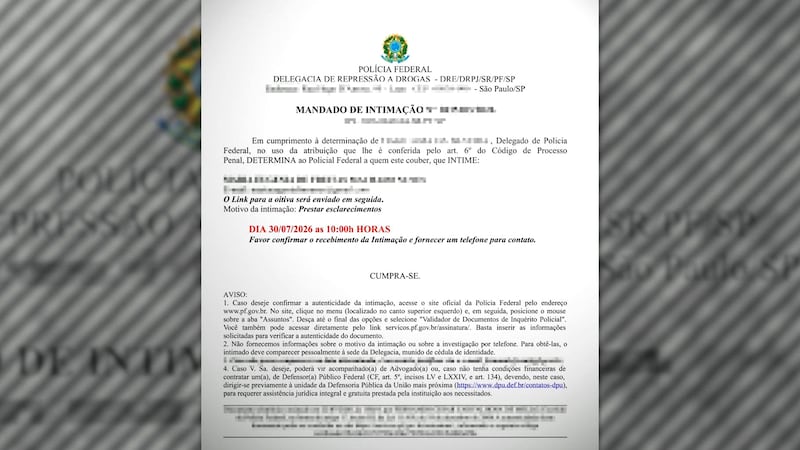
She left the CBSA interview thinking the ordeal was over. But the next month, the Brazilian Federal Police got in touch.
They wanted her to attend an online interview. And they weren’t asking.
“The Canadian authorities, they said, ‘You don’t have to go. It would be nice if you come,’” Maria said. “In Brazil it was different. They said, ‘No, you have to.’”
The Brazilian officer told her she was the subject of an international drug trafficking investigation.
He also finally told her what exactly was in the suitcase with her bag tag on it: 15 kilograms of hashish.
The officer showed her pictures of two bags and gave her a name, and asked her repeatedly if she knew that person.
“I’m guessing this happened with two people on the same flight and they were trying to see if I had any connections with this other person,” she said.
‘I feel like I’m not safe’
Maria said she hasn’t heard anything from Brazil since her interview this summer, and is hoping no news is good news. But without a resolution, she said the stress is still weighing on her.
She said she’s been on high alert at airports since then, constantly scanning her luggage and surroundings.
“Every time I’m travelling right now I feel like I’m not safe,” she said, fearing that something “crazy” could happen at any time.
Maria said she knows it could have been much worse. Canadians have been jailed abroad — some trapped for more than a year.
“It’s funny to think that I was the lucky one, because I was not lucky,” she said. “But at the end of the day, I was kind of lucky.”
Still, she said, “I’m never going to check in a bag.”
Maria said she has since received her permanent residency.
A spokesperson for Air Canada previously told W5 that the airline takes security seriously, but noted that luggage moves through “a complex network of infrastructure operated and overseen by various third parties, from check-in to delivery.”
Who is liable for bags that are tampered with comes down to “circumstances and applicable law, including an assessment of the role of each party,” the airline added.

