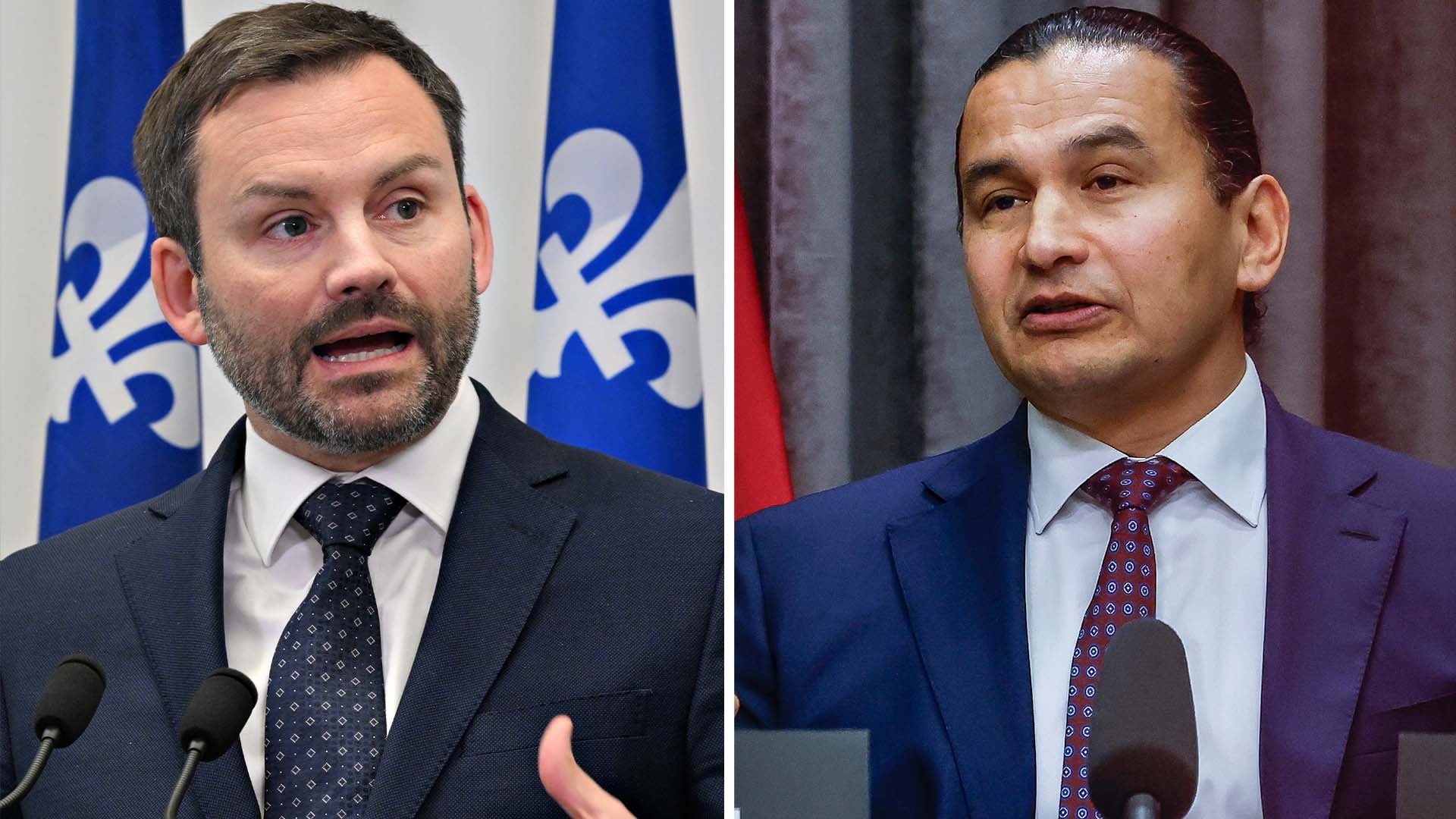
Quebec Premier Paul St-Pierre Plamondon condemned comments made by Manitoba Premier Wab Kinew about the Supreme Court of Canada’s ruling on Bill 21 and called on him to retract his remarks.
“I strongly condemn the Manitoba premier’s remarks describing Law 21 as “legislative racism,” St-Pierre Plamondon wrote on social media Saturday.
“Not only does the Supreme Court uphold the validity of Quebec’s secularism, it affirms the legitimacy of our distinct approach to this issue: “Law 21 is part of Quebec’s legitimate and longstanding commitment to ensuring the secularism of the state in a free and democratic society.”
“Mr. Kinew should be ashamed of his disrespectful and intolerant remarks about Quebec. I call on him to retract them.”
‘Legislative racism’
The Supreme Court upheld Quebec’s Bill 21 on Friday.
The law was adopted in 2019 by the previous Coalition Avenir Quebec (CAQ) government and aims to separate the state from religion by restricting certain public sector employees like judges, police officers and teachers from wearing religious symbols while on the job.
Kinew told reporters Friday that Quebec’s Bill 21 was designed to discriminate primarily against Muslims, but also Sikhs and other religious minorities.
“The Canada that I want to live in should have an RCMP officer free to wear a turban, should have a school teacher if she chooses to wear a hijab to be able to do so (...) and yes, your premier should be able to have long hair. These are all cultural symbols that would be banned by Bill 21, which I think is legislative racism,” he said.
Quebec invokes notwithstanding clause
Quebec invoked the notwithstanding clause pre-emptively to shield Bill 21 from certain Charter challenges.
The notwithstanding clause, also known as Section 33 of the Canadian Charter of Rights and Freedoms, allows provincial legislatures or Parliament to override certain Charter protections for up to five years.
Kinew’s government, which intervened in the case, argued that judges should still be able to assess whether a law violates Charter rights, even when the notwithstanding clause is invoked.
The court was divided over whether to declare that Quebec’s secularism law violated Charter rights.
However, four of the seven judges agreed that Canadian courts can still issue declarations even when a government invokes the notwithstanding clause.
The declaration would not strike down a law but would be a finding that the law would violate Charter rights.
“This is a bittersweet day for Manitobans within Confederation,” Kinew said. “It’s bittersweet on the negative side, because Bill 21, which is legislated discrimination, is allowed to stand.”
“We won on the intervention that we made,” Kinew added.
Win for Quebec secularism
On Friday, Parti Québécois leader St-Pierre Plamondon called the Supreme Court’s ruling a victory for Quebec secularism but raised concerns about its implications for provincial autonomy.
“Secularism won, but we have just witnessed a setback for the provinces,” he said in a news conference in Quebec City.
He said the court’s decision to allow non-binding declaratory judgments “weakens” the notwithstanding clause and could lead to courts issuing “hypothetical judgments.”
“This is not a victory for provincial autonomy,” he said.
St-Pierre Plamondon argued that Quebec is now facing “chronic instability” over the application of its laws, which he said justifies sovereignty.
He described the court’s decision as a “unilateral change” to the rules of the 1982 Constitution, noting that Quebec never signed the constitutional agreement. He also criticized Ottawa’s decision to intervene in the case.
He plans to raise the issue with other premiers at a meeting in Toronto on Dec. 7 and 8.

