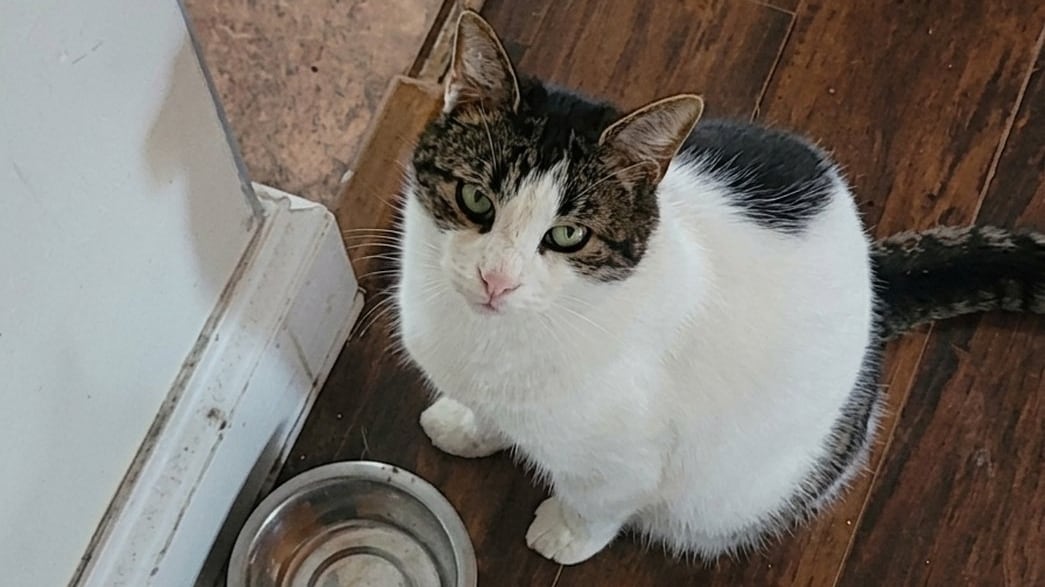
HALIFAX — A Nova Scotia woman whose cat disappeared two months ago says she was surprised when a trucker in New Brunswick recently texted her to say he had found her cherished pet.
Melanie Morrissey says she was initially skeptical about the man’s claim, saying her suspicions were aroused when he immediately asked for $150 before making any arrangements to return Arthur the cat to his home.
“I immediately thought, ‘OK, this is a scam,’” Morrissey said in an interview from her home in Murray Siding, N.S., north of Halifax.
When she asked where Arthur had been found, the man didn’t answer. But when Morrissey asked for a photo of the mostly white tabby, an image of what appeared to be Arthur suddenly appeared.
“All logic went out the window,” she said. “It really looked like Arthur on somebody’s deck …. You know, when that logical part is suspended, you’re given hope again. You really want it to be true.”
Still, Morrissey knew something was wrong.
Recalling that she had posted photos of Arthur on social media sites devoted to reuniting people with their lost pets, Morrissey wondered if one of those images had been altered by generative artificial intelligence to produce the picture she was looking at.
“I’m an art teacher,” she said. “AI is always at the back of my mind … It really is something people have to be hyper aware of.”
After consulting a few friends, Morrissey asked the trucker to send a video showing Arthur, along with some evidence of when the video was recorded.
“And that’s when his sense of urgency stepped up and he got mad,” she said, adding that the man said he shouldn’t have to provide endless amounts of proof. Again, he asked for the money, suggesting that if he wasn’t paid, Morrissey would never see Arthur again.
“I knew then that it couldn’t be real. Nobody would react like that. I texted him to say, ‘We both know you don’t have my cat.’” There was no response.
According to the Canadian Anti-Fraud Centre, many frauds are based on requests for fees in advance of receiving goods or services. And the centre advises that anyone facing high-pressure tactics should always be suspicious of urgent pleas that play on their emotions.
In one case reported from British Columbia, a man who had lost his dog was persuaded by a scammer to send money to buy a cage to keep the animal safe while they worked out details of the transfer.
Scams involving lost pets are nothing new. Typically, the scammer claims to have found the animal and asks for money to ensure a safe and speedy return home. But there is almost always some urgency involved, a pressure tactic to ensure the vulnerable victim complies.
As for Morrissey, she said there was no point in wondering why someone would be so cruel. Instead, she said it was more important to ask what would make them so desperate.
“I feel sorry for them,” she said. “I’m a very trusting person by nature, but I’ve had family members who have been scammed over the phone …. I feel terrible because I know it’s going to happen again and someone is going to pay.”
Meanwhile, Morrissey said she and her family will continue their search for eight-year-old Arthur.
“He is a big baby and he is so friendly,” she said. “We thought maybe he was just hanging out at other people’s houses for a while …. I don’t think he’s ever had a mood other than just chill.”
And even though Arthur would occasionally spend time sunning himself outside, he wasn’t keen on wandering off.
“He’s really afraid of his own shadow. So when he does go outdoors … he’ll just watch (the birds) from a distance and that’s as far as he goes.”
This report by The Canadian Press was first published Nov. 28, 2026.
Michael MacDonald, The Canadian Press

