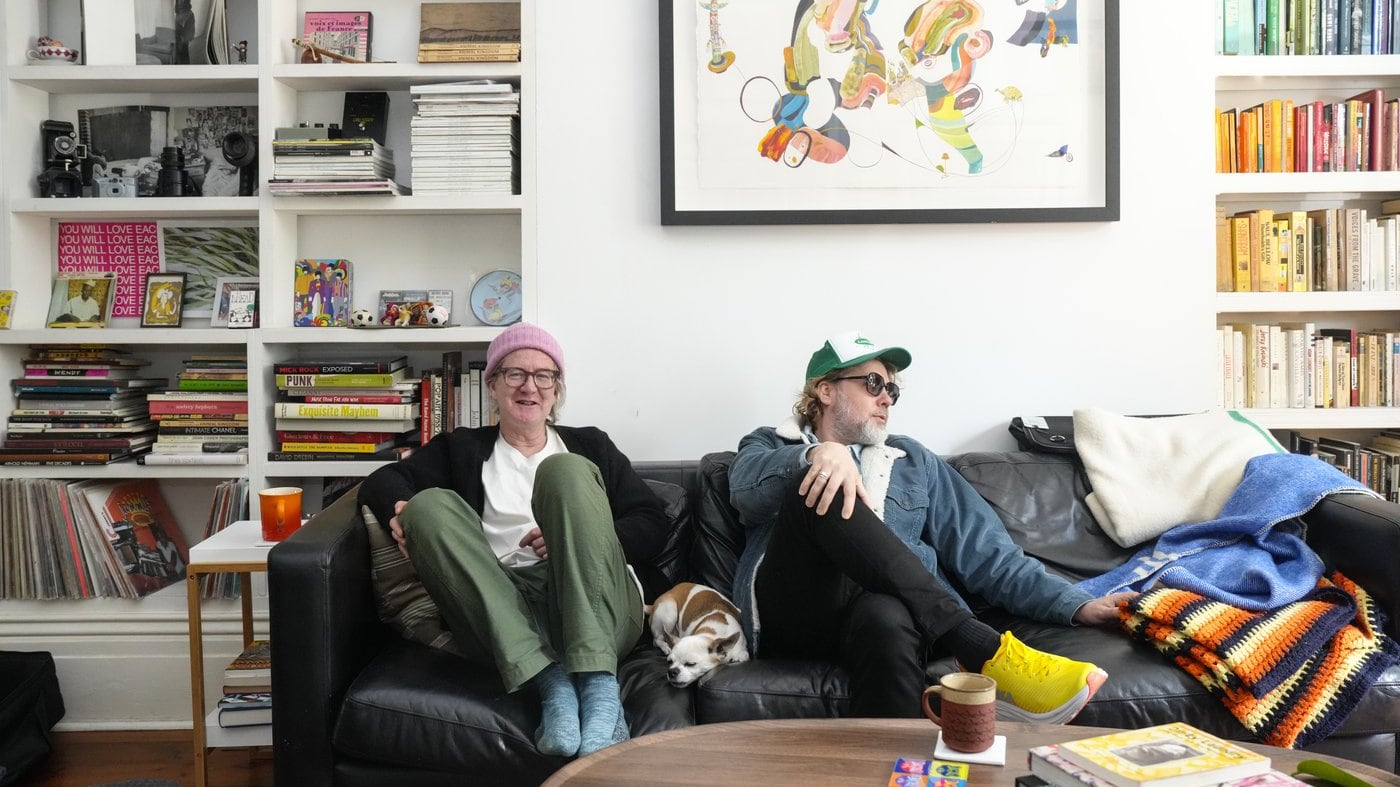
TORONTO — More than two decades after Broken Social Scene founders Kevin Drew and Brendan Canning started making music together in a Toronto basement — eventually mutating their two-man project into an unwieldy, ever-shifting indie rock collective — the band is still intact.
Kind of.
“I think parts of us are broken now,” de facto frontman Drew says.
“And I think parts of our relationship are broken, but not the parts that would stop us from continuing.”
The Canadian band’s sixth studio album, “Remember the Humans,” arrives Friday, more than a quarter-century after its debut “Feel Good Lost” — a period marked by rotating lineups, long gaps between releases and a career that’s left a wide imprint on indie rock, even as the years begin to show.
“Brendan and I were two different people in that basement — with the same spirit and the same musical motivation — but that was 26 years ago,” Drew says.
“You gain a lot, and you lose a lot as you continue in life.”
At the kitchen table in Canning’s west-end Toronto home, the band’s history hangs in the air with equal parts affection, fatigue and muscle memory.
“You’re not a gang anymore, but when you’re back, you’re still that gang, whether you like it or not,” Canning says, drawing a knowing laugh from Drew.
At times boasting more than 20 members, Broken Social Scene is sometimes described as indie rock’s Wu-Tang Clan, its sprawling, fluid cast functioning like a shared creative hive — one that helped spin off acts like Stars, Metric and Feist, who’ve all built global followings. Over time, as their individual careers expanded outward, the swarm became harder to draw back in.
“We were never too far off a breakup,” says Drew, noting people around the band assumed its egos and logistics would eventually implode.
It’s been nine years since their last album, 2017’s “Hug of Thunder,” and “Remember the Humans” began, says Drew, out of a simple desire to keep going.
“We’re at a point where our identities aren’t so wrapped up in our work anymore. We just want to keep working, we want to be a band and we want to create honest and truthful music.”
Emerging from the pandemic, the collective set up a studio in Warkworth, Ont., and slipped back into old rhythms — albeit with more need for personal space.
“By day three, it’s like, ‘Oh my God, what have I done?’ And you can see he wants everyone together,” Canning says, gesturing to Drew, who lets out a cackle.
“But it’s like, ‘OK, I don’t want that much of you.’ But it’s too late — you’ve got everyone. And then, the next thing you know, you go on this... three-year journey.”
Feist returns, but Emily Haines and Amy Millan’s song left off
The band will hit the road this summer with Metric and Stars — the first time the three acts have shared a bill in 25 years.
“If everybody keeps their emotional maturity intact, it’s going to be a love fest,” says Drew.
He adds Metric’s Emily Haines and Stars’ Amy Millan even recorded a track for the new album, but it didn’t make the final cut: “It just didn’t fit in with all the other wonderful songs we had.”
A searching, unresolved Leslie Feist, however, anchors the soft-focus melancholy of “What Happens Now.”
“I feel very grateful she reached out and said, ‘Let’s keep this friendship train going,’” says Drew.
Still, as Drew and Canning compare notes on prescriptions and various aches, the ride feels different now.
“The amount of tequila that’s gonna get drunk on this tour is way less than what it used to be,” says Canning. “I can’t bounce back from booze like the good old days, when Kevin would lay down the credit card after our Henry Fonda Theatre gig in L.A. and we’d take over an entire bar.”
“As you get older, and you lose friends and you lose family,” adds Drew, “you hold on to those memories more than you could ever have expected.”
‘We’re a QR code as a species now’
The new record reunites Broken Social Scene with producer David Newfeld, who shepherded their 2002 breakthrough “You Forgot It in People” and its self-titled 2005 followup. Both he and Drew had recently lost their mothers, bringing a shared sense of grief into the sessions.
The familiar heart-swelling, tangled, communal chaos is there — in the brass-soaked crescendo of “Paying For Your Love” or the campfire glow of “Only the Good I Keep,” led by Vancouver’s Hannah Georgas.
But a deeper sense of absence runs through the LP; the slow-building ache of opener “Not Around Anymore” hears Drew lament a world where “it’s all gone away.”
That feeling extends beyond personal sorrow.
“(It’s about) the loss of ourselves, really,” says Drew.
“Us, as a connection, as a community. We’ve let it all go. We’re a QR code as a species now.”
He’s also mourning a city that no longer resembles the Toronto the band came up in.
“Even in this neighborhood of Brendan’s, how much it’s drastically changed into the idea of skyscrapers and condos and the things people can’t even really afford,” he says.
“We priced out our hearts and our families for what? And we live in a time where the word ‘influencer’ is a cancer to art.”
But ever the idealist, Drew believes a turnaround is coming — something rooted not in platforms, but in people.
“I’m so grateful to be in a band with a group of people, because it’s not about one individual. It’s about a group of friends who are still here and alive, trying to remind people about friendship,” he says.
“Friendship is one of the greatest protests we have right now.”
This report by The Canadian Press was first published May 8, 2026.
Alex Nino Gheciu, The Canadian Press

