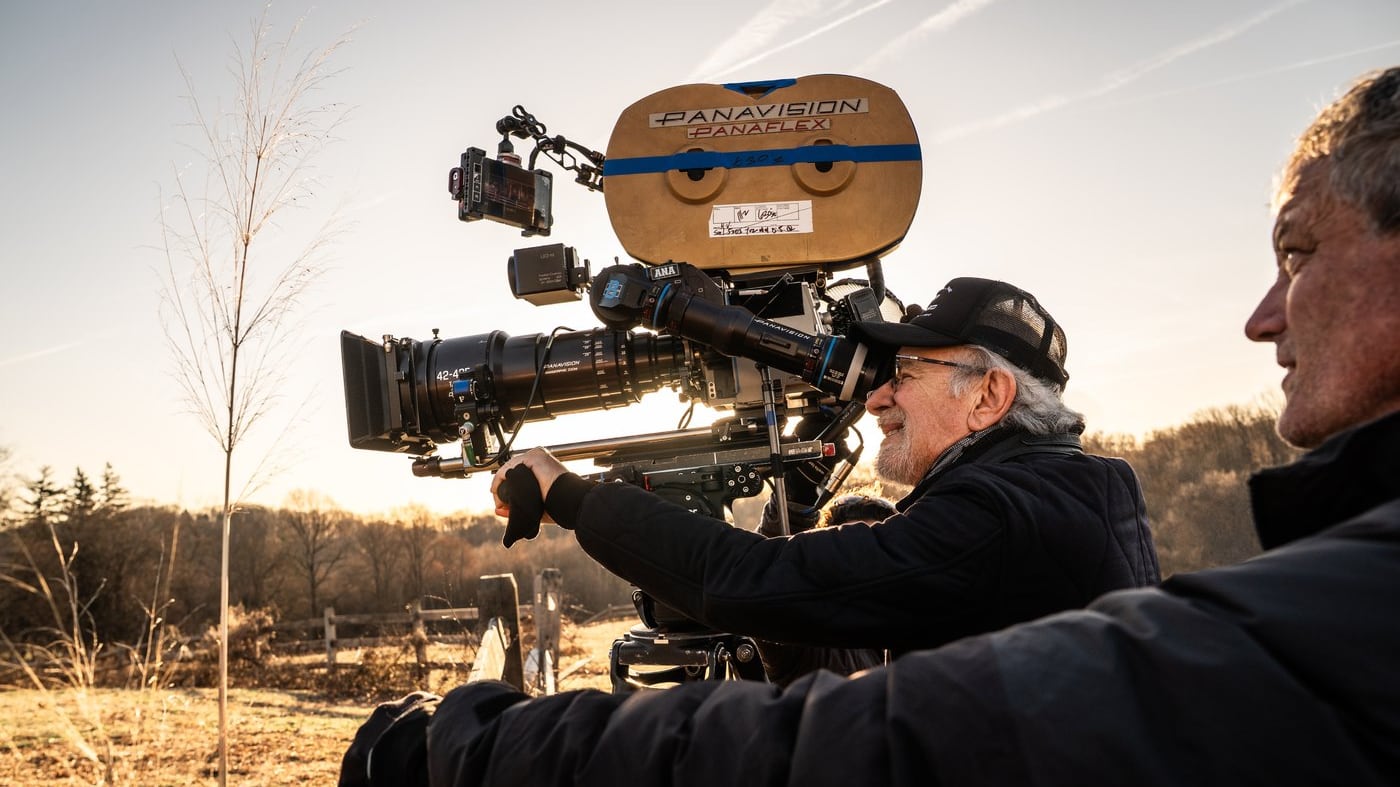
NEW YORK — A moment early on in “Disclosure Day” will instinctively feel familiar to anyone who grew up with Steven Spielberg films. A TV weather report predicts hail. The camera pans downward, from television set to kitchen table. Plinking sounds begin. Cereal falls into a bowl.
“Those were Froot Loops,” Spielberg says, smiling. “My favourite.”
Spielberg’s latest, like some of his earliest and most beloved films, again concerns what might fall from above. “Disclosure Day,” which Universal Pictures releases June 11, returns Hollywood’s preeminent big-screen craftsman to one of his most abiding questions: Are we alone?
Coming nearly half a century after “Close Encounters of the Third Kind,” “Disclosure Day” is a grand bookend for one of the most cosmically-minded moviemakers of our time, whose dreams of extraterrestrial life have shaped all of ours. It’s a distant answer to the final notes of “Close Encounters.” But while Spielberg grants his 1977 film was “speculative,” “Disclosure Day,” he insists, is the real deal.
“It’s my first film that will be considered science fiction that I do not consider to be science fiction,” Spielberg said in a recent interview. “It’s much more reflective of the world as it is evolving and discoveries that are being made as we speak.”
Spielberg, at 79, is trying to revive and reconsider the alien wonder that’s long lingered in his mind, from “E.T.” to “War of the Worlds.” “Disclosure Day,” Spielberg’s first summer movie in a decade, is already being hailed as one of his best in years. But this time, Spielberg is testing whether he can conjure some of his trademark movie magic less with imagination than with conviction.
“I’ve been a believer since I made ‘Close Encounters’ 50 years ago,” Spielberg says. “But I would always say: Until I’ve seen a UAP or a UFO with my own eyes, I’m not going to categorically state that life from out there has come here.
“But I’ve changed that,” he adds. “I’m now willing to change my mind because of the circumstantial evidence which is overwhelming.”
Aliens again, but different
“Disclosure Day” stars Josh O’Connor as a cybersecurity whistleblower with government evidence, long suppressed, chronicling a history of alien encounters. Guiding him in his escape from a corporate executive (Colin Firth) trying to keep it all under wraps is the disclosure movement’s leader (Colman Domingo). Meanwhile, a meteorologist named Margaret Fairchild (Emily Blunt) begins having a mysterious epiphany.
When he first began thinking about the movie, Spielberg called up the screenwriter David Koepp, a longtime collaborator who wrote “Jurassic Park” and “War of the Worlds.”
“I said, ‘Sure, what’s it about?’” recalls Koepp. “And he said, ‘Oh, you know, aliens again. But different this time.’”
Spielberg was coming off an unusually long break by his breakneck standards. His 2022 film “The Fabelmans” pulled from his own childhood, dramatizing his parents’ painful divorce and his own origins as a filmmaker. Spielberg’s first gut-wrenchingly autobiographical movie left him unsure of what was next.
“It was the hardest question I ever had to ask myself because there was such completion in resolving so many personal issues that I had never aired in public before ‘The Fabelmans,’” Spielberg says.
“I didn’t care whether people thought ‘The Fabelmans’ was just a tale, a yarn, or if they cared that it was all true. I didn’t care about that. It was something I did for myself. I always used to say it was $40 million of therapy that I didn’t have to pay for. Universal did,” he says, laughing.
But Spielberg, having long followed reports of alleged alien encounters, was inspired by the 2023 House Subcommittee on National Security hearing on UAPs: Unidentified Anomalous Phenomena. Among the witnesses was whistleblower and former Air Force intelligence officer David Grusch, who testified that the government concealed a program investigating UAPs.
The Pentagon then denied it. Yet in April, President Donald Trump said the Pentagon is preparing to release some “very interesting” UFO files.
Those 2023 testimonies and others so fueled Spielberg that he produced a 50-page treatment on what would become “Disclosure Day.” During the writing process with Koepp, he texted him more notes, he says, “than I’ve ever sent to anyone in my life.”
“There was a period in there where I believe he re-read the script every single day for a year,” Koepp says. “We’d be in different time zones and I would wake up to 30 or 35 texts from his most current reading of the script. When the leader of the project has that level of commitment, it tends to bring along everyone. You up your game.”
Extraterrestrial empathy
Spielberg has long considered his filmography split in two, between the filmmaker who made “Jaws” and “E.T.” and “Raiders of the Lost Ark,” and the one who, after 1985’s “The Color Purple,” was increasingly drawn to darker and more serious material with films like “Schindler’s List,” “Saving Private Ryan” and “Munich.”
“Disclosure Day” is a kind of bridge between both modes of Spielberg — a thrilling chase movie filled with wonderment that’s nevertheless grounded in reality and recent history. And its most ardent message is quite earthbound. Blunt’s character’s clarity comes from looking people in the eye. As much as it’s about aliens, “Disclosure Day” is about empathy.
“I think every movie should have a great emphasis on empathy because empathy sometimes feels like it’s in short supply,” Spielberg says. “We have it, sometimes we can’t use it. Sometimes it’s not allowed to be used if you want to stay aligned with your friends and your belief systems. But I think empathy is there for all of us.”
“Disclosure Day” opens in a much different movie world than Spielberg’s earlier alien adventures. It’s one of few big, original studio movies this summer — a moviegoing season that the “Jaws” filmmaker pioneered. But neither franchise domination, AI nor streaming make Spielberg fret for the future of movies.
“The audience gives me faith in the movies,” says Spielberg. ”Even though the numbers are still not pre-COVID level numbers for any films being released now, it’s more robust than it has been for many years. The audience gives me belief that people still want to congregate in a dark space in the company of strangers to share an experience of a film made by storytellers. And that gives me faith to continue making films.”
Spielberg will turn 80 this December. Around the same age, Martin Scorsese began to frankly ponder how many movies he had left. Spielberg doesn’t think the same way.
“I never think about how many more I have,” he says. “I’m just hopeful that I will be inspired when something comes along, as I was with ‘Disclosure Day,’ as I was with ‘Fabelmans,’ as I was with ‘West Side Story.’”
More inspiration is already on the way. Spielberg hopes that his next movie will be a Western. Despite his deep fondness for the genre and an indelible encounter with John Ford, it’s one genre that’s eluded him.
“I always feel like parts of the ‘Raiders’ adventure movies are like Westerns,” he says. “Whenever Harrison (Ford) was on a horse, it made me wistful for wanting to direct a full Western, a real Western.”
Margaret Fairchild in “Disclosure Day” has some echoes with another Spielberg protagonist: Richard Dreyfuss’ Roy Neary in “Close Encounters.” Both are compelled by a strange force beyond their control. It’s a character type that Spielberg, a compulsive movie maker, grants he connects with. “Disclosure Day” is his 35th feature film.
“I identify with characters who aren’t afraid of mysterious things happening to them,” Spielberg says, “and who are fighting for their survival by trying to discover what they don’t know.”
Jake Coyle, The Associated Press

