
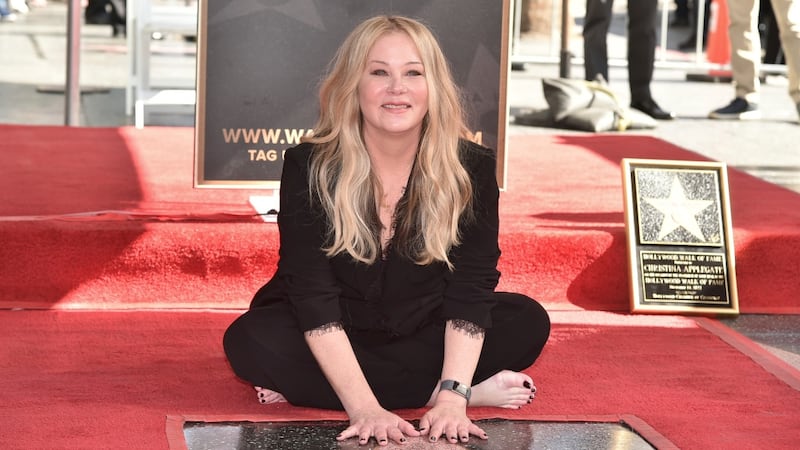
NEW YORK — Christina Applegate, who has candidly shared raw details about her journey with multiple sclerosis for years, revealed Monday her doctor says she doesn’t have the autoimmune disease and was misdiagnosed.
“I’m back at square one where I don’t know what’s going on with me,” the actor said on the latest edition of her podcast “MeSsy,” along with co-host Jamie-Lynn Sigler, who has been public about her own battle with MS.
Applegate first publicly announced in 2021 that she had been diagnosed with the disorder that causes the immune system to attack the cells in the central nervous system.
On Monday’s podcast, Applegate revealed that despite the misdiagnosis, she still has “every symptom of someone with MS,” adding, “I still have to use wheelchairs when I go to the doctor’s office. I can’t walk from the car to the room.”
There is no single test for MS, and a diagnosis usually involves ruling out other causes. It can take years and seeing multiple doctors before one puts the clues together.
Dr. Benjamin Greenberg, a neurologist who specializes in multiple sclerosis and autoimmune neurological disorders at the UT Southwestern Medical Center in Dallas, said the most reputable studies put the MS misdiagnosis rate at 10%.
“We rely on the clinical symptoms, the history, the MRI, often spinal fluid, and then a series of tests to rule out potential mimics. And unfortunately, those tests are not universally codified,” he said.
Greenberg said Applegate’s experience has lessons for both medical providers and patients. For doctors, it’s a reminder to ensure a single diagnosis doesn’t lead to a system-wide bias toward that conclusion.
“If I put `multiple sclerosis’ as a diagnosis on an MRI, a radiologist is far less likely to say, `Well, this isn’t multiple sclerosis. You really should consider something else.’ It can permeate the system,” he said.
“For patients and families, my general recommendation is whenever receiving a significant serious or chronic diagnosis, if feasible, there is never a harm in getting second opinions.”
Applegate said the news had put her in an odd place since she and Sigler have become prominent advocates for people with MS.
“It’s weird because I feel like I let everybody down,” she said. “It’s very unnerving, and it’s really confusing for me.”
Most autoimmune diseases, especially in adults, aren’t caused by a specific gene defect. Instead, a variety of genes that affect immune functions can make people susceptible. Scientists say it then takes an “environmental” trigger, such as an infection, smoking or pollutants, to set the disease in motion.
On the podcast and earlier this year while promoting her memoir, “You with the Sad Eyes,” the Emmy-winning Applegate has been candid about unpredictable symptoms that have forced her to use diapers and scoot down stairs on her butt.
“My life has in some ways shrunk to the size of my California king,” she writes in her book.
Mark Kennedy, The Associated Press

