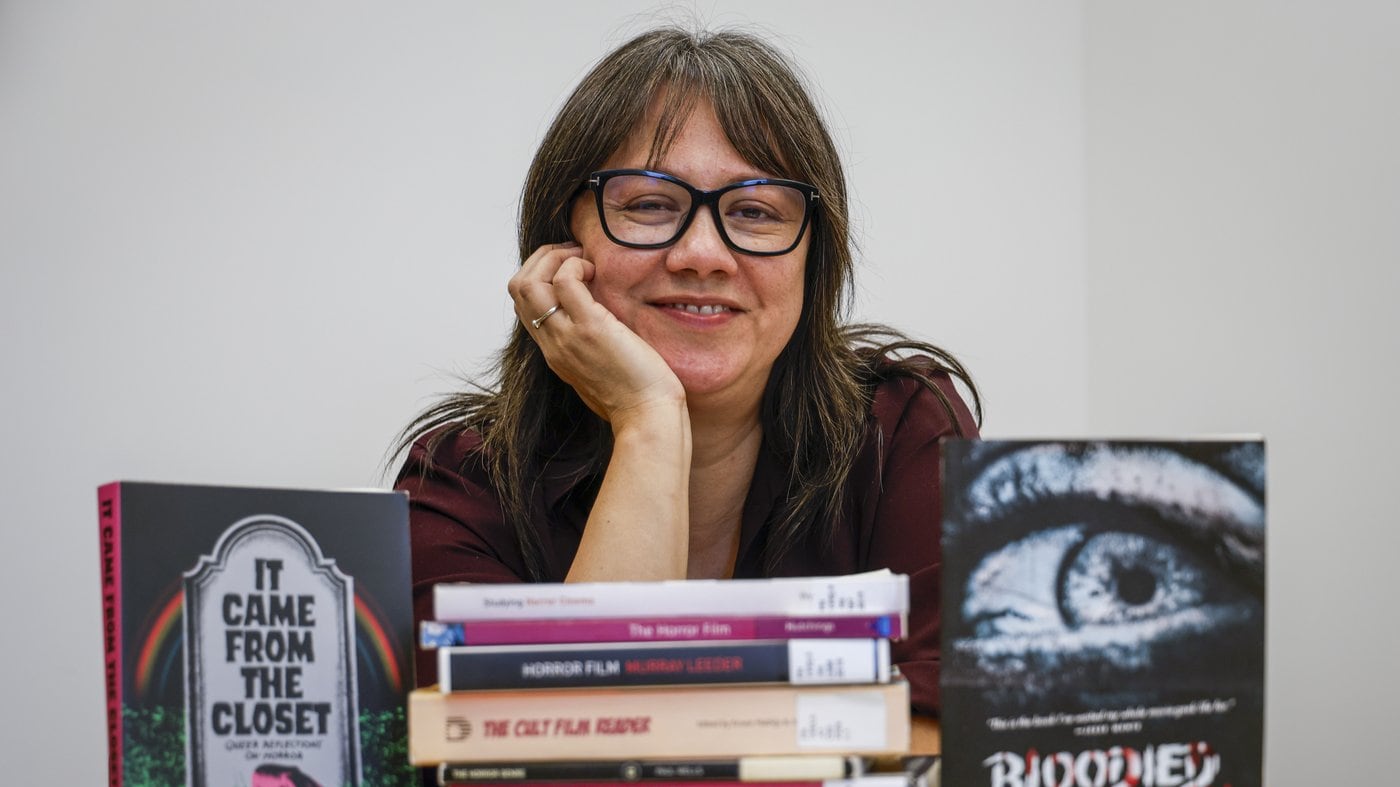
CALGARY — On a chilly pre-Halloween morning this week, Rane Gusdal watches the climactic last moments of her short film with her fellow university students: a video of her entrails being torn out of her stomach.
The blood and guts are a crimson mix of bread, Nutella and jam. She screams and flails on screen. She’s hoping they don’t laugh.
“I hope people felt grossed out and scared,” said the 19-year-old film major.
“I was trying to be dead, you know?”
Gusdal’s group is one of several that submit short films for Julia Chan’s course at the University of Calgary on the horror film genre, a style of film that peaks amid the supernatural spirit of Halloween.
As part of their skit, one group member had their drink spiked, turning them into a flesh-hungry monster with white-glossed eyes. They ravaged the group in a dim, concrete-walled hallway.
Gusdal said someone having their drink spiked at a nightclub began as a way to create the monster. As the project progressed, it held a much deeper meaning about the realistic threat of clubgoers being unknowingly drugged.
Over the length of the course, the class discusses how horror stories do more than scare us; they tell us about ourselves, our flaws, our culture, and how to confront our biggest fears.
“Maybe (horror films speak) to the fact that we need some kind of outlet to talk about what we’re afraid of,” said Chan, an assistant arts and film professor.
Chan referenced one scholar, Jeffrey Jerome Cohen, who says that monsters can show people about their culture, what people are afraid of and what their borders are: zombies are metaphors for pandemic and virus fears or something we don’t understand, Frankenstein about unchecked science, and digital and online threats reflect techno-fears.
“The monster itself tells us more about us than it does about the monster,” said Chan.
Her favourite horror film is “The Haunting” from 1963, a black-and-white ghost story about researchers studying the supernatural activity of a haunted mansion.
Between the camera work and the environment, it creates a frightening space, she said.
Earlier in the week, the class watched “Halloween,” the classic 1978 slasher film about the knife-wielding serial killer Michael Myers, to preempt its spooky holiday namesake on Oct. 31.
Horror movies and their supernatural or terrifying elements have become a staple Hollywood tradition for Halloween, which has a storied history drawing from folklore, the ancient Celtic festival Samhain and the Christian festival of All Saints’ Day.
Halloween evening is also believed to be the night that the veil between the living and the dead is thinnest. Pumpkins and costumes have also found their way into the celebration as a way to keep evil spirits at bay.
Every Halloween, Noah Kennedy watches “Scream,” the 1996 slasher movie featuring the iconically masked Ghostface. It sets the tone of the holiday. He first watched it when he was in his early teens.
But, while slashers, monsters and the occult ruled the late 1990s, it’s the psychological and uncanny horrors that toy with the mind that now intrigue 20-year-old Kennedy.
“You turn on a horror movie because you want to get scared, right?”
“It’s the same thing with a lot of films: it’s just feeling those emotions and it feels like really alive.”
Student Shannon Mascarin said she has grown up watching horror movies.
When asked which horror movie was her favourite, she responded, “Which sub-genre?”
She called herself a “latchkey kid,” home alone after school and falling in love with the ghouls.
“Somehow you just fall into those movies. They just find you,” she said.
And, because of that, she’s an avid fan of every Oct. 31.
“I get to wear a costume and I get free candy and all the horror movies are on TV,” she said.
“It’s better than Christmas.”
This report by The Canadian Press was first published Oct. 30, 2026.
Dayne Patterson, The Canadian Press

