Anyone who still has some old Canadian pennies might want to hold onto them for a little bit longer.
The last penny that will be minted in the United States was created on Wednesday, marking the end of a 238-year history.
In February, U.S. President Donald Trump announced he had instructed the Mint to stop making the coins due to the cost of production.
Canadians bid goodbye to our version of the penny more than a decade ago.
“It was kind of obsolete a long time ago,” Todd Sandham, owner of Colonial Acres Coins in Kitchener, Ont., said. “Canada stopped [producing pennies] in 2012, so it makes sense that [the U.S.] finally decided to stop.”
Canadian pennies were withdrawn from circulation in 2013, one year after production ground to a halt.
“I can’t believe that [the U.S.] was still making pennies in the last 20 years or so,” Sandham said. “Everybody seems to have to round up or they’re like, ‘Oh, I owe you $0.02. I don’t even want it. Just keep it.’”
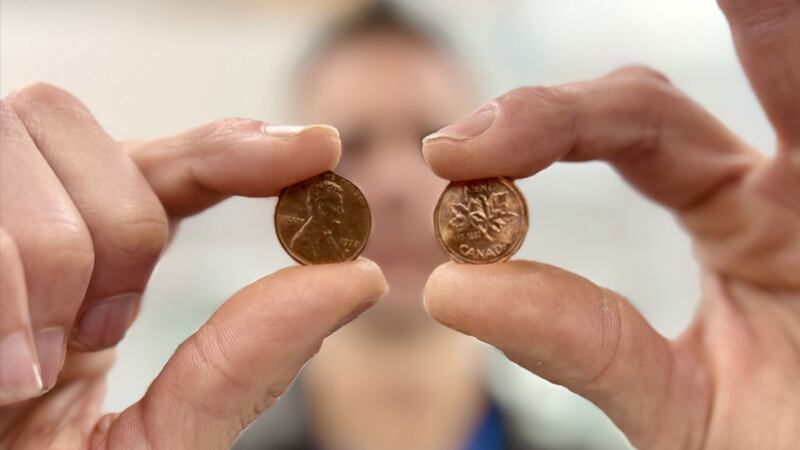
Rolls of Canadian pennies are still accepted at most banks, but Sanham said you might want to check the dates on them before handing them over. Pennies made before 1997 were mostly made of copper instead of the zinc and steel core that later became standard.
“Copper keeps climbing in price. A penny actually melts for about $0.03 now. I buy them for $0.02 and sell them for $0.03 as just a commodity of copper value,” he explained.
However, if you find a penny from 1858, the year that the coins were first made, it could be worth even more.
“The collector value of an 1858 penny in average condition sells for about $75,” Sandham said. He urged people not to bring those coins to a bank. “You can get more from someone like me.”

Could the nickel be next on the chopping block?
“Since Canada’s currency system is the exclusive jurisdiction of the Government of Canada, the Mint is not in a position to comment on speculation concerning the future of any coin denomination,” a spokesperson for the Royal Canadian Mint said in a statement to CTV News.
Cash is still king, and that includes coins, according to the Bank of Canada. A 2024 survey found Canadians kept an average of $156 on hand, $16 more than 2023. Almost 80 per cent of Canadians also said they have no plans to go cashless.

