WESTPHAL, N.S. — When Martin Arsenault is grocery shopping and looking for a good deal, he goes to the Gateway Meat Market, a store that has become a major draw because of its cheaper food prices.
“I’ll walk into a regular grocery store, and I’ll walk back out again,” said Arsenault.
Fellow shopper Sheryl Martin said coming to this market reduces the pain she feels at more expensive stores.
“You can almost get double than some places like Sobeys,” she said.
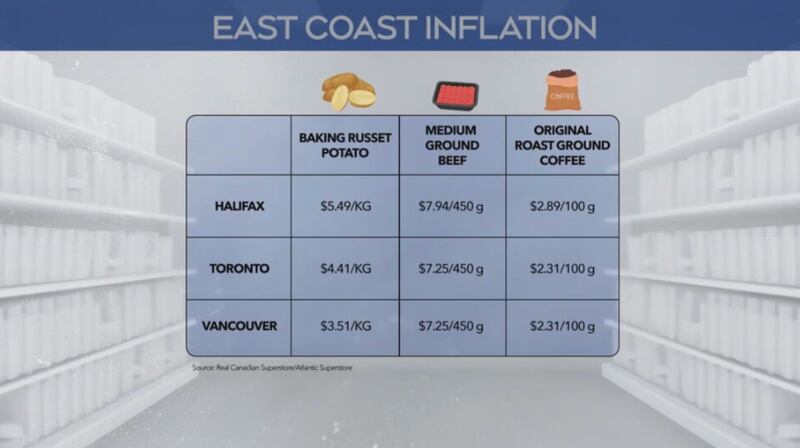
These deals come at time when food inflation in the Atlantic region is a bigger problem compared to other parts of Canada.
Nationally, food inflation jumped to 7.3 per cent, year-over-year, in January. In Nova Scotia, the food inflation rate was 9.2 per cent, and even higher at 10.1 per cent for Prince Edward Island.
“That leaves a lot of people going to food banks,” said Martin. “I’ve driven around Halifax and I have seen people at food banks, and it’s not a good situation for people who have low income.”
Retail analyst Bruce Winder said there are two main reasons for this expensive trend.
“One is the added transportation cost, because pretty much everything is trucked in and it’s more remote,” said Winder.
The second is the climate in the four Atlantic provinces, which Winder said also limits local food availability.
“You have a much shorter season to grow product,” he said.
According to Phoebe Stephens, an associate professor at Dalhousie University, groceries could become more affordable by improving the regional supply chain and increasing the volume of locally produced food.
“In Halifax, we have the food hub that is starting, and it is regionalizing and localizing food distribution,” said Stephens, who specializes in sustainable and alternative food systems.
“Hopefully, a hub like that starts to develop throughout Atlantic Canada, and that would be a great way to create more resilience within the system.”
According to people who work in the food industry, eliminating some of the interprovincial trade barriers in Canada could also help with the cost of shipping food, and make groceries more affordable across the country.
“That would be a very good thing, because we could do simply more business within our provinces,” Winder said.
However, he admitted that revamping trade barriers is no small task, which means food inflation in the Atlantic region will likely not improve anytime soon.

