


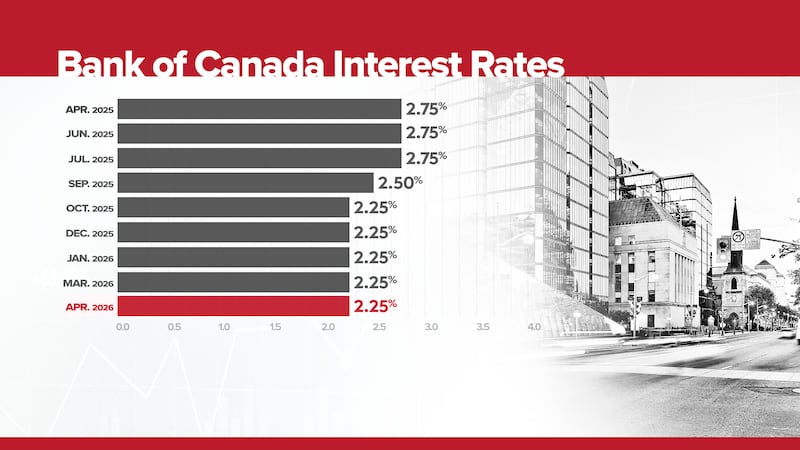
OTTAWA — The Bank of Canada is holding its key policy interest rate at 2.25 per cent for the fourth consecutive time as it warns of higher inflation for the short term.
In its first monetary policy report (MPR) since January, the central bank projects inflation will peak around three per cent in April, before declining to its two per cent target early next year.
That drop in inflation is based off an assumption that U.S. tariffs will remain at the current rate and that oil prices will drop from US$90 in the second quarter of 2026 to US$75 a barrel by mid-2027. That’s a 15-dollar-per-barrel increase since the bank’s previous MPR.
“After more than a year with inflation close to the two per cent target, higher global energy prices are pushing inflation up,” Bank of Canada Governor Tiff Macklem said in his opening remarks. “The surge in gasoline prices combined with still-elevated food price inflation is squeezing more Canadians.”
A deeper dive into the various components of the consumer price index (CPI), which measures inflation, shows that rent and food prices remain higher than average, while other components have dropped back to their historical norms.
For now, the bank says there is “little evidence” to show that oil prices are affecting the costs of goods and services more broadly. However, the country’s top central bankers acknowledge that their projections are heavily dependent on the outcome of trade negotiations with the United States and on the war in Iran. Because of slack in the economy and a soft labour market, Macklem says businesses are cautious about passing on costs to consumers and that will help slow the impact of higher oil prices throughout the economy.
“Governing council agreed to look through the war’s immediate impact on inflation but if energy prices stay high, we will not let their effects become persistent inflation,” Macklem said.
Compared its January report, the bank says its growth forecast has remained relatively unchanged. While consumer and government spending are pushing growth up, U.S. tariffs and trade uncertainty are weighing on exports and business investment pushing it down. The bank believes GDP will grow at 1.2 per cent in 2026, rising to 1.6 per cent in 2027 and 1.7 per cent in 2028.
“The conflict in the Middle East will affect the composition of growth, but the impact on overall growth is expected to be small because higher oil prices increase the value of our energy exports even as they squeeze consumers and many businesses.”
The Bank of Canada will make its next interest rate decision on June 10.
The best call for ‘today’
If oil prices come down as expected and U.S. tariffs remain unchanged, the governor suggested the bank’s current policy rate could hold. Though he did not rule out adjustments.
“Today, the best decision to maintain it. But monetary policy, the situation, could change,” Macklem said. “Monetary policy may have to be nimble.”
Macklem did highlight two clear scenarios in which the rate may need to be changed. If oil prices remain elevated and spread throughout the economy, Macklem said the bank may need to implement consecutive rate increases. On the other hand, if new U.S. tariffs or trade restrictions are introduced the Bank of Canada may have to cut rates to further support economic growth.
“Our job is to be a source of stability,” Macklem said. “What we’re saying is that we’re prepared to respond as needed and we’re giving some broad strokes as to what that could look like.”
In the short term, Deputy Governor Carolyn Rogers says higher oil prices are putting more pressure on the economy. But in the long term, the deputy governor says the bank is more concerned with the potential impact of U.S. tariffs and changes to U.S. trade policy.
“Over the longer term, the trade tensions are the bigger threat to the Canadian economy,” she said.
The impact of the measures included in Tuesday’s federal economic update were not taken into consideration in the bank’s latest monetary policy report.
What happens if oil prices remain high?
Until the war, the bank believed inflation would stay close to its two per cent target. That, however, has changed because of higher gasoline prices that are pushing up transportation and fertilizer costs.
If oil prices remain higher than expected, the government would bring in more revenue, but everyday Canadians and businesses would feel more of a pinch. The bank says that if that situation were to occur, and the conflict intensifies or proves more prolonged than anticipated, it is more likely the economy will see a so-called “pass-through” effect of higher costs into a broader set of goods and services.
In a scenario where oil remains at US$100 a barrel, the bank assumes the federal government will give half of the extra government revenue from royalites and taxes on oil companies back to Canadian households in some way to help hold up Canadian households. If those policies were to be enacted by the federal government, the bank says GDP would be pushed up slightly compared to its base-case scenario in 2027 and 2028 due to the transfer of government money to households, stronger business investment and energy exports.
In a situation where oil prices remain around US$100 a barrel, the bank expects inflation to peak at 3.1 per cent in the first quarter of 2027, instead of in the spring of 2026, and stay around the three per cent mark for a year. To bring it back down to two per cent, the bank of Canada would have to tighten monetary policy by introducing “consecutive increases” to the key policy interest rate.
“Higher interest rates significantly limit the increase to GDP and bring inflation back to the two per cent target,” the report says.
U.S. tariffs and the CUSMA review
The Bank of Canada says uncertainty is elevated in large part due to trade policy in the United States. If the U.S. imposes significant new trade restrictions, including tariffs on Canada, Macklem says a rate cut may be needed to further support economic growth.
Since tariffs were imposed by the White House, data shows that exports of steel, aluminum, lumber and motor vehicles have declined.
The industries affected by sectoral tariffs, which account for about one per cent of Canadian output and employment and roughly 15 per cent of all Canadian exports, have also seen declines in productivity, and employment.
As a result of U.S. tariffs, the bank believes potential output growth will slow in 2026 and pick up in 2027 as the economy adjusts to a new trade regime.
“Our trade relationship with the United States is fundamentally changed,” Macklem said. “Businesses are adjusting to that, and that will weigh on productivity growth.”
While the potential for growth is fairly weak in the near time, Macklem says it does pick up going forward in part due to the use of artificial intelligence.

