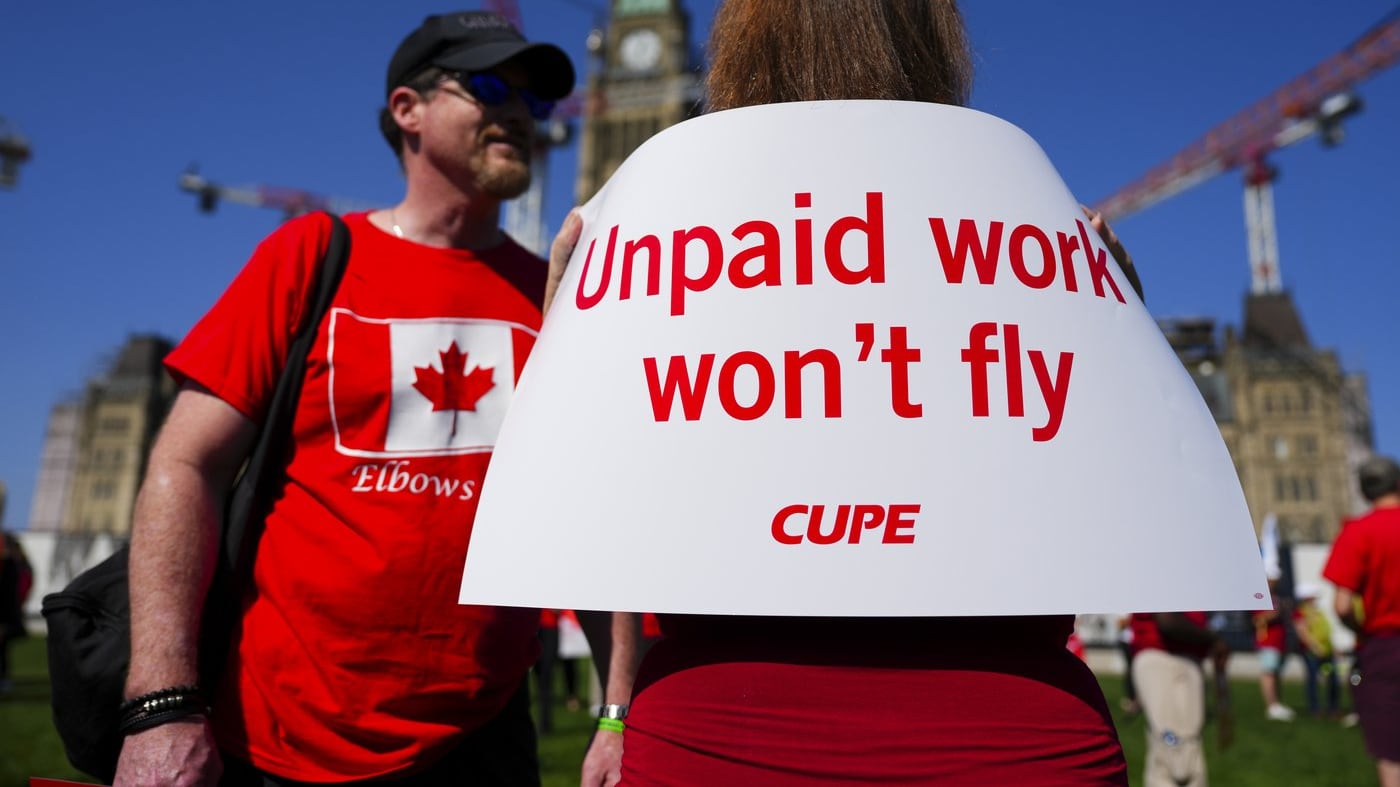
MONTREAL — Canada’s main flight attendants union is crying foul on airline submissions to the federal government for its probe into unpaid work in the sector, as questions persist around what constitutes aviation “work.”
In a letter, the head of the union’s airline division says the self-audits on wages that airlines provided to authorities this month rely on a narrow and “misleading” definition of work in order to prove that cabin crew are paid fairly.
Wesley Lesosky called on Jobs Minister Patty Hajdu to reject the submissions, claiming they fail to reveal that many junior flight attendants effectively work for less than minimum wage when activities such as boarding passengers, passing through security and conducting pre-flight checks are taken into account.
Waiting during delays and commuting between hotels and the airport also amount to time spent at the disposal of the employer, according to the Canadian Union of Public Employees, which represents 20,000 flight attendants at the country’s biggest airlines, as well as some regional ones.
“When calculating the normal hourly rate of pay, all of these hours should be included as working time,” Lesosky wrote.
Because they aren’t, the airline’s audits “overstate earnings, understate hours worked, and produce misleading conclusions” about compliance with the Canada Labour Code, the May 22 letter claims.
In Air Canada’s submission, obtained by The Canadian Press, the country’s largest airline said it found no instances where flight attendants’ hourly rate fell below minimum wage.
“Compensation structures consistently produced effective hourly rates at or above minimum wage requirements,” the summary states.
It found the effective hourly rate amounted to between $19.88 and $28.07 on Air Canada’s mainline and Rouge regional services.
Air Canada did not respond to questions Wednesday.
Under airlines’ credit-based pay structure — common across the continent — flight attendants receive income that seeks to compensate time spent both in the skies and on the ground.
“Rather than paying a lower hourly wage for every hour on duty, the credit hour system combines flight time, ground duties, delays and other required work into a single, higher rate of pay,” WestJet’s website states.
Nonetheless, a copy of the airline’s submission to the government obtained by The Canadian Press showed four instances out of 40 where flight attendants earned less than minimum wage — cases it attributed partly to shift swaps.
“These findings create a concern of minimum wage non-compliance that WestJet is committed to resolving, regardless of the underlying basis for how they came about,” WestJet’s submission reads.
Ottawa launched an investigation of the airline sector in August 2025, when negotiations between Air Canada and the union representing its cabin crew boiled over into a strike that saw planes grounded as workers took to the picket lines.
Central to that work stoppage were allegations from the union that flight attendants are regularly subjected to unpaid work when aircraft are grounded.
In response, Hajdu asked her department to look into whether workers in the sector were being paid below a standard set by the federal minimum wage.
Findings from the first phase of that probe, published in February, found little evidence that unpaid work was widespread in the industry, although investigators flagged some issues with part-time and entry-level flight attendants for a closer look.
Hajdu said at the time the federal government needed more data to fully settle the issue.
“Nobody should work for free in this country. The allegations of unpaid work in the airline industry are deeply concerning, and the government has been clear: we will get to the bottom of this,” the minister’s office said in an email Wednesday.
Unions and airlines remain free to submit additional information pertinent to the probe, it added.
National Airlines Council of Canada CEO Jeff Morrison said current practices already comply with labour laws and pay cabin crew fairly for their work.
“We welcomed the findings released by the federal government in February 2026 that there were no violations of the Canada Labour Code regarding flight attendant compensation,” he said in an emailed statement.
“Ultimately we continue to believe that compensation models are best negotiated in good faith around the bargaining table.”
However, the union pointed to its contract with Air Canada to highlight what it saw as a striking discrepancy in the carrier’s submission.
For their collective agreement, the employer and employees had agreed on a conversion formula that translates paid credit hours — ground time, pre- and post-flight work and layovers all factor in, as well as the trip itself — into hours worked for employment insurance reporting purposes.
The union argued Air Canada should apply the same formula when determining if it complies with minimum wage rules.
“Using this method, all audited junior flight attendants were paid, on average, below minimum wage during the audit,” Lesosky stated.
In an interview, he said he hopes a common understanding of what counts as work emerges from the federal probe, and called on Employment and Social Development Canada to clarify it.
“They haven’t told the airlines what the definition of work is — or they haven’t made it public,” he said of the government.
This report by The Canadian Press was first published May 27, 2026.

