Thousands more jobs could be at risk as U.S. President Donald Trump continues to escalate trade pressure on Canada, warns the United Steelworkers union.
The Canadian steel industry has already seen roughly 2,000 layoffs since the U.S. imposed a 50 per cent tariff on Canadian steel imports last year, says Meg Gingrich, assistant to the national director at the union, which represents 850,000 members across North America, including 225,000 in Canada.
“Our members are often working for industries where the employer is the largest employer in the community. Those are community-sustaining jobs,” Gingrich told BNN Bloomberg.
“It’s not just our members’ livelihoods at risk. It’s the full communities.”
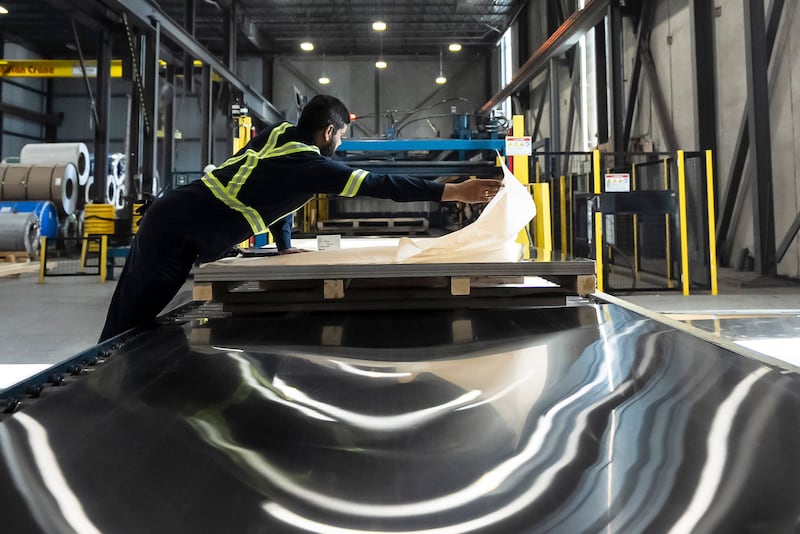
On Monday, Trump threatened to impose a 50 per cent tariff on all Canadian steel, vehicles, and auto parts starting Jan. 1, 2027. The tariffs would build on the existing tariffs already in effect that apply differently depending on the product class, as Canadian steel already faces a 50 per cent levy while non-U.S. automobiles and parts are currently subject to a 25 per cent tariff.
Gingrich says while there is still uncertainty whether Trump will follow through, the incoming tariffs would be “really destructive for the Canadian steel industry,” as the uncertainty itself is taking a toll on workers.
“It’s a psychological impact as well. As much as we have these supports and we can do domestically, it’s been really tough on our members and continues to be,” says Gingrich.
‘Canada has never been the problem’: U.S. workers
The United Steelworkers union leadership has been very vocal in opposing U.S. tariffs on Canadian steel and goods.
A month ago, the international presidents of the United Steelworkers union and the International Association of Machinists wrote a joint letter to U.S. Trade Representative Jamieson Greer calling on the Trump administration to drop its tariffs on Canadian goods.
“Canada has never been the problem,” said Roxanne Brown, international president of United Steelworkers.

“Our two nations share a deep collaboration built on decades of economic integration as well as intelligence and defense cooperation. Rather than imposing further tariffs through Section 338 or any other mechanism, we should instead work together with our Canadian allies to limit illegal trade practices and advance our shared prosperity.”
Union calls for more ‘Buy Canadian’ policies
Gingrich says the union is calling on Ottawa to take a three-pronged approach to supporting the industry, including enhanced worker support, stronger industrial policies and a broader trade strategy aimed at preventing Canadian producers from being undercut by cheaper foreign steel.
The union is also pushing for more Buy Canadian procurement policies and Gingrich says the priority should be to “keep people tied to their jobs.”
The federal government has already taken a step in that direction. On Monday, the Canadian federal government announced it is investing $11.3 billion to build six new program icebreakers for the Canadian Coast Guard.
This contract uses Canadian steel to support local workers, aiming to protect or create about 5,000 jobs.
Gingrich called the move a positive sign.
“I think there’s always more that we can do,” she says.
“We have commitments to large infrastructure projects, and we want to make sure that Canadian products, Canadian-made steel, aluminum, other products, are going into that.”
Stay strong on counter measures
The union is also calling for Canada to remain prepared to use trade counter measures against the U.S. while protecting the domestic market from unfairly traded steel.
“Historically, where we’ve seen a lot of the steel coming in, there’s just too much that’s produced in the world. A lot of it’s by China. A lot of it goes through other countries, Vietnam, Turkey,” says Gingrich.
“I could keep naming more, but the main thing is to protect the domestic industry.”
At the same time, she says Canada needs to balance those protections with its push to diversify trade beyond the U.S.
“We want to make sure that we’re not doing it in a way where we end up allowing for tariff-free access to our markets for our products that we do produce here that would then end up hurting workers in Canada.”

