Prime Minister Mark Carney is moving fast to secure new trade deals as his government attempts to make Canada less dependent on the U.S., but there’s reason to be optimistic that an agreement between Ottawa and Washington could come soon, an expert says.
“Canada has successfully concluded several free trade agreements with our Association of Southeast Asian Nations counterparts and with the Philippines at kind of a lightning speed,” Margaret Kim, international trade counsel at Gowling WLG, told BNN Bloomberg Wednesday.
“These are all part of Canada’s efforts to diversify trade away from the United States given the increasing complexity of our trade relations.”
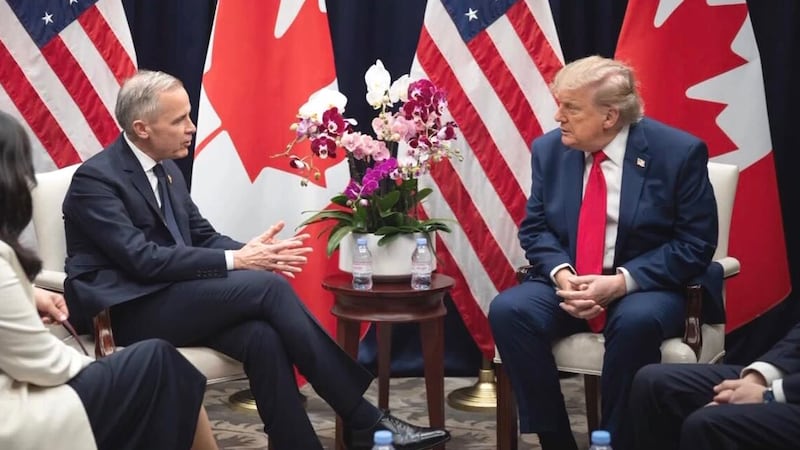
Kim’s comments came on the same day Carney met with U.S. President Donald Trump on the sidelines of the APEC summit in Shenzhen, China, where the two leaders “discussed the work underway to reach a mutually beneficial trade agreement,” according to a post-meeting readout.
While trade negotiations with the U.S. remain top of mind for Carney’s government, he’s also been focused on building Canada’s economic relationship with China, the world’s second largest economy.
Carney’s trip began with an announcement that Canada would drop some restrictions on imports of Chinese steel and aluminum in exchange for greater market access for Canadian pork, seafood and other agricultural products.
“I think overall the tariff relief is a positive development for sure, especially for those in the pork and seafood industry,” said Kim.
“We will see how this renewed sense of economic co-operation between Canada and China further develops… from a legal perspective we have to be mindful that these are provisional arrangements short of a full-fledged free trade agreement, which would give us and businesses more certainty.”
Kim said Canada and China have signalled that “this is the first of many further discussions to be had,” which will likely include talks related to the sale of Chinese electric vehicles (EVs) in Canada.
“I think in the area of EVs, certainly China is interested in bringing more China-manufactured EVs into the Canadian market,” she said.
“But from the Canadian perspective, I think prime minister Carney has clearly stated that it has to be within the terms that are acceptable within the realities of the Canada–United States–Mexico Agreement (CUSMA).”
‘Stay optimistic’
The future of CUSMA and the broader trading relationship between Canada and the U.S. remains uncertain, as the two neighbours have yet to strike a new deal that would end a monthslong trade war.
Kim said despite the diplomatic tensions and industry-specific tariffs and counter tariffs currently in place, she doesn’t see CUSMA “going anywhere,” but added that “certainly, there will be different versions of it.”
Much of the negotiations between the Carney and Trump governments have taken place behind the scenes, Kim noted, saying that the two leaders meeting face to face on Wednesday is a good sign.
“I think we have to stay optimistic,” she said, “and see how it shakes out.”
With files from CTV News’ Graham Richardson and The Canadian Press

