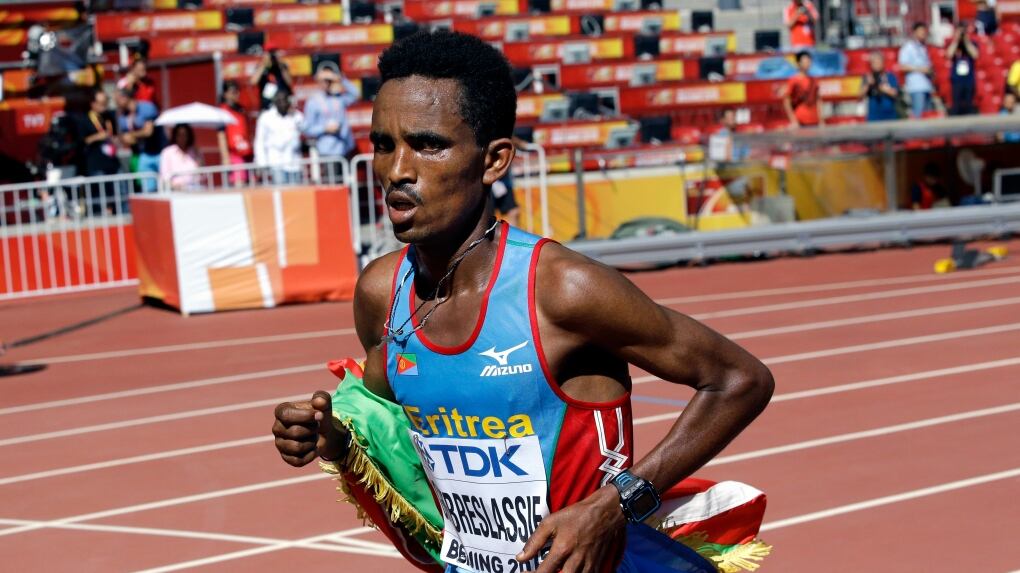
BEIJING -- Ghirmay Ghebreslassie became the youngest man to win the marathon at the world championships, using a late surge to take the title on a sweltering Saturday.
The 19-year-old Eritrean grabbed his country's flag as he entered the Bird's Nest and waved it to the cheering crowd. He finished in 2 hours, 12 minutes, 27 seconds to hold off Yemane Tsegay of Ethiopia by 40 seconds. Munyo Solomon Mutai of Uganda was third.
Defending world champion and 2012 London Olympic gold medallist Stephen Kiprotich of Uganda wound up sixth, while the favoured Kenyans struggled in the heat and humidity and didn't even make the top 20.
It was the first marathon win from Ghebreslassie, whose parents encouraged him to attend university over becoming an international runner. This turned out pretty good, too.
The race began early with the temperature already hot. It only soared from there, with the thermometer reading 28 degrees Celsius (83 degrees Fahrenheit) by the time the racers finished. The field tried to find shade whenever possible, hugging the side of the road to gain cover from the trees if only for a few steps. They also ran under coolers spraying water in the second half of the race.
A handful of runners didn't finish.
Tsepo Ramonene of Lesotho was the surprise leader at the 35-kilometre mark of the race, but he fell back to 14th by the finish. Ramonene wound up last at the London Olympics among those who finished.
The 24-year-old Ramonene didn't even have his name on his bib, just his number -- 724.
The air quality was listed as "good" by the U.S Embassy Beijing Air Quality Monitor throughout the race. Much of the concern around the marathon had to do with pollution levels.
But the local organizing committee took steps to improve air quality during the world championships by cutting down on pollution from nearby factories and limiting the amount of cars on the road in the lead-up to the competition.

