


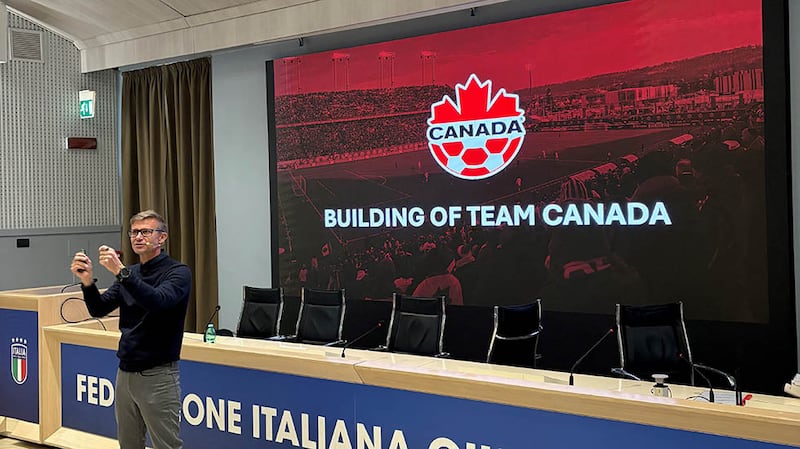
Florence, Italy — On a grey morning in late February, several hundred coaches, scouts and league executives from across Italy filed quietly into a conference room at the headquarters of the Italian Football Federation where Jesse Marsch, head coach of Canada’s men’s national team, stood ready to talk about data.
This is the language that now underpins elite sport, where data is treated as a currency and marginal gains are pursued with almost scientific obsession.
Across top clubs and national teams, players wear sleep trackers that monitor rest and recovery in granular detail. Nutritionists fine-tune supplement plans, from caffeine protocols and broccoli-based powders to baking-soda gels designed to extend performance at the edges of exhaustion.
In an effort to limit cramping, many players on Canada’s national team consume something before games and at halftime that you’d find in your fridge. (Canada’s strength and conditioning coach, Pierre Barrieu, asked to keep that secret tonic under wraps until just before the start of the World Cup because he believes it to be a competitive advantage and doesn’t want to flag it for other teams.)
Canada’s coaching staff and players have also experimented with virtual reality headsets over the past year to sharpen reaction times and decision-making under pressure. Every marginal gain is pursued and measured. Sport science has become a competitive battleground.
As many of the Italian coaches and officials pulled out notebooks and scribbled notes, Marsch explained how he and his staff pay close attention to the invisible physical toll of modern soccer, measured in speed, accelerations (bursts of pace), decelerations and changes of direction. Marsch and his coaching staff scrutinize the distance covered by players and also their intensity, calculating how much distance is performed at high speed, and how much stress it places on the body.
All of that data is collected by lightweight GPS units embedded between the shoulder blades in small vests, and the result is a measurement known as high metabolic load distance (HMLD), a metric designed to capture the true physical cost of a training session or match. HMLD has become one of the sport’s most revealing metrics and, for Marsch, one of its most urgent.
“The game is faster than ever,” he told the room. “But we haven’t always been as smart about how we measure that speed.”
At clubs and national teams around the globe, sports scientists monitor HMLD in real time. During training sessions, staff can see how close players are getting to thresholds associated with peak match performance. In matches, they can evaluate whether players are being pushed beyond sustainable limits.
For the 52-year-old Marsch, who has coached in Major League Soccer, the Austrian Bundesliga, the Premier League and now on the international stage, the technology has become central to how he builds his teams. His style, which asks players for intense pressing, rapid transitions and constant movement, is physically demanding by design. Without careful management, it can be unsustainable.
Marsch explained in Florence that when he took over midseason as head coach at Leeds United in March 2022, he had a 29-player roster, but only had six players who were healthy enough to train. At the time, Leeds had more than double the number of players with soft-tissue injuries as any other team in the Premier League.
“We had three guys out that had operations on their hamstring where the hamstring was ripped off the bone,” Marsch said. “They were each out for four months.”
The following season, Leeds had among the fewest player injuries in the league, Marsch said.
Now, as Canada’s head coach, Marsch said he feels at times like he wears a “lab coat” when he’s designing a training plan. The data offers something invaluable: a way to push players to the edge, without pushing them over it.
“Our players are traveling a lot,” Marsch explained to his audience. “When we played in [CONCACAF] Nations League last March, most of our players flew from Europe to Los Angeles… that flight feels like an eternity. They’re obviously young and athletic and they sit in business [class], but it’s a long way. So, now I really have to modify. How much do we push? Some players had games on Friday, some played on Saturday, some on Sunday. It’s a balance. I’m really using my feel and strategies to make sure we’re not exposing them to acute or chronic injuries.”
During training camps for Canada, Marsch explained that on “matchday minus three” (three days before a game) he wants his players in “high exertion” mode with “a lot of high-intensity running and high-speed running.”
“There are no coincidences when it comes to physical methodologies,” Marsch explained.
Marsch complemented his speech with dozens of slides. One was a “physical loading report” from a Canadian training session held in the U.S. on a “matchday minus three.” The slide showed that 19 players began a 94-minute training session at 10:30 a.m. in 27-degree heat.
Midfielder Stephan Eustaquio trained at 69 per-cent intensity, according to the slide, and ran 7,062 metres, including 48 metres sprinting, 484 metres running at high speed and 533 metres at high intensity. Eustaquio reached a maximum velocity of 27.7 kilometres per hour, accelerated 42 times and decelerated another 55 times. His HMLD score for the session was 1,575, the highest on the team.
But the next day, on matchday minus two, Marsch said his players’ physical and mental exertion needs to be “down, way down.”
Monitoring the physical exertion of players is only one way sports science has reshaped modern coaching.
“It’s amazing how today’s generation of players was born and raised with screens and technology and it’s all they’ve ever known,” Barrieu said in an interview with TSN. “They’re always asking questions like, ‘How much did I run and sprint?’ They understand they face the potential of injury more now because they play so many games. But they also understand technology allows us to better predict injuries, and avoid some of them, because we have so much more objective data.”
Barrieu, who coached with the U.S. national team from 2000-2011 and later at Leeds and Los Angeles FC before joining Canada, said trends in injury prevention have come and gone over the past decades.
For years, athletes tried to avoid cramps with water, bananas and concentrated broccoli juice, as well as with collagen and pungent liquids like juice from beets and sour cherries, which are both rich in antioxidants, Barrieu said.
“You get bombarded by companies offering the next new, great thing,” Barrieu said. “You don’t want to miss out on one that might be legit, so you try to check out as many as possible... there’s also a placebo effect with these things and that’s fine. If the athlete says it works for them, then it works for me.”
Canada’s coaches have provided players with baking soda during training camps over the past year.
Sodium bicarbonate, long used by middle-distance runners and cyclists, is delivered in a starchy gel form and helps buffer the buildup of acid in muscles during repeated sprints and intense phases of play, potentially delaying fatigue.
For a team that emphasizes pressing, transitions and high work rates, even small physiological gains can matter.
On a recent Canadian team camp in Montreal, national team coach Paolo Ceccarelli, who works primarily with Canada’s goalkeepers, set up in a hallway alcove at the team’s hotel, unpacking a number of headsets and devices that resembled Nintendo Wii controllers.
Ceccarelli was preparing for players to begin sports vision training, a program designed by Cambridge, Mass.-based company REACT Neuro that uses arcade-style games, virtual reality and other tools to strengthen the muscles around the eye and improve the link between the eyes and the brain.
When the players put the headsets on, they see a series of circles and have to move their hands to the left or right, depending on whether the circles are open or closed rings. The headset technology measures how well the players’ eyes scan, track and fixate on single and multiple objects and how quickly they react to what they see.
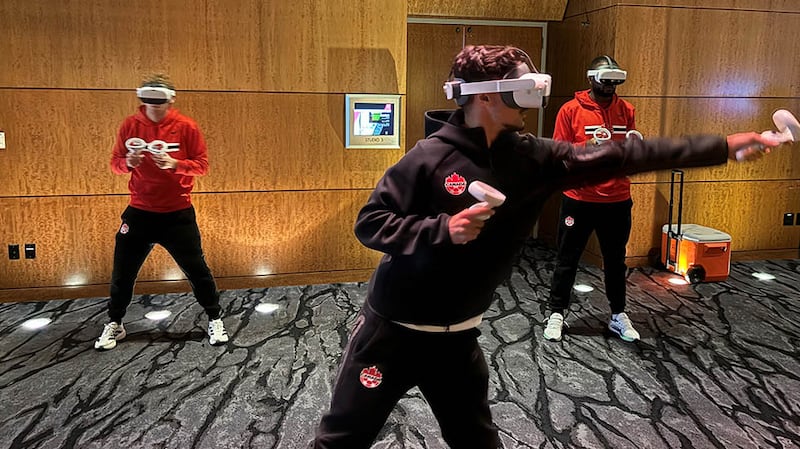
Players are ranked doing the drills and the chance to be faster than their teammates is a strong motivator.
“They’re pretty competitive; they all want to be at the top of the leaderboard,” Ceccarelli said in an interview with TSN.
All of the varsity teams at the University of Alabama are now using the REACT Neuro program and REACT Neuro’s website lists the Boston Celtics, New England Patriots and the Boston Bruins as its partners.
“The heart does one thing, it pumps blood,” Shaun Patel, REACT Neuro’s co-founder and chief executive, said in an interview. “Your brain is important in so many ways, but what are we doing for it? You go to the gym and there are machines to work your triceps or lats, but what do you do for your brain? Crosswords? That’s one tiny sliver of an exercise. We are finding more ways to exercise and train the brain.”
Barrieu said there was one variable he wished he could better control as players prepared for the World Cup: how well they sleep.
In the days leading up to the 2018 World Cup, Switzerland midfielder Granit Xhaka became a test case for how far teams and sponsors are willing to help players be their best. Backed by Under Armour, Xhaka’s preparation included an array of sleep-focused interventions, from customized mattresses and altered lighting in his home to blue-light-blocking glasses designed to reduce stimulation before bed.
The goal was straightforward: better sleep equals better performance. Some of the more experimental approaches verged on the futuristic. Xhaka was given “bio-ceramic” sleepwear and bedsheets, materials that claimed to absorb body heat and re-emitted it as infrared radiation to improve circulation and recovery.
That challenge is central to World Cup preparation. Players must synchronize their biological clocks with match schedules, training sessions and long-haul travel, often under intense pressure. For Xhaka, the hope was that a refined sleep routine could provide a meaningful, even if small, edge.
“Sleep is a No. 1 performance variable,” Barrieu said. “We want their mattresses to mimic the conditions they have at home. It’s risk management. If the mattress is too soft, too hot, the player can wake up with aches. I want to be able to control the temperature in the room, the sheets they use, all of it.”
Even with all of the work, of course, nothing is guaranteed.
Over the past year, Canada’s men’s national team has been hit again and again by injuries to key players, as soccer’s international schedule continues to expand with new events for clubs and national teams alike.
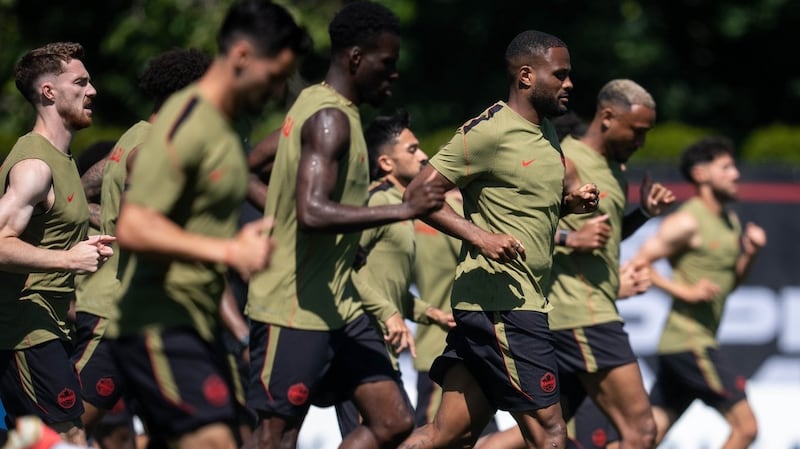
In late 2024, FIFPro, a global union for soccer players, published a “player workload monitoring report” that documented how 54 per cent of 1,500 monitored players experienced “excessive or high workload demands” during the 2023-24 season. The report warned that elite young players are accumulating competitive minutes at rates far beyond previous generations. England’s Judge Bellingham, for instance, played 251 competitive games before turning 21, compared with 54 for David Beckham, while Brazil’s Vini Jr. had 369 appearances by age 24, more than double Ronaldinho’s 163 at the same age.
(The Canadian men’s national team player with the most published club-and-country appearances in 2025 appeared to be Tani Oluwaseyi, with 60 total appearances – 12 for Canada, 29 for Minnesota United and 19 for Villarreal after his August move to Spain.)
In future years, as Canada Soccer’s budget increases, Barrieu said he’d like to further improve hotel and travel conditions for players. He would like to ensure that players always travel business class - they currently travel economy class if they are flying within North America - and to ensure that the mattresses and pillows players sleep on during training camps and games are the same models they have at home.
“During the World Cup our team is staying in hotels in Toronto and Vancouver because FIFA agrees to pay expenses for teams that stay in-market, but in an ideal world, maybe we would have enough money, like some other teams, that we don’t care about the FIFA funding and we just do what we want, like having a base camp, for at least the first round, that’s maybe halfway between Toronto and Vancouver,” Barrieu said.
Even as technologies improve, Barrieu said he relies on some tricks of the trade that have not changed in several decades. He said coaches give Canadian players about two ounces, or a shot glass worth, of pickle juice before games and at halftime. The briny liquid is an excellent source of salt and potassium, which helps alleviate cramping and, years ago, was credited with helping a National Football League team.
During the 2000 season opener at Texas Stadium, the Philadelphia Eagles guzzled pickle juice, pouring it out of jars and putting it in normal water bottles, as the temperature climbed to 43 degrees Celsius. The Eagles won 41-14 over the Dallas Cowboys and the game has been remembered as “The Pickle Juice Game.”
“Some things work and, if they do, you stay with them and don’t advertise too much,” Barrieu said. “We look for any advantage.”

