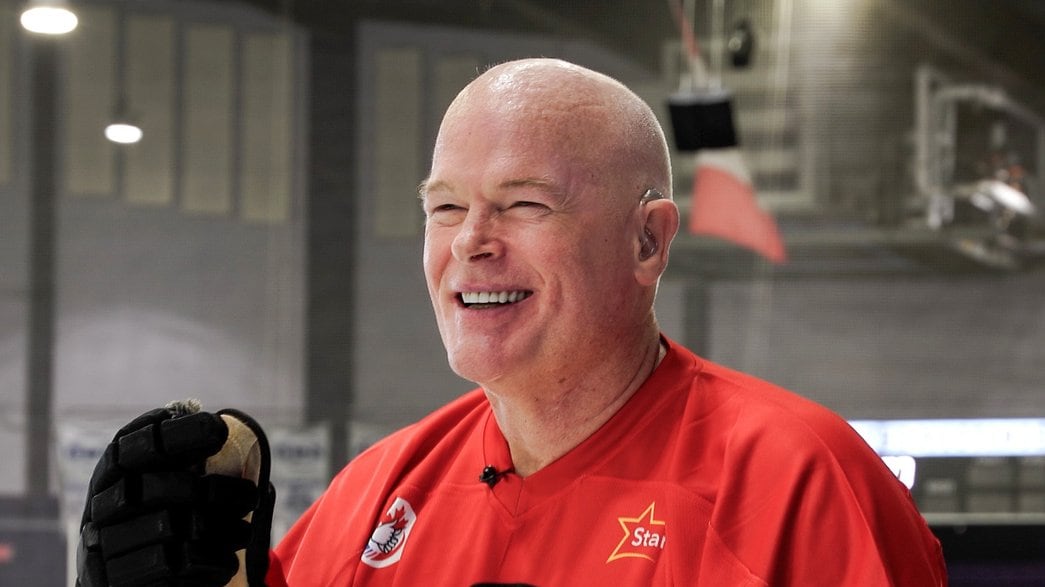
The first and only deaf NHL player says deaf Canadian athletes who wear the Maple Leaf internationally deserve equitable funding.
Jim Kyte played almost 600 NHL games while wearing hearing aids that shorted out during games because of perspiration. He applied a blow dryer to them between periods.
The 62-year-old from Ottawa will be an assistant coach of the Canadian men’s hockey team at the 2027 Winter Deaflympics.
Kyte is also the fundraising face for all of Canada’s 28 deaf or deafened athletes competing in women’s and mixed doubles curling, cross-country skiing and men’s hockey Jan. 15-24, 2027, in Innsbruck and Seefeld, Austria.
Athletes don’t get funding from national sport federations to compete in the Deaflympics, nor do they receive monthly Athlete Assistance Program cheques, worth up to $27,600 annually, as Olympians or Paralympians do.
“It’s a challenge and right now the funding from Sport Canada is really tied to the Olympic and Paralympic systems,” Kyte said. “The International Committee of Sports for the Deaf, the ICSD, isn’t really recognized by the national sport organizations for qualification for the Athlete Assistance Program, so there are zero athletes that have qualified for the AAP funding.
“I would love to see that change, but that’s a longer conversation that needs to take place with Sport Canada and with our national sport organizations.”
The Canadian Deaf Sports Association set a fundraising goal of $75,000 by December to help send the team to Austria.
“My understanding is it costs about $8,000 per athlete to go,” Kyte said. “That’s what it costs to attend, participate, room and board, flights and everything else.
“The hockey team’s players have all put in thus far approximately $3,000 each to go.”
Over half the fundraising goal has been raised, “which is wonderful,” Kyte said. “That last half is going to be hard to come by. It’s very difficult fighting for the charitable dollar.”
If fundraising exceeds $75,000, extra money would go toward sending a team to the 2028 Pan American Deaf Games in Colombia, said CDSA executive director Alain Turpin.
“This isn’t the first time elite Deaf athletes have faced financial challenges,” Turpin wrote in an email. “Unfortunately, we’re almost used to it. Athletes often have to cover a large part of the costs themselves or organize their own fundraisers just to represent Canada.”
The Winter Deaflympics date back to 1949, and the Summer Deaflympics to 1924.
Athletes must have a hearing loss of at least 55 decibels in their best ear — Kyte’s loss is 100 decibels — and aren’t allowed to use hearing aids or external cochlear implants during competition. In hockey, strobe lights signal a stoppage of play.
Canada, the United States, Sweden and Finland withdrew their teams from the 2023 Winter Deaflympics in Turkey because of conflict in the Middle East.
About 850 athletes from 30 countries are expected in Austria. Canada’s team includes curler Emma Logan, who was Nova Scotia’s lead in the 2020 Canadian women’s curling championship.
“I’m a big proponent of sport, period,” Kyte said. “Because of my status as the only deaf player in the 108-year history of the NHL, I want to try to use my experience and to try to let other kids that are deaf, and who aren’t being given a fair shake in their communities or by our government and so forth, to try to be the best that they can be.”
Kyte was a first-round pick (12th) by the Winnipeg Jets in 1982. He amassed 1,342 penalty minutes alongside 17 goals and 49 assists for Winnipeg, Calgary, Pittsburgh, Ottawa and San Jose during his pro career from 1982 to 1997.
Kyte will coach for the first time his nephews Johnny and Thomas in Austria. He says two other nephews were eligible to play for Canada, but couldn’t afford to do so.
The Canadian Deaf Sports Association received funding of $400,000 from the federal government’s Sport Support Program on April 1. Inclusion of Deaflympians in the AAP requires consultation with athlete groups, said Canada’s Secretary of Sport.
“We just expanded the Athlete Assistance Program. We increased the number of cards, so now I think it’s just over 1,900 cards across 70 sports and disciplines,” Adam van Koeverden said.
“We would need to sit down with some sport organizations who are looking at the Athlete Assistance Program.”
Only three Canadians headed to the Deaflympics are under the age of 24 and eligible for Canadian Tire’s Jumpstart grants for children and youth, Kyte said.
“These are Canada’s best deaf athletes,” he said. “Just like any of our athletes, whether they are able-bodied or deaf or in a wheelchair or blind or whatever, they need to be treated equally, if not equitably, and certainly the deaf athletes are not being treated on the same level as our peers.”
This report by The Canadian Press was first published Oct. 19, 2026.
With files from Gregory Strong in Toronto.
Donna Spencer, The Canadian Press

