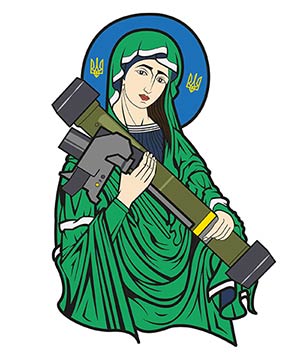
KYIV, Ukraine - When Christian Borys first came up with ‘Saint Javelin,’ he never could have imagined what the meme-turned-fundraiser would become.
“It was February 16, 2022, when I put the first stickers up for sale,” he says. “The Russians had been building up troops on Ukraine’s border for months and it felt like war was imminent, so I just wanted to raise some money (for Ukraine). A friend of mine had made this great meme, so I decided to sell a few stickers with it,” Borys says.
The image Borys is referring to is that of the Virgin Mary, drawn in the style of Eastern Orthodox religious icons, but with a twist. Instead of cradling an infant Jesus, she holds a Javelin anti-tank missile launcher, of the sort donated by the United States to Ukraine in large quantities.
Initial expectations were modest: “I thought I’d maybe sell a few dozen stickers,” Borys says. He surpassed that in hours, selling $1,000 of stickers on the first day, and then $5,000 worth on the second.
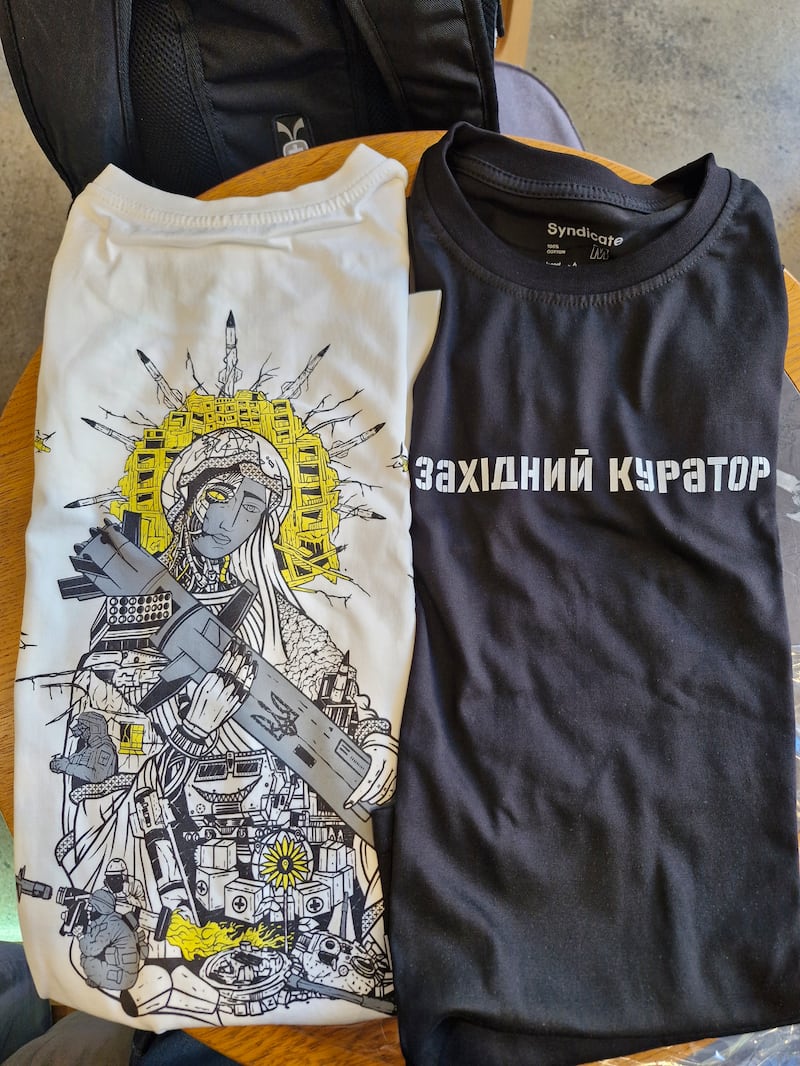
And that was just the start. Within a month, the Saint Javelin website was selling dozens of designs and had expanded to clothing. Barely a month after that, after the meme had gone fully viral, a Saint Javelin t-shirt found its way into the hands of Ukrainian President Volodymyr Zelenskyy himself.
“I visited Ukraine in April 2022, going to Kyiv and Bucha,” Borys says, referring to the suburb of the capital where Russian soldiers had massacred civilians during their six-week occupation. “I gave two shirts to [former Ukrainian Minister of Defence Oleksii] Reznikov, one for him and one for Zelenskyy, never actually thinking that [Zelenskyy] would receive it. Then a few hours later, I got a message: ‘the president has your shirt.’ It was absolutely surreal,” he says.
A Toronto native with Ukrainian heritage, Borys lived and worked in Ukraine as a journalist from 2014 to 2018, reporting on the initial Russian invasion of the eastern Donbas region. He moved back to Canada, opening a production studio in Toronto, but his experiences in Ukraine stuck with him.
“I remember being on a reporting trip and meeting the mothers of soldiers killed since 2014,” Borys says. “As the [Russian] buildup was happening in early 2022, I just kept thinking back to them, and what horrible things would happen to them if Russia really did fully invade. I knew these people, regular Ukrainian civilians, would need all the help they could get, and I wanted to do something,” he says.
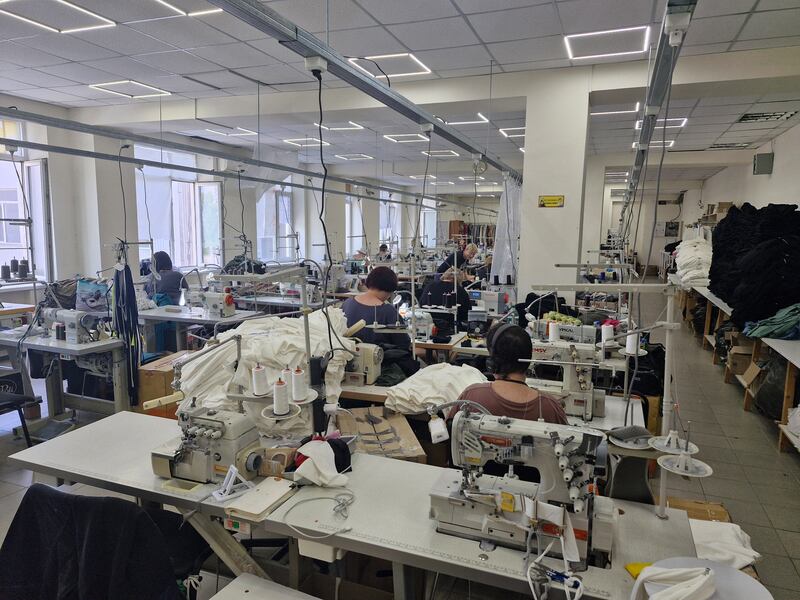
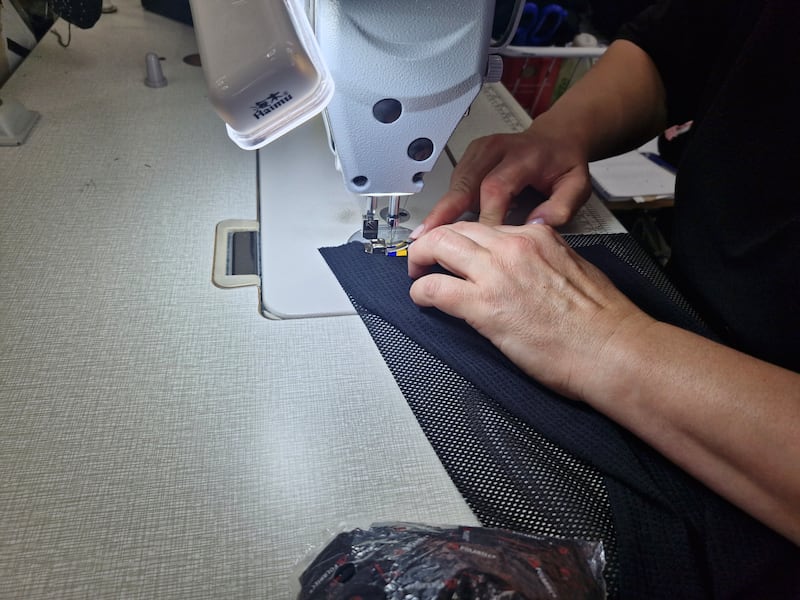
That has certainly been accomplished. To date, Saint Javelin has raised more than $2.5 million, Borys says. Its once-modest catalogue has expanded to hundreds of items, ranging from shirts and hoodies to patches, ceramics and heavy-duty backpacks - all of which are now produced in Ukraine itself.
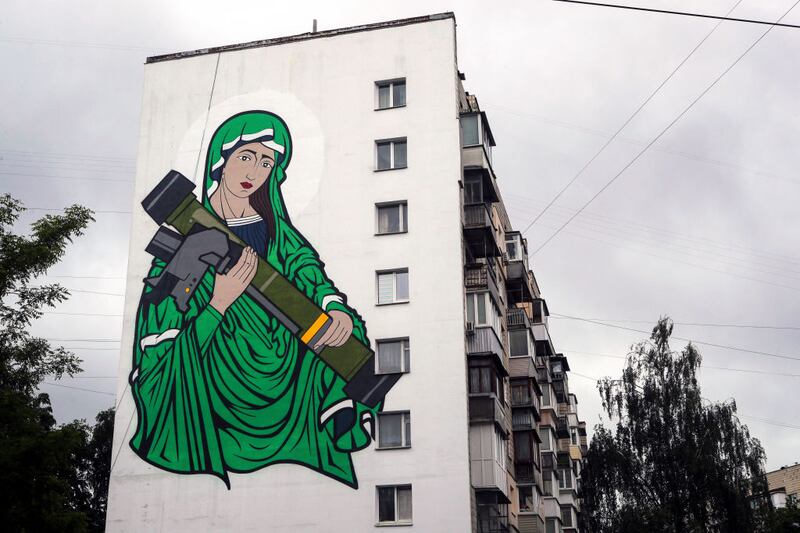
The brand itself is ubiquitous in the country. Graffiti and stickers bearing its Orthodox-inspired military imagery can be found all over Kyiv, while Ukrainian soldiers often sport Saint Javelin patches on their combat vests. One Kyiv apartment building even features an enormous mural of the design, painted in vibrant colour.
The money itself goes to a raft of different causes, ranging from military purchases to civilian aid. Much of the specific needs are determined by the Ukrainian World Congress (UWC), a Toronto-based nonprofit that was the first NGO to donate armoured vehicles to Ukraine, among other transfers.
As the business grew, so too did the demands of running it. Borys first hired one assistant, and then another. Before long, his team had grown to its present size: eight full-time employees, most of whom live in Ukraine, plus a rotation of part-timers. Borys himself was working full-time on the project by June 2022.
Nikita Batovsky is one of those Ukrainian employees. He joined the team in June 2024, working as a product manager and aiding in the effort to move all production to Ukraine.
“I was already aware of the brand - I had a Saint Javelin shirt,” Batovsky says. “So I was happy to join the team. Companies like this are very important these days: they are raising so much money for Ukraine, and we need all the help we can get,” he says.
Canada’s large ethnic Ukrainian population serves as an obvious link between the two countries: it hosts the second-largest Ukrainian diaspora in the world, after Russia. More than 1.2 million Canadians claimed Ukrainian heritage in the 2021 census, while nearly 300,000 more have arrived from Ukraine itself since Russia’s 2022 invasion.
But while they provided the initial basis for Saint Javelin’s sales, Canadian Ukrainians were soon surpassed by those with no relation to the country, Borys says.
“The first people to latch on to the project were a lot of my [Ukrainian] diaspora friends,” he says. “But then we did a survey last year, asking our customers some questions, and something like 70 per cent said they had no connection to Ukraine. They just care about helping the country,” Borys says.
For Ukrainians like Batovsky, that kind of support has been heartwarming -- a much-needed morale boost.
“It feels good to see that we are not alone in this fight,” Batovsky says. “That there are people who have nothing to do with Ukraine and could just ignore us, but instead choose to support us - that means a lot. I think all Ukrainians here appreciate that,” he says.
Saint Javelin’s priorities while the war rages on are clear. But while the end of the fighting may still be far off, Borys already has plans for the company in a future post-war Ukraine.
“Ultimately, I see Saint Javelin becoming a sort of Patagonia-type brand, producing outdoor-oriented products,” Borys says. “Ukraine is one of the most damaged countries in the world, and it’s going to need a lot of help. But we’ve been with them for three-and-a-half years already. We’re not going anywhere.”