For many Canadians, there is a before Oct. 7, 2023, and an after – 731 days since life changed forever.
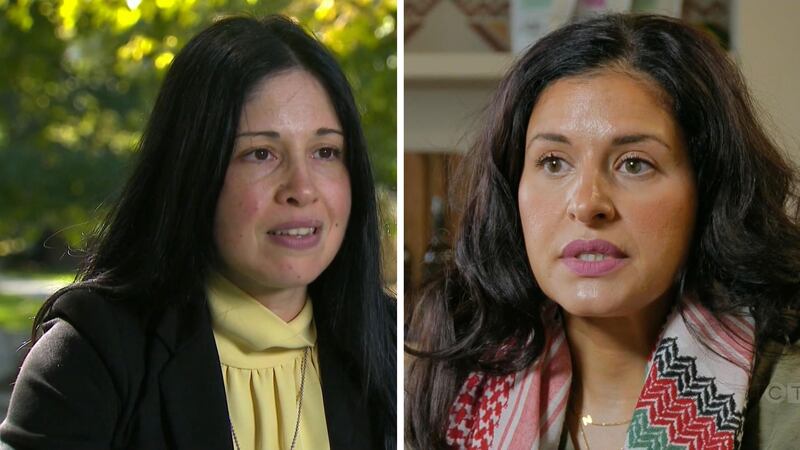
“I couldn’t do anything, I was broken,” Reut Kaddar says of the attacks. Kaddar was born and raised in Israel and moved to Canada seven years ago with her family. She grew up on a kibbutz, similar to the communities attacked two years ago.
Like many Israelis, she has friends and loved ones who were killed and kidnapped, and she wonders if the peace she grew up hoping for is still possible.
“Peace was a big part of my life growing up,” she says. “Talking about peace and learning Arabic at school and talking about sharing a future. And I don’t know that that’s something that will happen when I get to see it.”
The Oct. 7 attack was the worst on Jewish people since the Holocaust -- 1,200 people were killed and another 250 were taken hostage.
Among the dead, seven Canadians and others with close ties to the country.
Global outrage to Israel’s response has translated to a rise in antisemitism, something Kaddar has experienced in Toronto. She says a student at her son’s school drew a swastika on their computer and she no longer speaks Hebrew with her family in public.
“Why do people associate me with the Israeli government?” she asks. “I want people to listen to me for the values I hold dear, for the person I am. I am here to talk, not to fight. I am not choosing a side. I don’t want any innocent person to be hurt by any war.”
The military campaign Israel launched in the wake of the Hamas attack has killed more than 67,000 Palestinians, including both civilians and combatants, according to the Hamas-run Gaza Health Ministry. Tens of thousands more have been wounded with much of the enclave’s infrastructure reduced to rubble.
“Every day you wake up and check your phone and check to see if your family is alive,” says Noora Sharrab, a Palestinian-Canadian who lives in Mississauga, Ont. “The last two years have been paralyzing.”
Sharrab’s family is originally from Khan Yunis, a city in the southern part of the Gaza strip. She has aunts, uncles and cousins still living in Gaza, many of whom have had to flee their homes more than a dozen times. Last week, she says, 12 of her relatives were killed while waiting for food.
“They were standing in line, and they were attacked,” she says.
This week, negotiators are meeting in Egypt to discuss the terms of a possible ceasefire based around a 20-point plan put forward by U.S. President Donald Trump.
Sharrab says the proposal isn’t perfect, but she hopes it will lead to an end to the bombing.
“The first thing that is the top priority for anyone in Gaza right now is the stopping of the bombs that are raining down on them,” she says. “The fact that they don’t know when the next safe space will be.”
While Sharrab says the last two years have been unimaginable for those living in Gaza, the war has also taken a toll on the Palestinian community living abroad.
“We’re not okay,” she says. “Our community is suffering.”
Sharrab says she often gets hate emails and received one just yesterday.
“It said ‘we don’t want terrorists in our city, shut down your business,’” she says. “It’s scary because you don’t know if you are going to be targeted.”
Despite the worry and heartache of the last two years, Sharrab is still hopeful that one day there will be a lasting peace.
“I am hopeful we will see a free Palestine,” she says. “That we will see autonomy, that we will see a solution for everybody to live peacefully.”
It’s a hope that Reut Kaddar has as well.
“Be open to listen to others and talk to others,” she says, adding “remind yourself that we are all people and we all live here. And we want to live in peace.”

