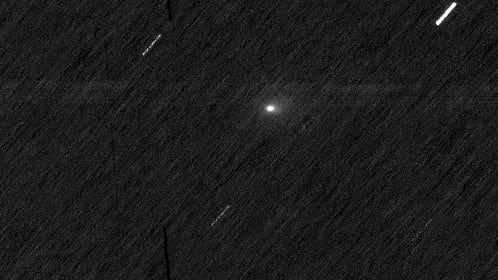
New images of a mysterious interstellar object have been released by the European Space Agency.
Coming from an unknown point beyond our solar system, the comet known as 3I/Atlas is only the third interstellar object that’s ever been detected.
The new images provide the closest view yet of 3I/Atlas. They were captured last week by a satellite orbiting Mars known as the ExoMars Trace Gas Orbiter, which is a joint project between the European Space Agency and Russia. Travelling at a dizzying speed of 310,000 km/h, 3I/Atlas made its closest approach to Mars on Oct. 3, when it came within 29 million kilometres of the red planet.
The images show the centre of the comet as a slightly fuzzy white dot against the vast backdrop of space.
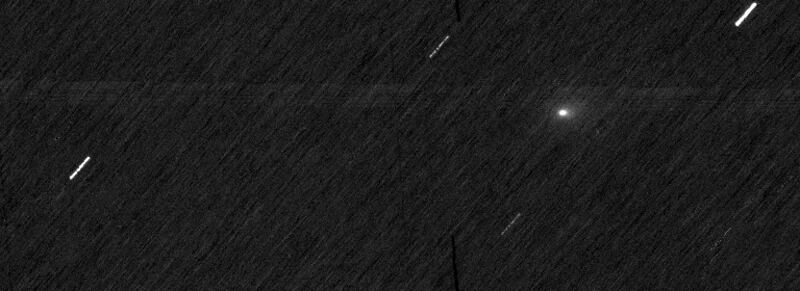
Because the satellite’s camera was designed to photograph the bright and nearby surface of Mars, scientists were unsure if it would be able to detect the comparatively dim and distant comet.
“This was a very challenging observation for the instrument,” Nick Thomas, the principal investigator of the ExoMars camera system, said in a news release. “The comet is around 10,000 to 100,000 times fainter than our usual target.”
Comets are generally comprised of a solid nucleus of ice, rock and dust. As a comet approaches the sun, heat and radiation causes material in the nucleus to vaporize and form a glowing halo known as a coma, which is then swept into a distinctive tail that can be millions of kilometres long. While 3I/Atlas’ tail cannot be seen in the new images, scientists expect it to become visible as the comet continues to heat up while travelling in the direction of the sun.
Discovered in July by a telescope in Chile, astronomers suspect 3I/Atlas could be three billion years older than our solar system and the oldest comet ever observed. It will make its closest approach to the sun at the end of October before swinging back towards Earth, where it is expected to come within 269 million kilometres of our planet in December. 3I/Atlas does not pose a threat to Earth or neighbouring planets.
Before 3I/Atlas, the only other interstellar objects detected in our solar system were Oumuamua in 2017 and Borisov in 2019.
“Astronomers have categorized this object as interstellar because of the hyperbolic shape of its orbital path,” NASA explained. “When the orbit of 3I/ATLAS is traced into the past, the comet clearly originates from outside our solar system.”
Observations from NASA’s Hubble Space Telescope indicate the comet’s nucleus could be between 440 metres and 5.6 kilometres in size. The European Space Agency’s Mars Express orbiter also trained its camera towards 3I/Atlas, but was unable to capture a clear image.
“Though our Mars orbiters continue to make impressive contributions to Mars science, it’s always extra exciting to see them responding to unexpected situations like this one,” European Space Agency scientist Colin Wilson said. “I look forward to seeing what the data reveals following further analysis.”
While most scientists agree that 3I/Atlas is a comet, some researchers have speculated without evidence that it could be extraterrestrial technology.
Scientists around the world will continue monitoring 3I/Atlas as it passes through our solar system by using both ground and space-based telescopes like the James Webb Space Telescope.
“These comets are absolutely foreign,” the European Space Agency said in a news release. “Every planet, moon, asteroid, comet and lifeform in our Solar System share a common origin. But interstellar comets are true outsiders, carrying clues about the formation of worlds far beyond our own.”
With files from The Associated Press

