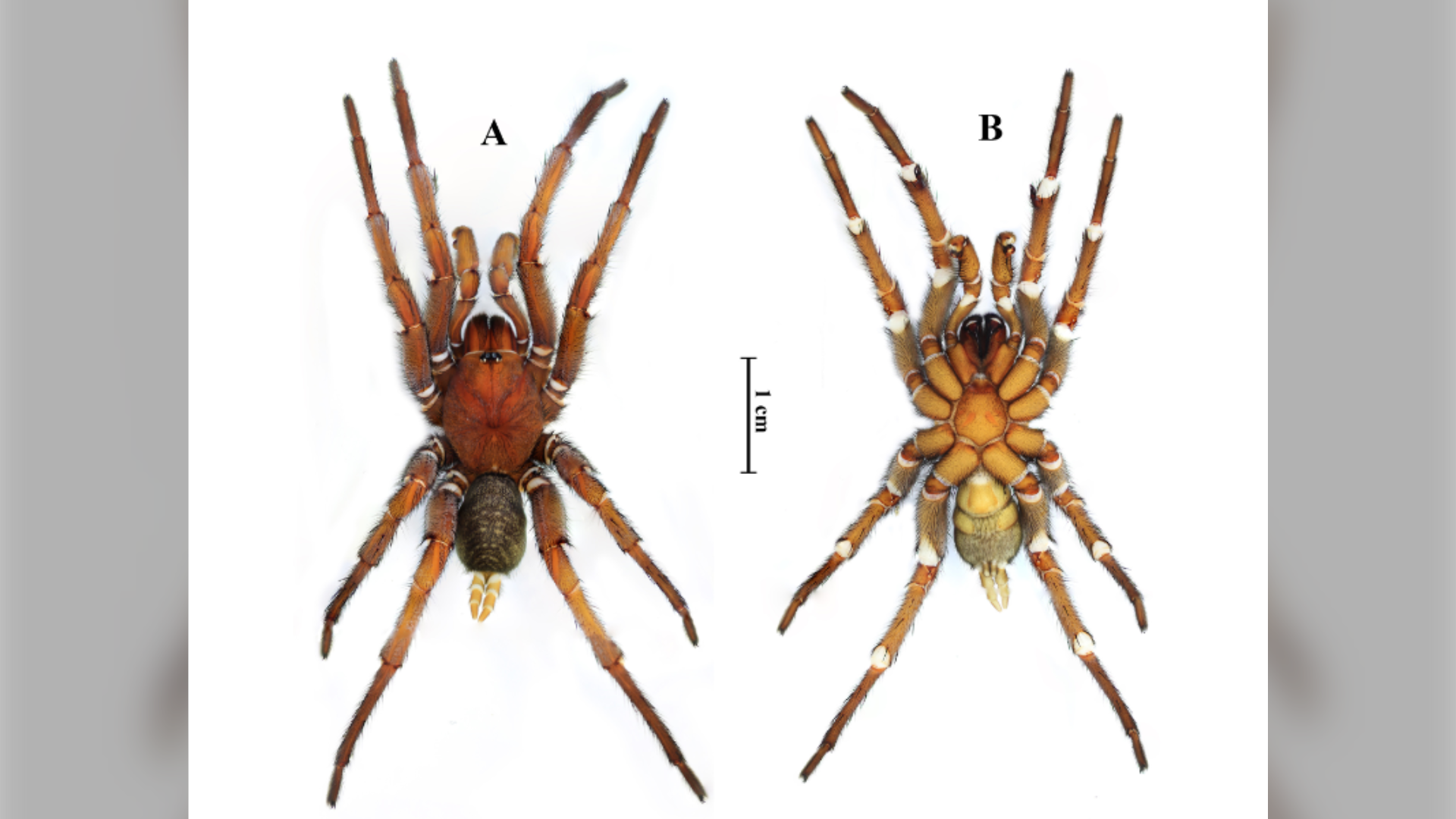
A team of researchers from Thailand has recently discovered a new species of spider that includes a “gynandromorph” specimen – rare organisms that are half male and half female, split right down in the middle.
The species was found near a forested area in Kanchanaburi province, western Thailand.
Researchers from the Chulalongkorn University Museum of Natural History determined, following an in-depth analysis, that the spider most likely belongs to the genus Damarchus, known as “wishbone” or “mygalomorph” spiders found in south and southeast Asia.
However, despite the physical attributes of this new species categorized into the genus Damarchus, data has not yet confirmed this.
In the research paper published in Zootaxa, researchers noted that the most striking feature of the species was the physical difference between the male and female spiders.
The male was only 0.6 inches (1.5 centimetres) long, while the female was found to be one inch long. The male appeared grey and covered with a layer of an unidentified white substance. The female was bright orange and did not have the white coating, the paper said.
“The species is named after Inazuma, a character from the Japanese manga ‘One Piece,’ known for the ability to change sex between male and female,” the study’s authors wrote.
“The Inazuma style is characterized by bilateral asymmetry, presenting distinct coloration with orange on the left side and white on the right side.”
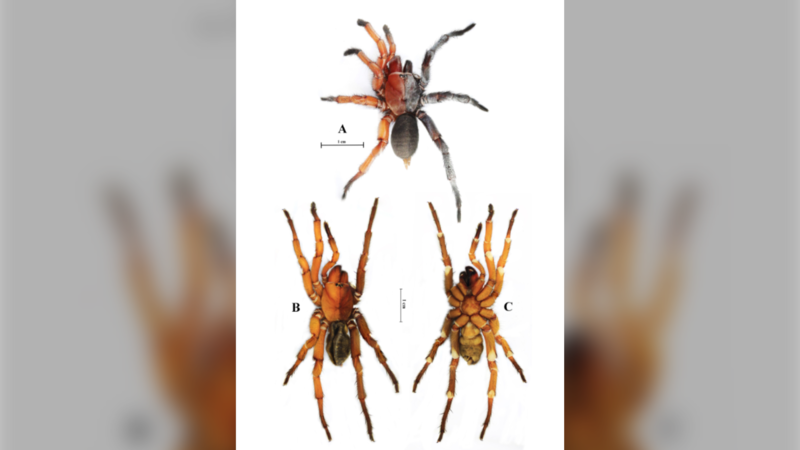
“This color arrangement closely mirrors the sexual dimorphism observed in this species, with males exhibiting white coloration and females displaying orange,” they added.
These spiders are known to make wishbone-shaped, silk-lined burrows in the ground while they ambush their prey.
“Gynandomorphs” are different from hermaphrodites. Hermaphrodite organisms have bilateral symmetry and naturally present both sex organs. The former is much rarer, the researchers said.
“Gynandromorphy is a rare phenomenon observed in the animal kingdom,” the paper read. “To confirm the presence of gynandromorphism, traits of both sexes, such as genitalia, must be present within the same individual, usually displaying bilateral asymmetry.”

