Researchers in Japan are shining light on an invisible space mystery that’s been challenging scientists since the 1930s.
Using the latest data from NASA’s Fermi Gamma-ray Space Telescope, researchers at the University of Tokyo believe they’ve detected dark matter.
First coined in the early 1930s by Swiss astronomer Fritz Zwicky, dark matter is described by NASA as an “invisible glue that holds the universe together.” While invisible, dark matter is believed to make up most of the matter in the universe.
Scientists have only been able to indirectly study dark matter through how it impacts detectable matter, such as its ability to produce enough gravitational force to hold galaxies together. It can’t be directly studied because dark matter doesn’t absorb, reflect or emit light.
A common theory on dark matter is that it’s made up of weakly interacting massive particles (WIMPs), which weigh more than protons and have little interaction with other matter. However, when two WIMPs collide, it’s predicted that the two particles will wipe out one another and emit other particles, like gamma ray photons.
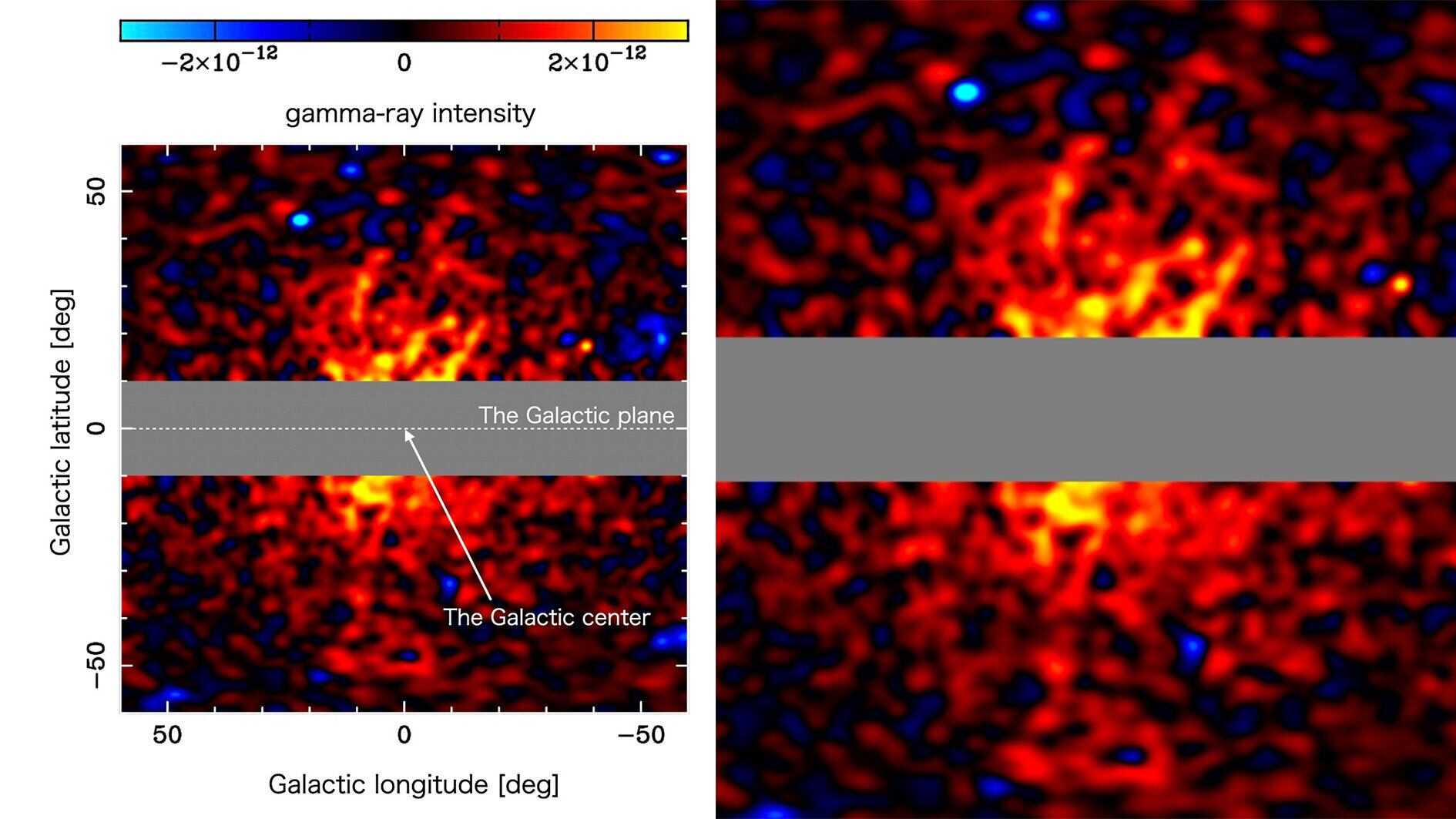
A research team led by astronomer Tomonori Totani targeted regions of concentrated dark matter, like at the centre of the Milky Way, spending years searching for these particular gamma rays. Using the latest data from the NASA telescope, Totani and his team believe they’ve finally found the specific gamma rays predicted by the annihilation of theoretical dark matter particles.
“We detected gamma rays with a photon energy of 20 gigaelectronvolts (or 20 billion electronvolts, an extremely large amount of energy) extending in a halo-like structure toward the centre of the Milky Way galaxy,” Totani said in a press release. “The gamma-ray emission component closely matches the shape expected from the dark matter halo.”
These particular gamma-ray measurements are not easily explained by other, more conventional astronomical phenomena or gamma-ray emissions. This leads Totani to believe the data is a strong indication of gamma-ray emission from dark matter.
“If this is correct, to the extent of my knowledge, it would mark the first time humanity has ‘seen’ dark matter,” Totani said. “And it turns out that dark matter is a new particle not included in the current standard model of particle physics. This signifies a major development in astronomy and physics.”
The study is published in the Journal of Cosmology and Astroparticle Physics. The findings still need to be verified through independent analysis by other researchers.
Yonatan Kahn is an assistant professor of physics at the University of Toronto. He says he and many of his colleagues have been working most of their careers on the observational evidence for dark matter. What’s been missing is the demonstration that the dark matter that interacts through gravity is also the dark matter that we see in our own galaxy.
“What this paper is purporting to show is they saw signatures of dark matter particles that were annihilating to other particles that we are then able to observe with this telescope,” he told CTV News.
Kahn said what he’d be concerned about regarding the research is how consistent it is with other searches that looked at similar parts of the galaxy and similar energy ranges, but were not able to conclusively claim a discovery.
“The general idea has definitely been tried before and so it’s not necessarily an entirely new data set nor a new observational technique,” he said. “It’s a new analysis that needs to be checked against things that already exist in literature.”

