


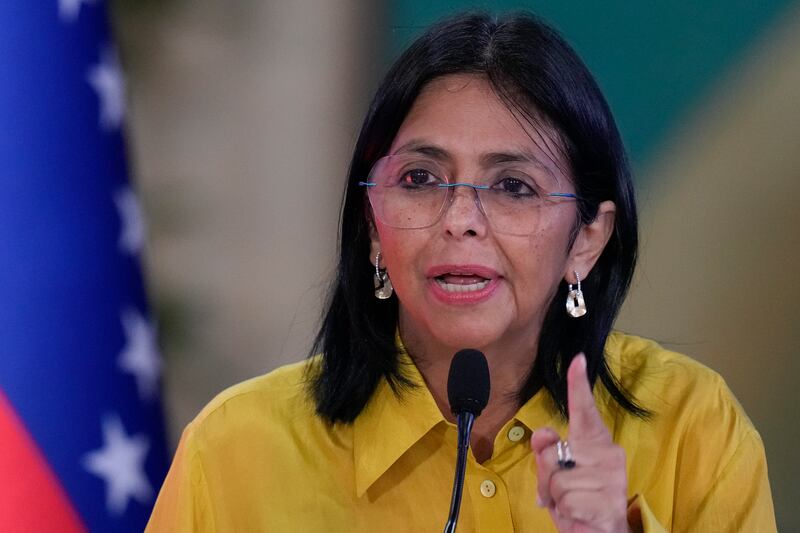
MEXICO CITY — As uncertainty simmers in Venezuela, interim President Delcy Rodríguez has taken the place of her ally President Nicolás Maduro, captured by the United States in a nighttime military operation, and offered “to collaborate” with the Trump administration in what could be a seismic shift in relations between the adversary governments.
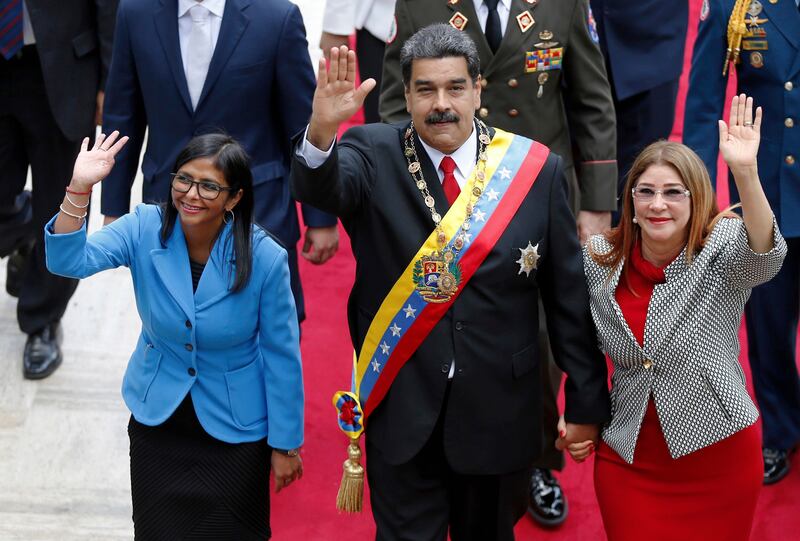
Rodríguez served as Maduro’s vice-president since 2018, overseeing much of Venezuela’s oil-dependent economy and its feared intelligence service, and was next in the presidential line of succession.
She’s part of a band of senior officials in Maduro’s administration that now appears to control Venezuela, even as U.S. President Donald Trump and other officials say they will pressure the government to fall in line with its vision for the oil-rich nation.
On Saturday, Venezuela’s high court ordered her to assume the role of interim president, and the leader was backed by Venezuela’s military.
Ally or adversary
Rodríguez, a 56-year-old lawyer and politician has had a lengthy career representing the revolution started by the late Hugo Chávez on the world stage. It’s been unclear if the leader would warm up to the Trump administration or follow the same adversarial line as her predecessor.
Her rise to become interim leader of the South American country came as a surprise on Saturday morning, when Trump announced that Secretary of State Marco Rubio had been in communication with Rodríguez and that the Venezuelan leader was “gracious” and would work with the American government. Rubio said Rodríguez was someone the administration could work with, unlike Maduro.
But in a televised address, Rodríguez gave no indication that she would co-operate with Trump, referring to his government as “extremists” and maintaining that Maduro was Venezuela’s rightful leader.
“What is being done to Venezuela is an atrocity that violates international law,” Rodríguez said, surrounded by high-ranking civilian officials and military leaders.
Trump warned on Sunday, if Rodríguez didn’t fall in line, “she is going to pay a very big price, probably bigger than Maduro.” He added that he wanted her to provide “total access,” from oil facilities to basic infrastructure like roads, so they can be rebuilt.
Trump’s comments also followed Rubio having asserted in TV interviews on Sunday that he didn’t see Rodríguez and her government as “legitimate” because he said the country never held free and fair elections.
On Sunday, in statements posted to her Instagram, she took a major shift in tone in a conciliatory message where she said she hoped to build “respectful relations” with Trump.
“We invite the U.S. government to collaborate with us on an agenda of co-operation oriented towards shared development within the framework of international law to strengthen lasting community coexistence,” she wrote.
Rise to interim president
A lawyer educated in Britain and France, the interim president and her brother, Jorge Rodríguez, head of the Maduro-controlled National Assembly, have sterling leftist credentials born from tragedy. Their father was a socialist leader who was arrested for his involvement in the kidnapping of American business owner William Niehous in 1976, and later died in police custody.
Unlike many in Maduro’s inner circle, the Rodríguez siblings have avoided criminal indictment in the U.S., though the interim president did face U.S. sanctions during Trump’s first term for her role in undermining Venezuelan democracy.
Rodríguez held a number of lower-level positions under Chávez’s government, but gained prominence working under Maduro to the point of being seen as his successor. She served the economic minister, foreign affairs minister, petroleum minister and others help stabilize Venezuela’s endemically crisis-stricken economy after years of rampant inflation and turmoil.
Rodríguez developed strong ties with Republicans in the oil industry and on Wall Street who balked at the notion of U.S.-led regime change. The interim president also presided over an assembly promoted by Maduro in response to street protests in 2017 meant to neutralize the opposition-majority legislature.
She enjoys a close relationship with the military, which has long acted as the arbiter of political disputes in Venezuela, said Ronal Rodríguez, a spokesperson for the Venezuela Observatory of Rosario University in Bogota, Colombia.
“She has a very particular relationship with power,” he said. “She has developed very strong ties with elements of the armed forces and has managed to establish lines of dialogue with them, largely on a transactional basis.”
Future in power
It’s unclear how long Rodríguez will hold power, or how closely she will work with the Trump administration.
Geoff Ramsey, a senior non-resident fellow at the Atlantic Council, a Washington research institute, said Rodríguez’s initially firm tone with the Trump administration may have been an attempt to “save face.” Others have noted that Maduro’s capture required some level of collaboration within the Venezuelan government.
“She can’t exactly expect to score points with her revolutionary peers if she presents herself as a patsy for U.S. interests,” Ramsey said.
Venezuela’s constitution requires an election within 30 days whenever the president becomes “permanently unavailable” to serve. Reasons listed include death, resignation, removal from office or “abandonment” of duties as declared by the National Assembly.
That electoral timeline was rigorously followed when Maduro’s predecessor, Chavez, died of cancer in 2013. However, the loyalist Supreme Court, in its decision Saturday, cited another provision of the charter in declaring Maduro’s absence a “temporary” one.
In such a scenario, there is no election requirement. Instead, the vice-president, an unelected position, takes over for up to 90 days — a period that can be extended to six months with a vote of the National Assembly.
In handing temporary power to Rodríguez, the Supreme Court made no mention of the 180-day time limit, leading some to speculate she could try to remain in power even longer as she seeks to unite the disparate factions of the ruling socialist party while shielding it from what would certainly be a stiff electoral challenge.
——
Megan Janetsky And Isabel Debre, The Associated Press
Janetsky reported from Mexico City and Debre reported from Buenos Aires, Argentina. Associated Press writers Joshua Goodman in Miami, Darlene Superville aboard Air Force One and Jorge Rueda in Caracas, Venezuela, contributed to this report.

