


PARIS — In a hypothetical nuclear war involving Russia, China and the United States, the island of Greenland would be in the middle of Armageddon.
The strategic importance of the Arctic territory — under the flight paths that nuclear-armed missiles from China and Russia could take on their way to incinerating targets in the United States, and vice versa — is one of the reasons U.S. President Donald Trump has cited in his disruptive campaign to wrest control of Greenland from Denmark, alarming Greenlanders and longtime allies in Europe alike.
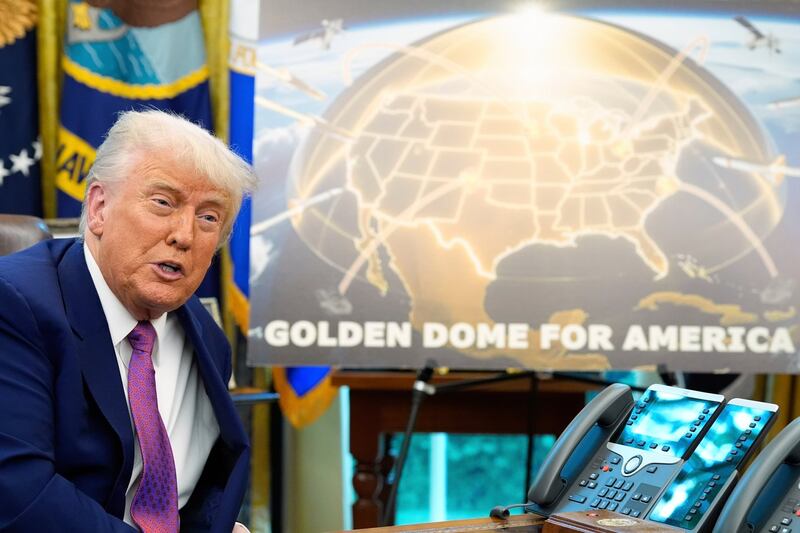
Trump has argued that U.S. ownership of Greenland is vital for his “Golden Dome” — a multibillion dollar missile defence system that he says will be operational before his term ends in 2029.
“Because of The Golden Dome, and Modern Day Weapons Systems, both Offensive and Defensive, the need to ACQUIRE is especially important,” Trump said in a Truth Social post on Saturday.
That ushered in another roller-coaster week involving the semiautonomous Danish territory, where Trump again pushed for U.S. ownership before seemingly backing off, announcing Wednesday the “framework of a future deal” on Arctic security that’s unlikely to be the final word.
Here’s a closer look at Greenland’s position at a crossroads for nuclear defence.
ICBM flight paths
Intercontinental Ballistic Missiles, or ICBMs, that nuclear adversaries would fire at each other — if it ever came to that — tend to take the shortest direct route, on a ballistic trajectory into space and down again, from their silos or launchers to targets. The shortest flight paths from China or Russia to the United States — and the other way — would take many of them over the Arctic region.
Russian Topol-M missiles fired, for example, from the Tatishchevo silo complex southeast of Moscow would fly high over Greenland, if targeted at the U.S. ICBM force of 400 Minuteman III missiles, housed at the Minot Air Force Base in North Dakota, the Malmstrom Air Force Base in Montana and the Warren Air Force Base in Wyoming.
Chinese Dong Feng-31 missiles, if fired from new silo fields that the U.S. defence Department says have been built in China, also could overfly Greenland should they be targeted at the U.S. Eastern Seaboard.
“If there is a war, much of the action will take place on that piece of ice. Think of it: those missiles would be flying right over the center,” Trump said Wednesday at the World Economic Forum in Davos, Switzerland.
Pituffik Space Base
An array of farseeing early warning radars act as the Pentagon’s eyes against any missile attack. The northernmost of them is in Greenland, at the Pituffik Space Base. Pronounced “bee-doo-FEEK,” it used to be called Thule Air Base, but was renamed in 2023 using the remote location’s Greenlandic name, recognizing the Indigenous community that was forcibly displaced by the U.S. outpost’s construction in 1951.
Its location above the Arctic Circle, and roughly halfway between Washington and Moscow, enables it to peer with its radar over the Arctic region, into Russia and at potential flight paths of U.S.-targeted Chinese missiles.
“That gives the United States more time to think about what to do,” said Pavel Podvig, a Geneva-based analyst who specializes in Russia’s nuclear arsenal. “Greenland is a good location for that.”
The two-sided, solid-state AN/FPS-132 radar is designed to quickly detect and track ballistic missile launches, including from submarines, to help inform the U.S. commander in chief’s response and provide data for interceptors to try and destroy warheads.
The radar beams out for nearly 5,550 kilometres (3,450 miles) in a 240-degree arc and, even at its furthest range, can detect objects no larger than a small car, the U.S. Air Force says.
Expert sees holes in Trump’s arguments
Pitching the “Golden Dome” in Davos, Trump said that the U.S. needs ownership of Greenland to defend it.
“You can’t defend it on a lease,” he said.
But defence specialists struggle to comprehend that logic given that the U.S. has operated at Pituffik for decades without owning Greenland.
French nuclear defence specialist Etienne Marcuz points out that Trump has never spoken of also needing to take control of the United Kingdom — even though it, like Greenland, also plays an important role in U.S. missile defence.
An early warning radar operated by the U.K.’s Royal Air Force at Fylingdales, in northern England, serves both the U.K. and U.S governments, scanning for missiles from Russia and elsewhere and northward to the polar region. The unit’s motto is “Vigilamus” — Latin for “We are watching.”
Trump’s envisioned multilayered “Golden Dome” could include space-based sensors to detect missiles. They could reduce the U.S. need for its Greenland-based radar station, said Marcuz, a former nuclear defence worker for France’s defence Ministry, now with the Foundation for Strategic Research think tank in Paris.
“Trump’s argument that Greenland is vital for the Golden Dome — and therefore that it has to be invaded, well, acquired — is false for several reasons," Marcuz said.
“One of them is that there is, for example, a radar in the United Kingdom, and to my knowledge there is no question of invading the U.K. And, above all, there are new sensors that are already being tested, in the process of being deployed, which will in fact reduce Greenland’s importance.”
‘Golden Dome’ interceptors
Because of its location, Greenland could be a useful place to station “Golden Dome” interceptors to try to destroy warheads before they reach the continental U.S.
The “highly complex system can only work at its maximum potential and efficiency ... if this Land is included in it,” Trump wrote in his post last weekend.
But the U.S. already has access to Greenland under a 1951 defence agreement. Before Trump ratcheted up the heat on the territory and Denmark, its owner, their governments likely would have readily accepted any American military request for an expanded footprint there, experts say. It used to have multiple bases and installations, but later abandoned them, leaving just Pituffik.
“Denmark was the most compliant ally of the United States,” Marcuz said. “Now, it’s very different. I don’t know whether authorization would be granted, but in any case, before, the answer was ‘Yes.’”
John Leicester, The Associated Press

