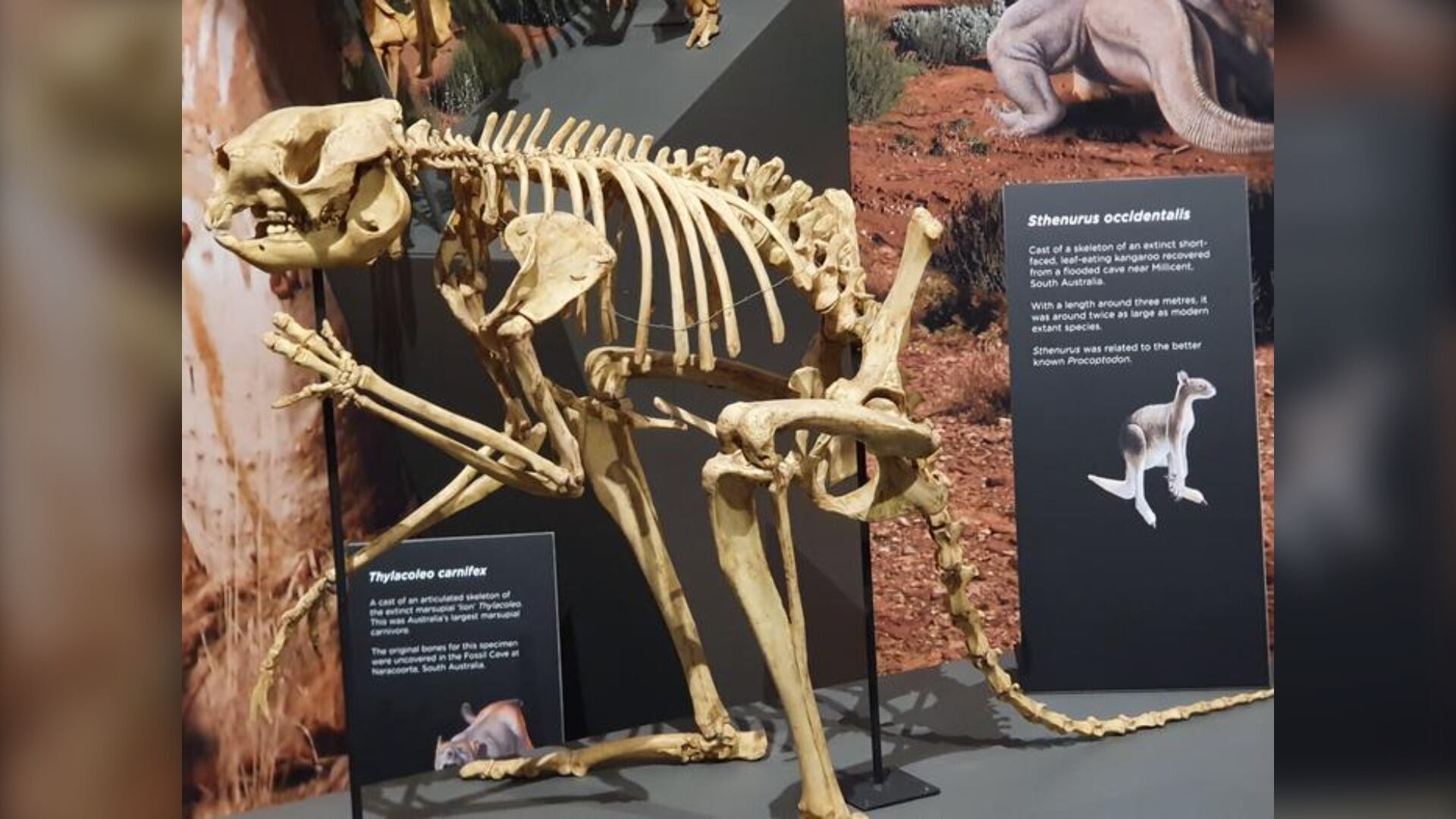
Scientists examining the fossil remains of giant prehistoric kangaroos have found that even animals weighing more than 200 kilograms, or 440 pounds, may still have been capable of hopping.
A new study led by researchers at the U.K.-based University of Manchester, working in collaboration with the University of Bristol and the Australian-based University of Melbourne, argued previous assumptions failed to account for anatomy differences.
Rather than relying solely on scaled-up versions of modern kangaroos, the team combined data from living animals with direct measurements from fossilized bone.
According to the results, published in the journal Scientific Reports, indicate that giant kangaroos were built differently in ways that could have allowed them to hop despite their massive size.
Today, the red kangaroo is the world’s largest living hopping animal, typically weighing up to 90 kilograms, which equates to nearly 200 pounds. The study said during the Ice Age (nearly 12,000 years ago), Australia was home to several species of kangaroos that dwarfed their modern relatives, with some estimated to weigh as much as 250 kilograms (550 pounds).
For decades, researchers believed animals of that size would have been unable to hop, instead relying on walking or other forms of locomotion - movement of an entire organism from one location to another.
The study said that earlier models suggested that hopping would become mechanically unworkable beyond roughly 150 kilograms.
How the study worked
The researchers focused on two key factors that influence hopping: the strength of the bones in the foot, and the ability of the ankle to support the powerful tendons that store and release energy during a jump.

Fossil evidence shows that giant kangaroos had shorter, thicker foot bones than modern species, making them better suited to withstand the high forces generated when landing.
Their heels bones were also wider, providing room to anchor much thicker ankle tendons, the study explained.
However, the way they moved was likely very different from the fast, efficient bounding seen in modern red kangaroos. Thicker tendons, while stronger and safer under heavy loads, store less elastic energy, the study said.
That trade-off would have made hopping slower and less energy-efficient, limiting how far or how often giant kangaroos could bounce across the landscape.
Researchers suggest it could have helped giant kangaroos move quickly across rough terrain or escape threats over short distances, rather than serving as their primary means of getting around.
How walks differ
The fossil analysis also points to the diversity in how these extinct species moved. Some appeared to have combined hopping with other strategies, such as walking upright on two legs or moving on all fours.
This suggests that hopping was just one element of a broader movement tool kit, rather than an all-or-nothing behaviour.
Beyond locomotion, the findings add to the growing evidence that prehistoric kangaroos occupied a wider range of ecological roles than their modern counterparts. While some large species were grazers — animals that eat low-lying vegetation and similar to today’s kangaroos — others were browsers, feeding on leaves and shrubs in higher woody terrain.
That kind of ecological diversity is no longer seen among Australia’s largest living kangaroos, the study said.

