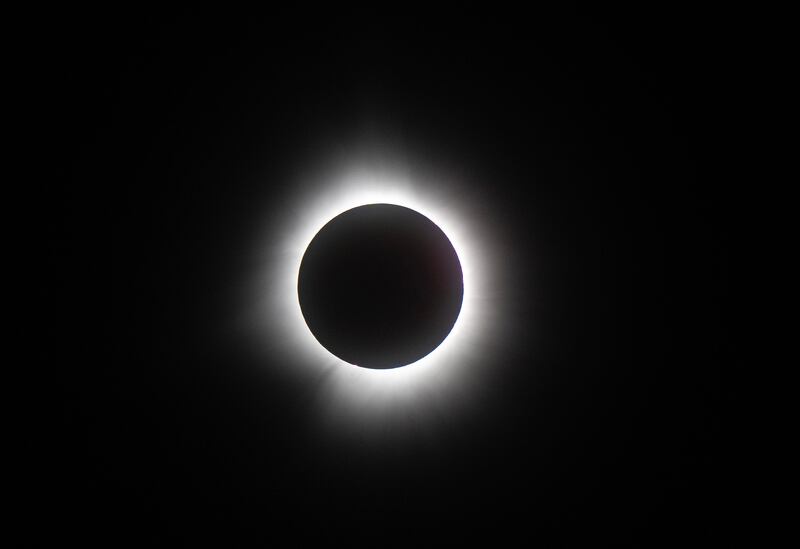
Parts of Antarctica were treated to a solar eclipse on Tuesday, creating a dazzling ring of fire in the sky as the moon passed in front of the sun. Known as an annular eclipse, the celestial show was likely only witnessed by a handful of humans and posses of penguins.
While a total eclipse completely blocks the face of the sun to reveal the sun’s corona, an annular eclipse — like the one that happened on Tuesday — occurs when the moon is further away from Earth, leaving the outer edge of the sun visible as a fiery halo.
Catching an eclipse is all about being in the right place at the right time. Total solar eclipses occur about once every 18 months and annular solar eclipses take place every one or two years. While not uncommon, eclipses are only visible over a narrow and specific path, like the one that stretched from Mexico to Newfoundland in April 2024.
That means that from any one place on Earth, an eclipse will only be visible overhead about once every 366 years, according to NASA. That is, unless you live in a lucky community like Sault Ste. Marie, Ont., which will be treated to two eclipses in the coming decades.
If you missed the 2024 spectacle, you’ll have four chances over the next 30-or-so years to catch a total or annular solar eclipse above Canada skies. Or, think about travelling to a country like Chile, Spain or Morocco in 2026 or 2027.
Four chances over three decades
You’ll have to wait more than a decade for the next major eclipse to occur above Canada. You’ll also have to venture somewhere remote to see it, as the annular eclipse on June 21, 2039 will only be visible over parts of the Canadian territories, including Tuktoyaktuk in the Northwest Territories, which is the northernmost community in Canada that’s accessible by road. This eclipse will also be visible over much of Alaska, including the state’s capital city, Anchorage.
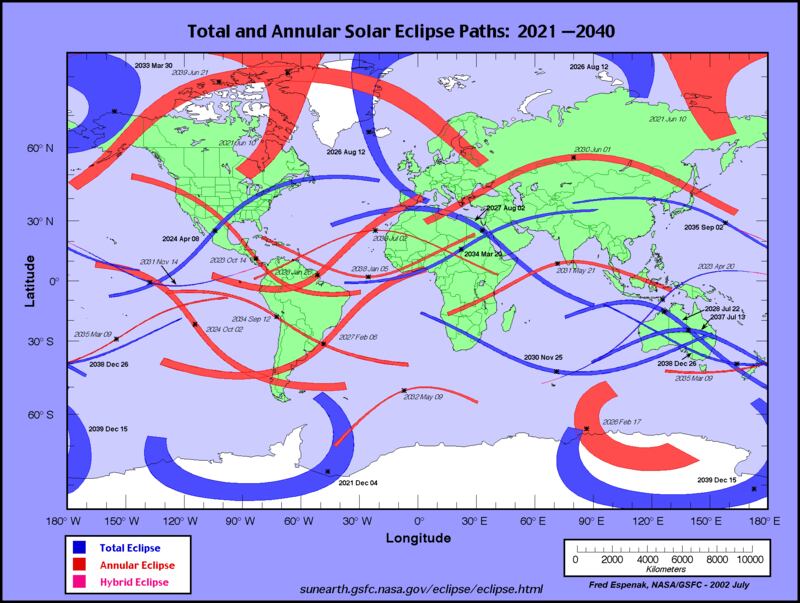
Many more Canadians will have a chance to see the total solar eclipse that will occur on Aug. 23, 2044. This eclipse will be visible across southern Saskatchewan, most of Alberta, eastern B.C. and parts of the Canadian territories. Much off the Canadian Rockers lie within the path of totality, as well as major cities and towns like Medicine Hat, Lethbridge, Calgary, Banff and Edmonton.
Another annular solar eclipse will be visible over parts of northern Ontario, Quebec and Labrador on June 11, 2048. The most populated Canadian communities along its path include Ontario towns like Sault Ste. Marie and Timmins. This eclipse will also be visible over countries like Iceland, Norway, Sweden, Latvia, Russia and Afghanistan.
In just over 30 years from now, an annular eclipse will also be visible on July 1, 2057 over parts of the territories, Alberta, Saskatchewan, Manitoba, Ontario and a sliver of Quebec. Cities and communities that lie within this eclipse’s path include Yellowknife, Thompson, Man., and Thunder Bay, Sault Ste. Marie, Sudbury, Barrie and Toronto in Ontario.
Take an eclipse holiday in 2026 or 2027
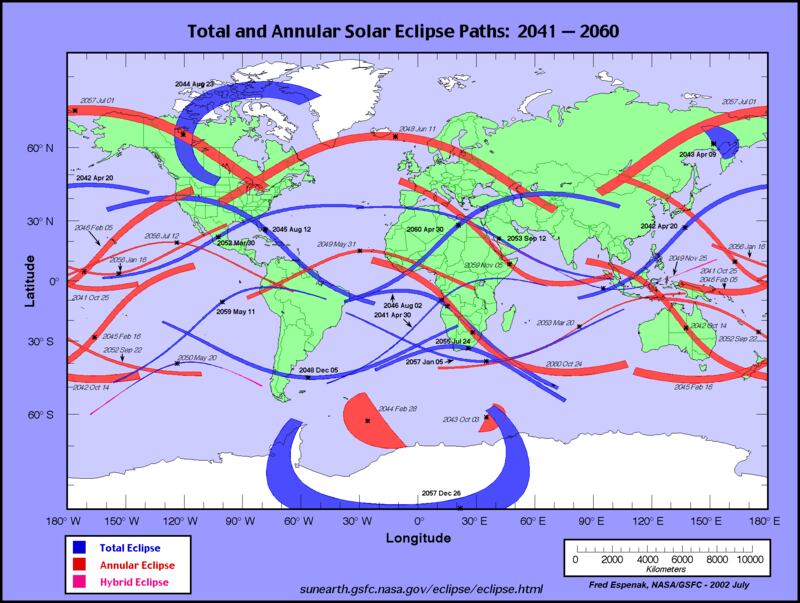
Catching a total or annular solar eclipse is a once-in-a-lifetime experience, and if you’re willing to travel to see one, you’ll have three chances between now and the end of 2027.
Spain will be the best place to catch the Aug. 12, 2026 total solar eclipse, which will be visible over islands like Ibiza and Mallorca, as well as cities and towns that include Valencia, Zaragoza and Oviedo. This eclipse will also be visible from eastern Greenland.
South America and West Africa will be treated to an annular eclipse on Feb. 6, 2027, which will be visible over parts of countries like Chile, Argentina, Ghana, Togo, Benin and Nigeria.
On Aug. 2, 2027, you’ll be able to witness a total solar eclipse in Gibraltar and the southernmost part of Spain, as well as across North Africa and the Middle East in countries like Morocco, Algeria, Tunisia, Libya, Egypt, Saudia Arabia, Yemen and Somalia.
Partial eclipses and eye protection
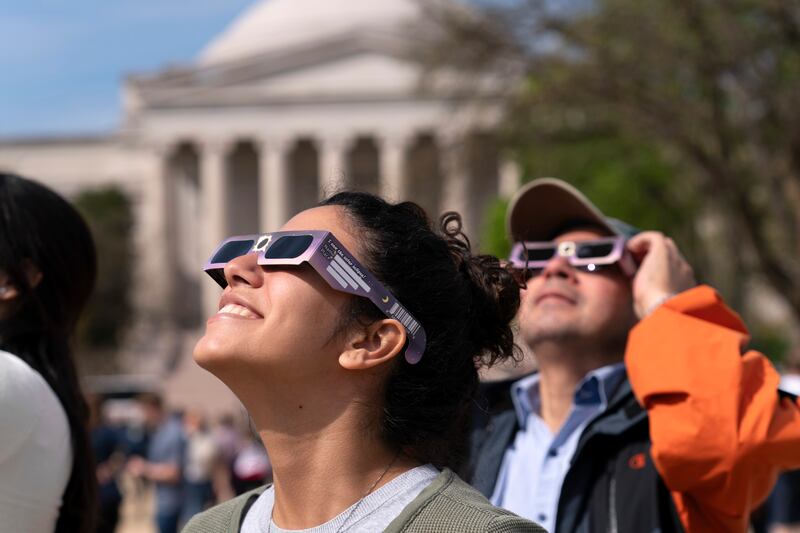
Partial solar eclipses are much more common. In a partial eclipse, the moon blocks only part of the sun to create a glowing crescent that should only be viewed with proper eye protection. If you are outside the path of a total or annular eclipse, you can also see a partial eclipse overhead with the right gear. Partial eclipses will be visible over parts of Canada in January and June 2029.
Looking at the sun without proper protection can cause retinal burns and vision loss. To avoid damaging your eyes, glasses with special dark lenses certified for solar viewing with an ISO 12312-2 international standard are the simplest option and relatively inexpensive. During an eclipse, it is only safe to remove eye protection in the brief period the sun is blocked.