Eric Ham is based in Washington, D.C. and is a political analyst for CTV News. He’s a bestselling author and former congressional staffer in the U.S. Congress and writes for CTVNews.ca.
The U.S., like Russia did with Ukraine, has now launched a war of choice in Iran. Meanwhile, China continues to move closer towards a military offensive to bring Taiwan under its rule. Three of the world’s most dominant military powers, seemingly in unison, are leaning into their hard power capabilities.
All are eschewing global norms, diplomacy, and international safeguards as they re-shape the global world order. The unilateral offensives are coming into clearer focus. Meanwhile, Prime Minister Mark Carney’s ‘middle power doctrine’—unveiled in Davos—has, until now, spoken volumes. Staving off unilateral action by the United States in Greenland, the prime minister’s new foreign policy ethos is being called upon at a time of great crisis and turmoil.
The Middle East once again burns hot; the Western Hemisphere simmers as Cuba and Ecuador face the wrath of American power; and Asia is on a slow boil as Beijing circles Taiwan. Prime Minister Carney, the self-anointed architect of this newly minted middle-power strategy meant as a parapet against despotic regimes, will now more than ever be put to the test.
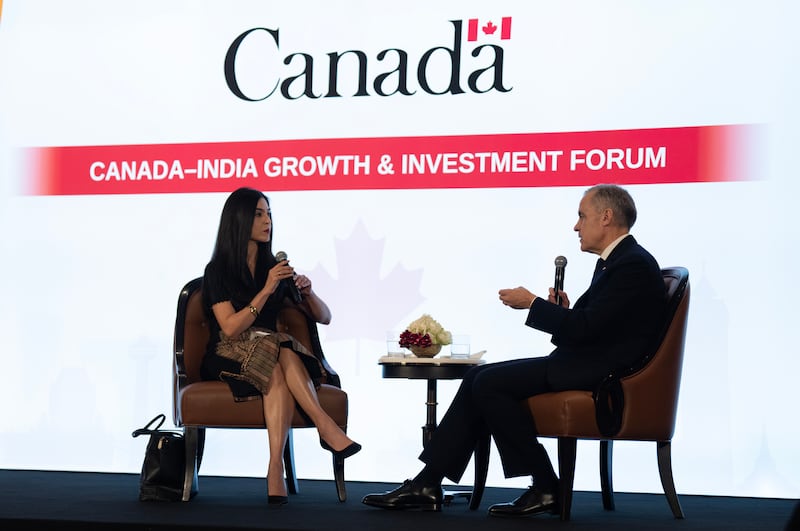
During a fireside chat in Mumbai as part of a global trade mission, the prime minister said, “It is a serious conflict. In a serious conflict, you have to make choices.” Though the Canadian leader opted not to join the fray, it remains unclear how far, or even if, this new policy is prepared to challenge roguish actions that step outside the bounds of international law and transparency.
Since returning to power, President Trump has launched military offensives on seven nations, including Iran. The attacks on Iran—the second in as many months on a sovereign nation—mark another brazen violation of international law and the most aggressive escalation yet by the American strongman. Perhaps even more undeniable is this president’s clear embrace of hard power tactics to pummel foreign governments and extract concessions for his own gain.
Bold words in Davos
Canada’s foreign minister, Anita Anand, posted on social media: “Canadians in Israel, Lebanon and Palestine should consider leaving while commercial options remain available,” adding that the federal government’s ability to “provide consular services to Canadians during an active conflict is likely to be limited” and that Canadians should come up with contingency plans that don’t rely on government aid. The bold words that ran counter to U.S. hegemony in Davos are now noticeably mute. No coalition of the willing, with Canada as the lead, has risen to act as sword and shield providing safe passage to the Iranian people.
In Davos, Carney said, “In a world of great power rivalry, the countries in between have a choice: to compete with each other for favour or to combine to create a third path with impact. We should not allow the rise of hard power to blind us to the fact that the power of legitimacy, integrity, and rules will remain strong — if we choose to wield it together.”
Now, with the world on the precipice of global conflict, Carney appears to favour the former, not the latter, choice.
Currently in Australia, he continued his call for middle powers to band together, all the while expressing dismay at the fraying of global norms. He said, “we do, however, take this position with regret, (preventing Iran from obtaining a nuclear weapon) because the current conflict is another example of the failure of international order.”
Again, more words; but no discernible action. A far cry from Switzerland where he galvanized the West to curb the unchecked aims of takeover and control of a wayward president. In Davos, he acutely highlighted the falsehoods afoot.
At the table or on the menu?
Aware of the inherent imbalances undergirding a system built to shield the strong, reward the compliant and punish the weak, he stated, “We knew the story of the international rules-based order was partially false. That the strongest would exempt themselves when convenient…And we knew that international law applied with varying rigour depending on the identity of the accused or the victim.”
But when “the strongest” are demonstrating enormous callousness and indifference to the global community, the very man that championed the latent strength and influence of middle power unity and exercised it to thwart takeover of a middling nation, is now inert.
The world now more than ever needs that unified voice. Its chief flag-bearer’s words still reverberate at a time of great tumult: “Middle powers must act together, because if we’re not at the table, we’re on the menu.” Ukraine, Ecuador, Cuba, Taiwan, are all on the menu. The lines are blurred between aggressor and victim. For the strong not only exempt themselves from the rules, they often shape the narrative. Propaganda becomes truth. Rightful opposition is framed as malevolent. Progression is the enemy of the good. Carney understands this.
Canada, until recently, stood in the shadows of an authoritarian America bent on forcing the nation to relinquish its sovereignty, fixated on usurping its independence in the face of authoritarianism. A false narrative meant to demean, oppress and control. In the face of this threat, Ottawa’s leadership and its people stood strong and confronted the threat head on.
Now, that middle power framework is being called upon once again. Help is needed to stave off the chaos, check unbridled power and re-establish order where unpredictability and disaster loom. Middle powers, are you there?

