
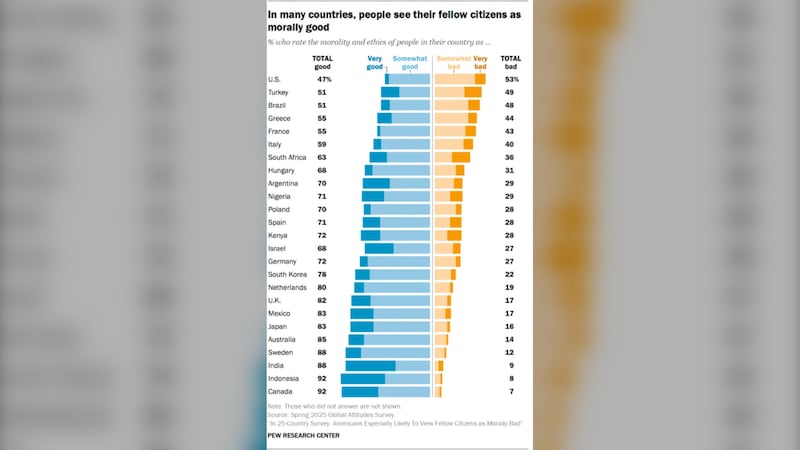
Most Americans see their fellow Yankees as morally bad, while less than one in 10 Canadians feel the same about their fellow Canucks, a new survey from the Pew Research Center found.
The centre polled nearly 32,000 people from 25 different countries in 2025 to study how citizens reacted to various topics including homosexuality, abortion, and gambling, giving respondents the option to cast a moral judgement.
“In nearly all countries surveyed, more people say that others in their country have somewhat or very good morals than say their compatriots display somewhat or very bad levels of morality,” the centre wrote in a press release Thursday.
Only seven per cent of Canadians saw their compatriots as morally bad, the least of any country surveyed.
The U.S. was the only country of the 25 surveyed to have a negative view of its fellow countrymen, with 53 per cent of respondents seeing their fellow Americans as having bad morals. In Canada, 92 per cent of survey respondents thought other Canadians were morally good.
Canada and Indonesia tied for the highest rate of positive judgements towards fellow citizens but most Indonesians viewed the topics surveyed as morally unacceptable, while relatively few Canadians condemned the issues.
Party politics can affect these perceptions, the centre found, suggesting that the “people who don’t support the governing party are particularly likely to view their fellow citizens as immoral.”
In the U.S. specifically, people who lean towards the Democratic Party are “much more likely” to rate other Americans as morally and ethically bad at a rate of around 60 per cent. For Americans who prefer the Republican Party, it was slightly less at 40 per cent.
“Because we have never asked this question before, we don’t know whether a majority of Americans have long held a skeptical view of the ethics of fellow Americans, or if it’s something new,” Pew Research noted. The centre did not share any data regarding party politics for other countries.
Abortion
About one in five Canadians surveyed said that abortion was morally unacceptable, while nearly half (47 per cent) of the American respondents held the same view.
Divorce
In Canada, 11 per cent of respondents called divorce morally unacceptable, while 23 per cent of Americans shared the opinion.
Most countries surveyed had a minority who called divorce morally unacceptable, with India and Nigeria being the only exceptions.
Marijuana
Despite being one of the first countries to legalize marijuana for recreational use, nearly one in five (19 per cent) Canadian respondents called use of the drug morally unacceptable. That number only increased a few percentage points for Americans with 23 per cent.
In Latin America a majority of respondents cast a negative moral judgement on the drug. Indonesians had the most negative responses with 91 per cent of respondents calling morally unacceptable.
Pornography
Nearly half of Canadians (48 per cent) surveyed said viewing pornography was morally unacceptable and 52 per cent of American respondents felt the same.
In both Nigeria and Indonesia, 85 per cent of respondents called it morally unacceptable, the largest proportion of the countries surveyed.
Homosexuality
Attitudes towards homosexuality differed dramatically across the 44th parallel, with more than twice as many Americans condemning homosexuality as Canadians. In Canada, 15 per cent of respondents called homosexuality morally unacceptable, while in the U.S., that number inflated to 39 per cent.
Gambling
Canada was the most accepting of gambling, with only 27 per cent of respondents calling it morally unacceptable, the least of any country surveyed. The U.S. had the second least at 29 per cent.

