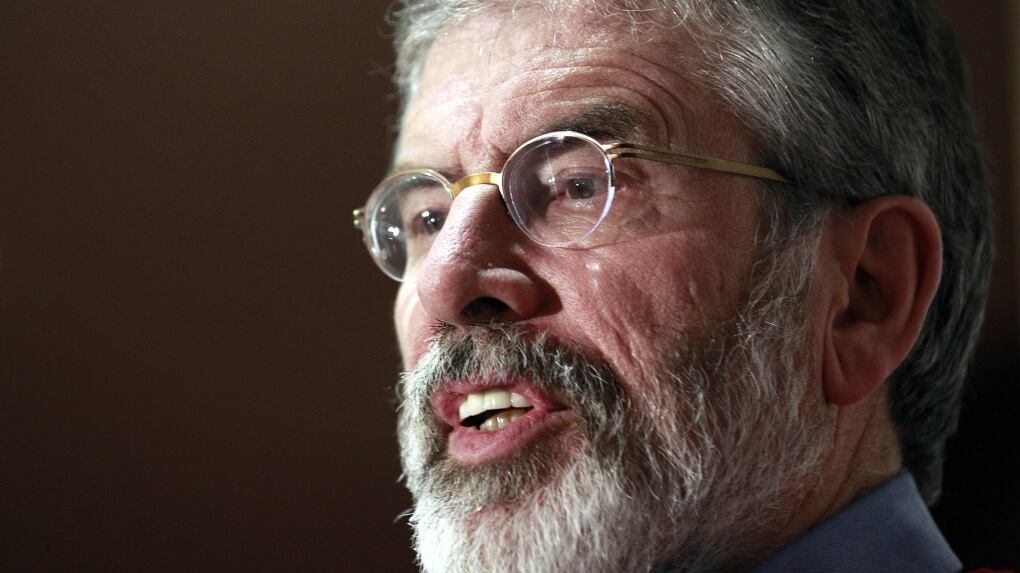
LONDON - Former Irish republican leader Gerry Adams appeared in a London court on Monday for the opening of a civil trial brought by three bomb victims who seek to hold him personally responsible for attacks as an alleged senior member of the IRA.
Arriving in a protective vest at the Royal Courts of Justice, according to U.K. media, it is the first time Adams has appeared in an English court.
The 77-year-old has always denied being a member of the Irish Republican Army, but has been dogged by legal spats over his role in the Troubles -- the three-decades-long violent sectarian conflict over British rule in Northern Ireland that ignited in the late 1960s.
More than 3,600 people were killed during the Troubles, which largely ended after a 1998 peace accord.
Adams, who led Sinn Fein -- the IRA’s former political wing -- during the Troubles was for years a hated figure for many Protestants in the British province.
Adams is being sued in the High Court for symbolic damages of one pound for “vindicatory purposes”.
The action is being brought by John Clark, a victim of an IRA attack on the Old Bailey courthouse in London in 1973, as well as Jonathan Ganesh and Barry Laycock, who were injured in IRA attacks in 1996 at London’s Docklands and in Manchester, respectively.
‘Directly responsible’
Three people died in the three bombings, and scores of people were injured.
The three men allege Adams was a senior IRA member for over 25 years who had a key hand in directing the 1973 and 1996 attacks.
The lawyer Anne Studd representing the trio said in a written submission that “on the balance of probabilities (Adams) was as involved as the people who planted and detonated those bombs”.
Adams was “directly responsible for and complicit in those decisions made by (the IRA) to detonate bombs on the British mainland in 1973 and 1996,” she said.
Studd cited the participation of Adams in an IRA negotiating team that met the British government in the early 1970s.
She also said evidence provided by British intelligence officers in the coming days would show his involvement in the attacks.
His lawyer Edward Craven told the court that Adams “emphatically, unequivocally and categorically denies any involvement in the bombings” and also “that he was ever a member of the IRA”.
“The claimants have not adduced a single piece of direct evidence or contemporaneous documentary evidence to show that (Adams) played any role whatsoever” in the attacks, said Craven.
They have a “have a mountain to climb” to win their case, he said.
The white-bearded Adams, wearing a suit, waistcoat and red tie, listened in silence to the opening submissions.
The trial is scheduled to last seven days, with the first claimant due to give evidence Tuesday, followed by Adams later this week.
The men are expected to produce evidence from around a dozen witnesses, including former IRA members and ex-British Army and Northern Irish police personnel.
‘Campaign of demonization’
Writing in the Belfast-based Andersonstown News newspaper last month, Adams said he will “robustly” defend himself from “unsubstantiated hearsay” and challenge any allegations made by former combatants as part of the claimants’ case.
He said an “official campaign of demonization” is being waged against him by the “British establishment”.
Adams became president of Sinn Fein in 1983 and served as an MP from 1983 to 1992, and again from 1997 to 2011 before sitting in the Irish parliament between 2011 and 2020.
He stepped down as leader of Sinn Fein in 2018.
Although interned twice in the 1970s, Adams has never been found guilty of IRA membership.
In 1978 a case charging him with membership was dropped due to insufficient evidence to secure a conviction.
He was arrested in 2014 and questioned for four days over the high-profile murder of a widowed mother-of-10, Jean McConville, in 1972 but was released without charge over lack of evidence.
In 2020, he had convictions for attempting to escape jail quashed by the U.K. Supreme Court.
Last year he won a libel case in Dublin against the BBC over a report containing allegations he was involved in killing a British spy.

