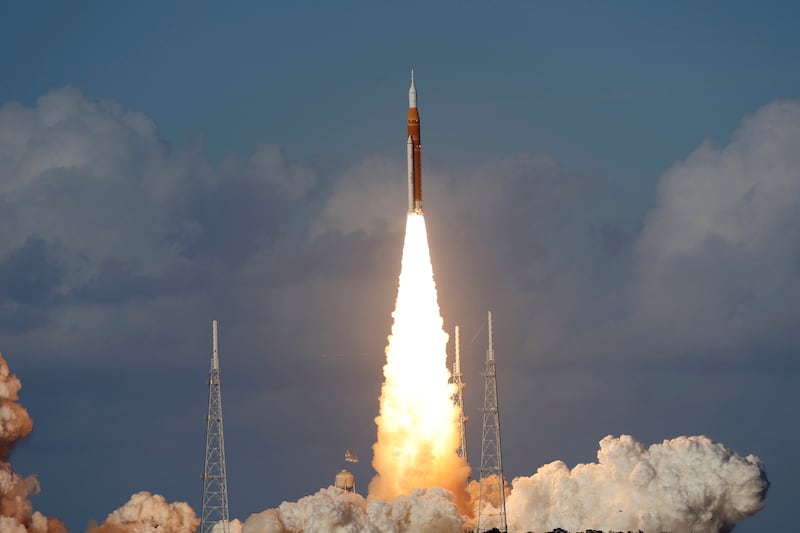
The Artemis II lunar mission successfully launched from the Kennedy Space Center in Florida on Wednesday, and a few seconds after liftoff, the crew communicated verbally with ground control for the first time.
- Canadian astronaut circling Earth after successful Artemis II lunar launch
- Here are 5 reasons Artemis II matters to Canada
- IN PICTURES: Artemis II moon launch: Canadian astronaut Jeremy Hansen makes history
“Roll pitch,” could be heard, followed by the confirmation: “Roger, roll pitch.”
Here’s what that callout means.
Leaving Earth’s atmosphere
Once a space-bound rocket clears the launch tower, it must adjust its “attitude” or orientation in order to align itself with its planned trajectory that will take it out of Earth’s atmosphere.
To do this, the rocket “rolls” partially around its longitudinal axis, then “pitches” by tilting its nose down, utilizing its side-to-side axis, allowing the rocket to continue accelerating horizontally, rather than strictly vertically against Earth’s gravitational pull.
The manoeuvres properly position the rocket and allow it to use gravity to its advantage as it tilts to the side and continues its trajectory out of the Earth’s atmosphere at an angle, referred to as the “target azimuth.”
“A rocket can be manoeuvred in several different ways,” the National Aeronautics and Space Administration (NASA) says on its website.
“In flight, the fins of the rocket produce aerodynamic forces. These forces are applied at the centre of pressure of the rocket which is some distance from the rocket (centre of gravity) and produce torques (or moments) about the principal axes. The torques cause the rocket to rotate.”
NASA’s Artemis II Orion spacecraft, the capsule that contains the mission’s four astronauts, reached space on Wednesday after separating from the space launch system rocket.
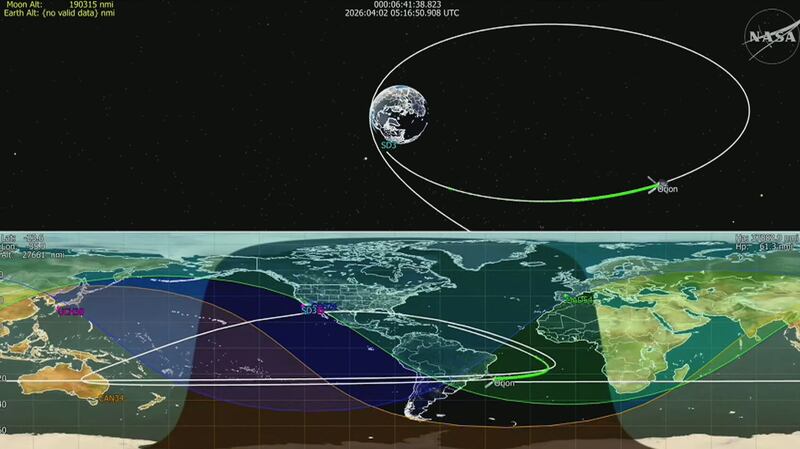
The mission is expected to take roughly 10 days, with Orion first orbiting Earth twice to ensure all systems are operational before heading toward the moon.
“That gives us a day in space before we have the opportunity to come back to Earth,” said Canadian astronaut Jeremy Hansen in a video from the Canadian Space Agency.
If the mission goes according to plan and Orion makes its journey around the moon, Hansen will be the first non-American to visit deep space.