


Prime Minister Mark Carney reaffirmed Canada is a “strong NATO member” focused on Arctic security Thursday, responding to questions about the future of the transatlantic military alliance.
Carney was asked about U.S. President Donald Trump’s displeasure with NATO’s participation, or lack thereof, in its military campaign in Iran. Earlier that morning, Trump reiterated that gripe on Truth Social.
“None of these people, including our own, very disappointing, NATO, understood anything unless they have pressure placed upon them!!!” he wrote. It was the second statement on the alliance in less than 24 hours – Trump wrote the evening prior that NATO “WON’T BE THERE IF WE NEED THEM AGAIN.
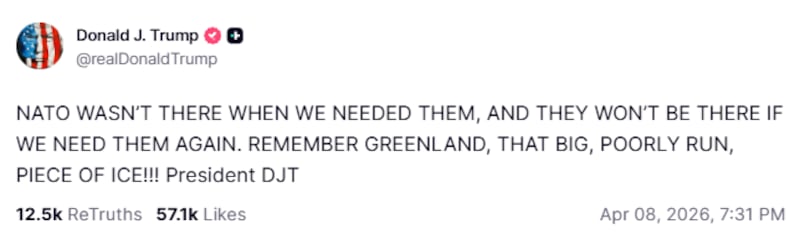
“REMEMBER GREENLAND, THAT BIG, POORLY RUN, PIECE OF ICE!!!” he concluded, referencing his previous musings about taking control of the island, which is part of the Realm of Denmark, a NATO ally.
On Thursday, Carney called back to a recent two per cent military spending landmark as evidence of Canada’s commitment to NATO. Though the number is not important, he added – “what’s important, first and foremost, is protecting Canadians.”
To do that, he said, Canada is working more closely with “subsets” of NATO allies, including the Nordic countries, the U.K., the Netherlands and Germany, to protect “our Arctic.”
That protection is critical to Canada, “regardless of how NATO itself evolves.”
NATO ‘failed’: Trump
The question of how the alliance will evolve has been a recurring question in Washington.
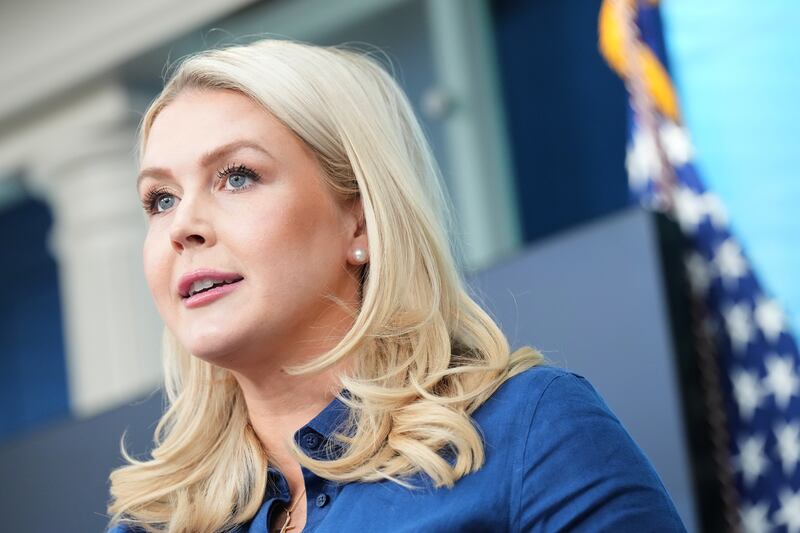
On Wednesday, White House spokesperson Karoline Leavitt was asked to respond to a joint statement from Carney and other NATO leaders affirming their support to reopen the Strait of Hormuz – a key channel bordering Iran which in peacetime, supports the travel of 20 per cent of the world’s crude oil shipments.
“I have a direct quote from the president of the United States on NATO,” she said.
“‘They were tested and they failed.’ And I would add it’s quite sad that NATO turned their backs on the American people over the course of the last six weeks when it’s the American people who have been funding their defence.”
Can Trump pull out?
While Trump could in theory, pull out of the alliance, he would have to clear a series of policy-related hurdles to do so.
That’s according to Kerry Buck, a former Canadian ambassador to NATO.
“Most lawyers in the U.S. agree,” she said, that Trump would not be able to drop out of the treaty without congressional approval. That’s because of the 2024 National Defense Authorization Act, which prohibits withdrawal “without the advice and consent of the Senate or an act of Congress.”
In other words, she said, it’s not likely to happen soon. But Trump’s rhetoric does weaken the alliance, which is based on an understanding of unity between the member states during an attack.
She also said that Trump’s criticisms are misguided. NATO, as an organization, was not asked to join the U.S.-Israel joint strikes on Iran. Conversely, NATO itself has not said it would stay out of the operation. Rather, select member states have decided independently not to get involved.
“Why? Because they weren’t asked at the beginning,” she said. “And more importantly, because the goals, or the objectives, have been muddied, at best.”
Several European states she noted, have permitted the U.S. to use their bases. The U.K., for example, has given the U.S. authorization to use its bases to carry out strikes in order to secure the Strait of Hormuz.

