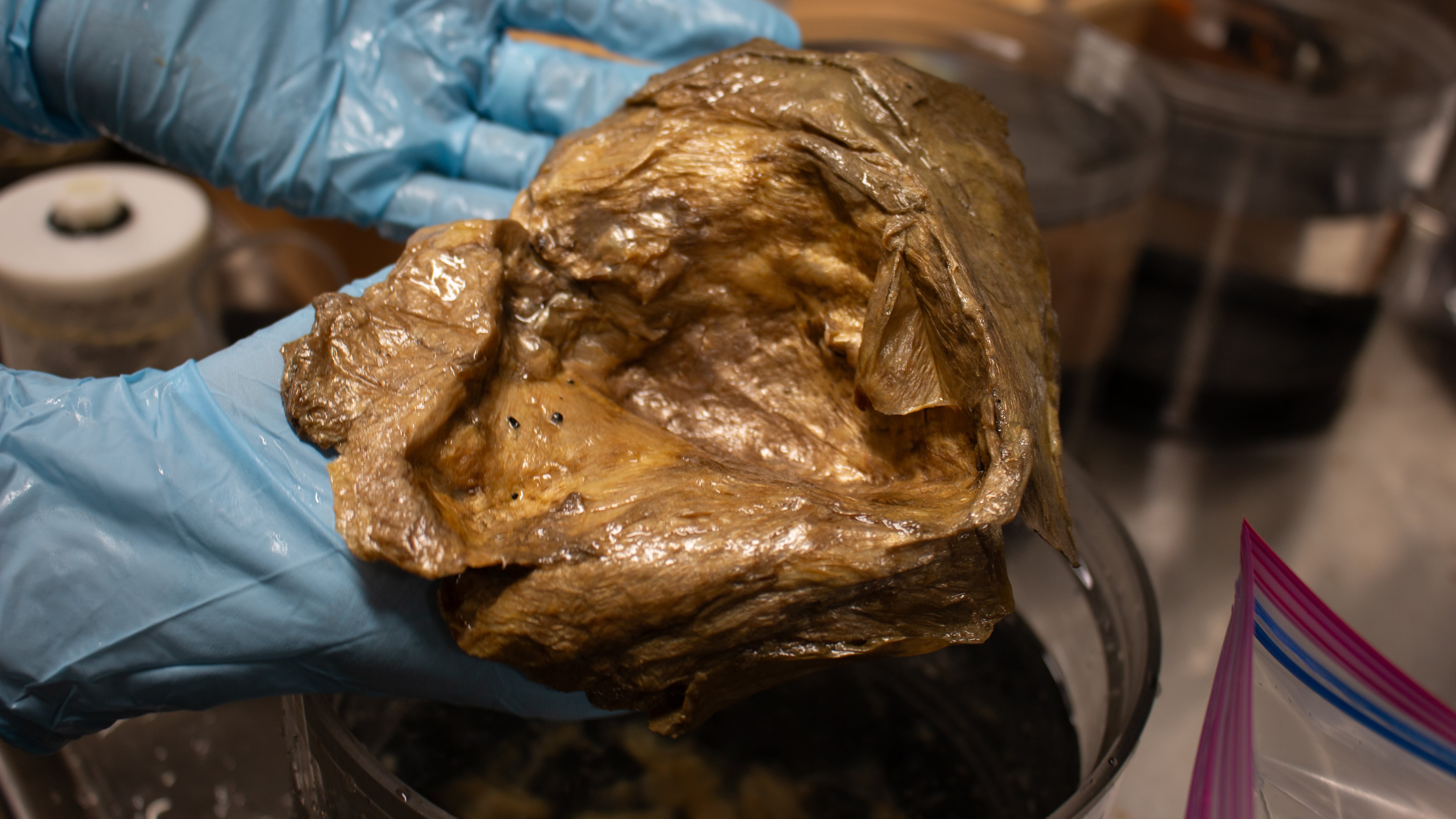
Scientists have identified a mysterious “golden orb” that was discovered deep in the ocean off the coast of Alaska.
According to the U.S. National Oceanic and Atmospheric Administration (NOAA), the object was found in August 2023 in the Gulf of Alaska by a remotely operated deepsea diving vessel.
NOAA researchers say they were initially puzzled by the “golden, mound-shaped object” that was about 10 centimetres in diameter and had “an apparent torn opening on its surface.”
While it’s “not uncommon” to encounter deepsea organisms that are not immediately recognizable, researchers say imagery and expert consultations are usually enough to quickly find answers.
“However sometimes real mysteries exist and imagery alone only raises questions,” the research team explained in a new preprint paper. “Such is the case of the Golden Orb.”
Attached to a rock at a depth of 3,250 metres, the specimen was collected using a suction sampler and then sent to a lab at the Smithsonian National Museum of Natural History in Washington, D.C., where scientists analyzed its “flakey” physical structure and DNA.
After more than two years of investigation, they were finally able to identify the object.
“We work on hundreds of different samples and I suspected that our routine processes would clarify the mystery,” zoologist and NOAA scientist Allen Collins said in a news release. “But this turned into a special case that required focused efforts and expertise of several different individuals. This was a complex mystery that required morphological, genetic, deepsea and bioinformatics expertise to solve.”
‘Many secrets left to uncover’
While the specimen lacked typical animal anatomy, the first clue about its identity was the presence of stinging cells, which suggested that it could be a type of coral or anemone. Initial DNA tests were inconclusive, likely due to other microscopic life, but whole genome sequencing eventually confirmed animal DNA with genetic material from a giant deepsea anemone.
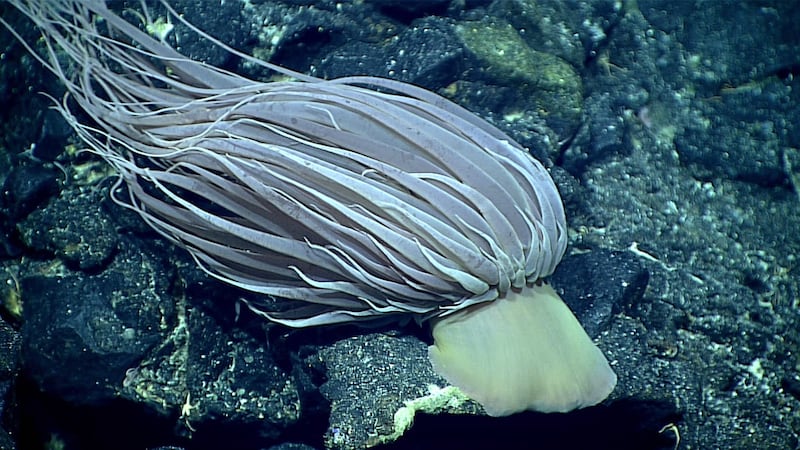
Also known as Relicanthus daphneae, these anemones are massive predatory creatures with cylindrical bodies that can grow about a metre across and tentacles that can stretch nearly two metres in length. Scientists from NOAA concluded that the golden orb was the remnant of dead cells formed at the base of anemone that attached the creature to the rocky seafloor and is usually hidden under the animal. Scientists believe in this case the anemone either died or relocated, leaving part of its base behind.
“So often in deep ocean exploration, we find these captivating mysteries, like the ‘golden orb,’” Captain William Mowitt, acting director of NOAA’s ocean exploration office, said in the news release. “With advanced techniques like DNA sequencing, we are able to solve more and more of them. This is why we keep exploring — to unlock the secrets of the deep and better understand how the ocean and its resources can drive economic growth, strengthen our national security, and sustain our planet.”
When the mysterious discovery was first made in 2023, it generated multiple headlines and rampant speculation, including that it could be an egg or even an object of otherworldly origin.
“At the Smithsonian Institution, inquiries to the status of the Golden Orb persist to the present day with frequent public inquiries since its collection,” the preprint paper said. “Through an integrative taxonomic approach we conclude that the Golden Orb is not an object of alien origin, but rather one of Earth’s own inner space which still holds many secrets left to uncover.”