Sub-Saharan Africa could split up in a few million years, and scientists believe they might be witnessing the early stages of this geological process.
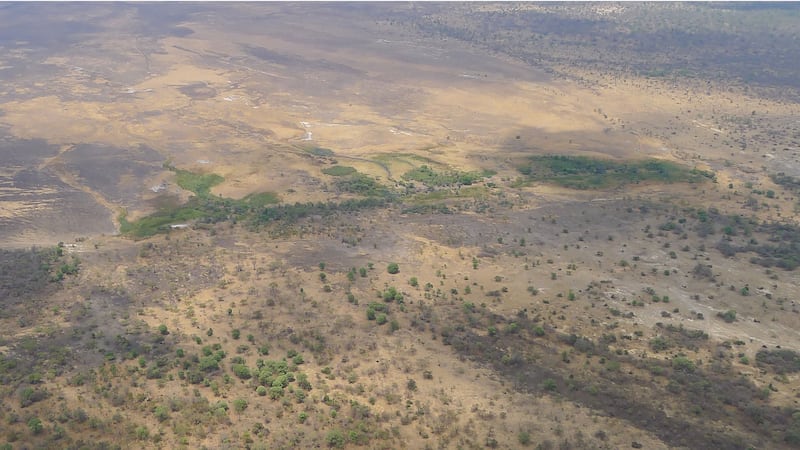
The split would occur along the Kafue Rift, which is part of a roughly 1,500-mile-long (2,500-kilometre) rift line spanning from Tanzania to Namibia. A rift is a crack in Earth’s crust that disturbs the surface and can cause sinking land and earthquakes. Thousands of rifts exist around the world, and while the majority are inactive or dead, they can occasionally reactivate.
Geologists thought the Kafue Rift was long dead. But some experts now say it has shown signs of activity in the past few decades. Growing evidence is raising suspicion that the feature could be turning into a new continental rift — and could eventually become a new boundary between tectonic plates, creating a brand-new sea in the process.
Previous studies have collected these clues. Earthquakes too faint to be felt by people but strong enough to be picked up by instruments, increased underground temperature, and minute changes in the elevation of the ground spotted with satellites all suggest that the area may be tectonically active.
Now, a new study published Monday in the journal Frontiers in Earth Science goes one step further. “We have the first geochemical data from this area,” said Rūta Karolytė, who led the study when she was a postdoctoral research fellow at the University of Oxford in England. “That’s quite a different line of evidence that really strengthens the idea that we have rift activity in the area.”
Studying a new continental rift would help answer one of the most fundamental questions in tectonics.
“How does a new plate boundary begin? Mature plate boundaries are easy to recognize. The earliest stages are much more subtle,” said Estella Atekwana, a distinguished professor of Earth and planetary sciences at the University of California, Davis, who did not take part in the study.
“If the Kafue Rift is part of a newborn plate boundary, it gives us a rare opportunity to study the birth of a plate boundary before volcanism, large earthquakes, and major surface deformation have overprinted the original conditions.”
Clues to a new tectonic plate
To gather the evidence, Karolytė and her colleagues collected samples from hot springs and geothermal wells in Zambia that have naturally appeared above the suspected rift. “There’s hot water bubbling up to the surface, and we sampled the gas that’s coming up from that,” said Karolytė, who is currently a principal product scientist at UK-based Snowfox Discovery, a natural hydrogen exploration company.
The researchers were looking mainly at the ratio between two types of helium — helium-3 and helium-4. The team hunted for a telltale sign that the springs and wells had a connection with Earth’s mantle, the layer sandwiched between the crust and the core that’s hundreds of miles thick. “We found more helium-3 than you’d normally find in the crust, which is generally a signal of mantle fluids coming up into the water,” Karolytė added.
The result is only preliminary because the samples come from just six sites in a highly concentrated area. But the researchers also sampled two hot springs about 60 miles (95 kilometres) from the suspected rift and didn’t find a similar increase in the helium-3 ratio.
Since material from the mantle can reach the surface as tectonic plates stretch and begin to split apart, the study team believes this new geochemical data may serve as an early signal hinting at the formation of a new plate boundary.
An economic benefit
Tectonic plates are gigantic slabs of solid rock ranging in size from a few hundred to thousands of miles across, with a thickness of up to about 120 miles (190 kilometres). Ever since these plates developed early in Earth’s history, they have been sliding over the mantle at a speed comparable to the growth rate of fingernails. About 200 million years ago, the shifting plates started to separate a giant landmass called Pangea into today’s continents. The plates are still moving, and that movement drives geological processes such as earthquakes and the formation of volcanoes.
The boundaries between plates are mostly under the oceans, and they can slide past each other, crush together or drift apart. The boundaries are also the areas where most of the earthquakes and volcanic activity happen.
An active, developing rift can turn into a tectonic plate boundary — but not necessarily. “These rifts often start and stop, or they can spread a little bit and stop again. It’s hard to predict what will happen,” Karolytė said.
Africa already has a well-developed rift that’s tens of millions of years old. The East African Rift has several volcanoes and is seismically active. However, it would take a long time for the new rift to develop in such a way and then turn into a plate boundary. “At the fastest, it could happen in a couple of million years. At the slowest, it could take 10 or 20 million years,” said study coauthor Mike Daly, a visiting professor in Earth sciences at the University of Oxford.
“The southern part of Africa would break off, but before that, you would start to see a lot more earthquakes, and some volcanic activity with lava flowing out. You would start to have deep rifts, and water would start to stagnate in it, so you’d get lakes as you get in East Africa today, and ultimately you’d get the sea,” he added.
In the much nearer term, however, Zambia could economically benefit by harnessing energy — geothermal plants are emerging in the area. The landlocked nation could possibly even collect the helium, which is in high demand and has several applications in medicine and the tech industry.
To confirm the findings, the researchers are collecting more gas from a wider geographical area along the suspected rift, and they are already working on a new study with broadened results.
Answering fundamental questions
Folarin Kolawole, an assistant professor in the department of Earth and environmental sciences of Columbia University in New York who wasn’t involved with the study, thinks the findings are novel and exciting because they provide a “strong confirmation” that there is direct upward flow of fluids from the mantle to the surface through newly forming rift zones.
“The key significance of a new plate boundary in southwestern Africa is that we now have an established pathway for the continent to break up from eastern Africa all the way through Botswana and Namibia to the Atlantic Ocean,” he added in an email.
The number of samples is limited, but the results are still significant, according to UC Davis’ Atekwana. “They provide strong geochemical evidence that the Kafue Rift is active at depth, even though magma has not reached the surface,” she wrote in an email.
Atekwana added, however, that more evidence along the whole proposed boundary is required to determine whether the mantle’s helium signal is continuous or only local. “This is one important line of evidence, not the final word. It supports the hypothesis of early-stage rifting, but confirming a new plate boundary requires a full plate-boundary-scale test,” she said.
“This does not mean Africa is splitting apart tomorrow; these processes unfold over millions of years. But scientifically, it would be like catching a plate boundary in the act of being born.”
By Jacopo Prisco, CNN

